


How the Cosmos Gathers

The BespokeCurry Cosmos is a Black-rooted relational architecture.

African cosmology is not decoration placed around the work. It is the living root from which the Cosmos’s waters, chambers, membranes and methods emerge. How the Cosmos Gathers asks what becomes possible when non-Black folx enter without requiring Blackness to disappear—when invitation retains protocol, access develops responsibility and what is received must be metabolized into something that can return. A living world can expand without becoming infinitely available. Its boundaries are part of how the gathering remains alive.
◉)) I Hear Tings — Aural Worlds
Track | Function |
“Think About It” — SAULT | The pause before entry: discernment about what a body is carrying, seeking and prepared to return. |
“Sweet Life” — Frank Ocean | The comfort of consuming a beautiful world without confronting the conditions, labor or source sustaining it. |
“Running Away” — VANO 3000 / BADBADNOTGOOD | The ease of receiving an experience and leaving before access develops into accountable relationship. |

3 Aural Worlds
These three Aural Worlds move through How the Cosmos Gathers as a relational sequence. SAULT’s “Think About It” creates the pause before entry: not simply Can I access this? but What am I carrying, and what will my presence require? Frank Ocean’s “Sweet Life” enters through the comfort of consumption—the ability to enjoy what a world produces without having to witness the labor, boundaries or Black source sustaining it. “Running Away” arrives where intensity fails to become infrastructure: access is easy, staying in accountable relationship is harder, and leaving does not erase what was received. Together, the songs move from consideration to consumption to consequence. They ask whether an encounter with the Cosmos becomes another private experience—or material that changes how a body relates and what it returns.
How the Cosmos Gathers

Black Rootedness, Non-Black Entry, and the Difference Between Relationship and Consumption
Black bodies have always been relegated to other.
Othered as bodies.Othered as knowledge.Othered as source material.Othered as culture available for extraction.
The Other Is Not the Third

Other is a position assigned by power.
The third is a space built through relationship.
To be Black is to be queer.
Queer here does not begin and end with sexuality or gender. It names a body forced outside what the dominant world recognizes as natural, standard, legible and human—and then required to produce the culture through which that world understands itself. Blackness has always troubled the borders between person and property, man and woman, citizen and stranger, sacred and profane, nature and culture. Black bodies have never been allowed uncomplicated membership in the categories we are told should contain us. We have had to make life in the break, build kinship beyond permission and create worlds from locations the dominant world names impossible. That is queer.
Most Black bodies cannot handle that statement. Respectability has taught us to survive by proving we are normal: correctly gendered, correctly partnered, correctly religious, correctly productive, correctly human. For many Black folx, queerness still names the line they believe Blackness must not cross if we are ever going to be admitted into the center. So the word is rejected even while Black life continues to exceed every structure built to contain it.
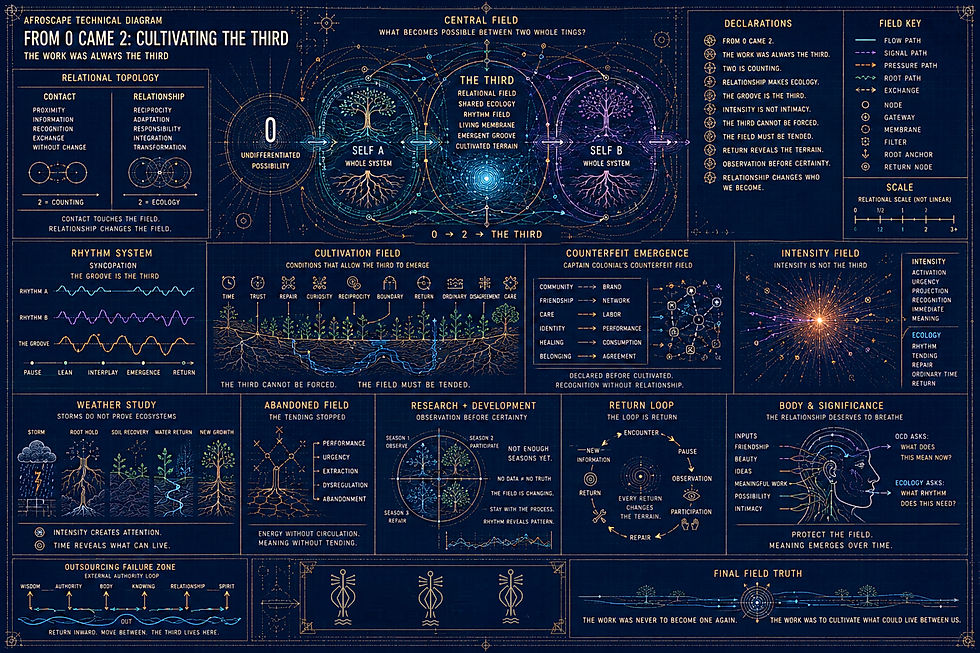
But the other and the third are not the same. The other is produced by the center and kept in relationship to it. The third does not ask the center for recognition. It creates another relational field. It is not a neutral middle between Black and non-Black bodies, and it does not erase where anybody entered from. The BespokeCurry Cosmos is a third space because it is rooted, bounded and capable of encounter without requiring sameness. It does not make othering sacred. It takes what was exiled and builds a living architecture where relationship can happen on different terms.
The Center Feeds on What It Excludes

Blackness becomes the difference against which everything else is allowed to understand itself as standard. Then the same systems that produce Blackness as other reach back toward Black bodies for language, style, sound, labor, imagination, resistance, spiritual practice and new ways of surviving.
Blackness is kept outside the human center while everything we produce is pulled inside the marketplace.
The BespokeCurry Cosmos does not seek to reverse this structure by placing Blackness at the top. It does not seek to create another hierarchy with different bodies occupying the position of dominance.
But refusing hierarchy does not mean removing location.
The root is African cosmology.
The relational center is Black bodies.
The architecture has emerged through my life as a Black, nonbinary, autistic body navigating water, gender, movement, memory, cannabis, food, hair, performance, ecology, rupture and return. The Cosmos carries Black ecological knowledge, Black imagination and the technologies Black people have built for remaining in relationship with ourselves and one another under conditions designed to sever those relationships.
That root cannot be removed without changing the entire organism.
And still, that does not mean the Cosmos is only for Black bodies.
Everything Does Not Have to Be for Everybody

We have moved into a place where everything is expected to be for everybody.
Every offering must be universally accessible. Every cultural practice must be translated. Every boundary must be justified. Every closed door becomes evidence of exclusion rather than evidence that something living is being protected behind it.
That is not real life.
It is not how bodies work. It is not how ecosystems work. It is not how relationship works.
Every organism does not consume every plant. Every root does not require the same amount of water. Every body cannot survive in every atmosphere. Some relationships depend upon proximity. Some depend upon distance. Some forms of life can meet one another without becoming the same organism.
Difference does not automatically create hierarchy.
The demand that everything must be for everybody often presents itself as an ethical commitment to inclusion. But it can also function as a market demand. If everything is for everybody, then everything must remain available for consumption. Nothing can preserve its own membrane, pace, rituals, risks or responsibilities. Nothing can ask who is entering, what they are carrying or what they intend to do with what they find.
“For everybody” can become another way of saying that nothing is allowed to refuse us.
That is not liberation.
It is entitlement with softer language.
Watching CBC Television's Trickster, from the Trickster Trilogy Books by Eden Robinson which brought me into contact with the potlatch—not as a metaphor for me to detach from its Indigenous location, but as evidence that gathering has never had to mean unrestricted access. Potlatch traditions differ across the Indigenous nations of the Northwest Coast.
Within Kwakwaka’wakw practice, guests enter as witnesses, gifts circulate, histories are carried and particular names, songs, dances, stories and rights are transferred through protocol. Everybody present does not become entitled to everything held by the community. Presence has a role. Witnessing creates responsibility. Wealth becomes meaningful through what is returned to the collective, not through how much one body can accumulate.
That structure was so threatening to colonial power that the Canadian government outlawed the potlatch for decades. It was not only attempting to stop a ceremony. It was attacking an economic, governmental and relational system that could sustain Indigenous life beyond colonial terms. The potlatch reminds me that invitation does not require cultural surrender. A space can gather different bodies while retaining its laws, distinctions and responsibilities. What is shared can circulate without becoming available for anybody to possess. U’mista Cultural Centre, The Canadian Encyclopedia
The Root Is African Cosmology

The BespokeCurry Cosmos begins in African cosmology.
That statement is not ornamental. It is not branding wrapped around an otherwise universal system. It identifies where the thought comes from, which bodies have shaped it and which histories are moving through its construction.
The Cosmos does not become more expansive by obscuring that root.
African cosmology does not have to be reduced to an aesthetic, detached from Black bodies and renamed universal before non-Black folx can encounter it. Its Blackness is not an obstacle to broader relationship. Blackness is part of the relationship.
Some of what lives inside the Cosmos expands beyond race.
Water moves through all of us. Every body exists inside an ecology. Every body encounters weather, memory, regulation, nourishment, change, rupture and death. Every body has histories that preceded it. Every body must negotiate how to remain a self while living in relation to other bodies.
But shared conditions do not produce identical relationships to those conditions.
We may all encounter water.
We do not all encounter the same water.
We may all inherit histories.
We do not inherit the same histories.
We may all need sovereignty.
We have not all had our sovereignty disrupted, criminalized, commodified or made structurally impossible in the same ways.
The Cosmos can hold tings that move beyond race without pretending those tings arrived outside race. It can invite non-Black bodies into relationship without positioning those bodies at the center of its meaning.
You do not have to become the center of a world to be transformed by entering it.
Expansion Is Not Evacuation

I want the Cosmos to expand.
But expansion cannot mean the evacuation of Blackness from the structure.
I am not interested in creating another allegedly universal space that becomes universal only after every culturally specific root has been cut away. I am not interested in flattening African cosmology into a collection of metaphors that anybody can claim without having to remain accountable to the Black bodies through whom the work has become available.
The Cosmos can expand without becoming raceless.
It can hold non-Black bodies without pretending that every body has the same relationship to every chamber. It can allow recognition without creating ownership. It can build connections across difference without forcing difference to disappear.
Expansion, as I understand it, is ecological.
A root system expands because it remains rooted. Mycelium travels because it maintains relationships across bodies, nutrients and environments. Water moves because land, pressure, temperature and atmosphere shape where it can go.
Nothing expands alone.
And nothing living expands without limits.
The question is not simply whether non-Black folx are allowed inside the Cosmos.
The question is: What kind of relationship are you building with what you encounter here?
They Wanted Access, Not Relationship

The biggest lesson I am learning—and am still learning—from the last ten years of my life is that many people were not interested in building with me relationally.
They were interested in access to me.
Access to my labor.
Access to my imagination.
Access to my language.
Access to my social body.
Access to the version of my Blackness that made them feel more interesting, more ethical, more radical or less guilty.
They wanted proximity without the infrastructure required to sustain relationship.
I did not know how to performatively engage. I still do not know how to performatively engage in the ways many social spaces expect. When I believed I was building depth, other people were sometimes participating in a temporary social arrangement. When I believed we were constructing a shared structure, they were having an experience they could leave whenever that experience stopped serving them.
Intensity became confused with infrastructure.
Access became confused with relationship.
Visibility became confused with knowing me.
My Blackness was often a place where people could assuage their guilt without doing the long work of confronting themselves. Proximity to me allowed them to feel close to Blackness. They could touch the language, enter the atmosphere, wear the aesthetic, receive the analysis or place themselves near my body without examining what their presence required of them.
They could feel changed without changing how they related.
That difference matters.
I have been harmed by plenty of folx, and I have caused harm. Both are true. But placing those truths in the same sentence does not make their scale equal. The harm caused to me outweighs the harm I have caused in full.
Naming that is not an attempt to avoid accountability. It is a refusal to distort proportion so everybody can leave the history equally innocent, equally responsible and equally wounded.
False equivalence does not create repair.
It only protects the people who already benefited from the confusion.
Building the Membrane

I am learning to build the membrane between the self and others.
A membrane is not a wall.
It is not total closure. It is also not unconditional access. A membrane is a living intelligence that regulates exchange.
It decides what may enter.
What can leave.
What requires transformation.
What can circulate.
What threatens the organism.
What the body must expel in order to remain alive.
For much of my life, I did not know how to build that membrane. I understood relationship as an opening. If we were in relationship, then I believed the relationship itself carried responsibility. I did not fully understand how easily another person could enter the opening, receive what they wanted and leave me to process the material consequences alone.
The membrane changes that.
It allows me to recognize that openness and sovereignty are not opposites. I can share without making the entire body available. I can create access without surrendering discernment. I can allow the work to circulate without granting every observer ownership of its source.
The BespokeCurry Cosmos is part of that membrane.
It is the third space between the private self and the body other people believe they know socially. It holds what I have lived, studied, made, composted and come to understand without collapsing the work into unrestricted access to me.
The Cosmos is not a costume.
It is the skeleton that was always underneath my work.
For years, people became obsessed with tearing apart the costume they believed they saw: the clothes, the performances, the visual language, the social presence, the gender, the Blackness they thought they could interpret from the outside.
They mistook presentation for availability.
They mistook visibility for consent.
They mistook a fragment of the work for ownership of the world producing it.
That is why so much static developed between me and what people believed to be a social me and body. They were relating to a projection while I was trying to survive the pressure of being treated as that projection’s infrastructure.
The Cosmos creates somewhere else for the work to live.
Not hidden.
Not surrendered.
Held within a membrane.
The Eyes Are Here. The Support Is Not.

Black language is for sale.
Black sound is for sale.
Black gender is for sale.
Black hair, Black grief, Black resistance, Black survival and Black ecological knowledge are continually severed from Black bodies and circulated as material for somebody else’s recognition, profit or self-construction.
But I am not being paid for this.
There is very little material support sustaining this website. There are eyes here. The numbers tell me people enter. They move through the essays. They witness the graphics, language, systems, questions and skeleton underneath my work.
Most leave no relational trace.
No comment.
No heart.
No response.
No indication of what the work moved, disturbed or made possible.
Some folx have reached back. I know that. I do not want to erase them. But those encounters have been few and far between.
The dominant relationship remains consumption without contact.
A heart would not pay me.
A comment would not sustain the maintenance of this website.
Relational engagement and material support are not interchangeable.
But when neither is present, I am left carrying every part of the exchange.
I make the work.
I conduct the research.
I build the infrastructure.
I maintain the Cosmos.
I reveal the architecture.
I absorb the vulnerability of being seen.
I am the writer.
The worldbuilder.
The assistant.
The web master and designer.
Other people get to look and leave.
That concerns me.
Not because every reader owes me intimacy. Not because everybody who enters must announce themselves. Not because silence automatically means harm.
The concern is the collective pattern: Black production surrounded by watchful eyes, with very little returning to the Black body making what everyone came to see.
Visibility is not support.
Traffic is not relationship.
Being watched is not the same as being held, valued or materially sustained.
Attention without response can begin to resemble surveillance. Access that never circulates anything back toward the source can become extraction, even when the person consuming does not understand their behavior that way.
The intention of each individual observer does not change the material condition produced by the collective.
The eyes are here.
The support is not.
I Am Not Pimping What I Come From

I need this work to support me.
That does not cheapen the work. It names the material body underneath it.
The website costs money.
Materials cost money.
Research requires time.
The graphics, essays, videos, archives, systems and publishing architecture emerge from a body that must eat, sleep, remain semi regulated, housed and continue living.
Reciprocity cannot remain metaphorical while my survival remains material.

Black artists should not have to perform distance from money to prove our sincerity. I should not have to make myself economically vulnerable so the work can appear pure to people who benefit from receiving it without cost.
But this is not me pimping what I come from.
I am not slicing the Cosmos into culturally legible pieces and selling proximity to Blackness. I am not packaging African cosmology as a costume other bodies can purchase, put on and remove when they are finished experiencing themselves differently.
I am sharing relationally what I know.
I am revealing the skeleton that was always underneath my work. I am creating a form through which the ideas can move, develop relationships and materially support the body that made their movement possible.
Payment would not give somebody ownership of the Cosmos.
It would not purchase intimacy with me.
It would not make every chamber available.
Material support is part of reciprocity, not a transfer of possession.
And money is not the only possible return. Some people cannot offer it. But a living ecosystem contains more than one route of circulation. You can respond. You can cite. You can share with context. You can let the work change how you approach your own histories. You can build something responsible within your own location rather than extracting an aesthetic from mine.
You can leave evidence that the encounter produced more than your private consumption.
The Cosmos Should Make You Curious About You

The Cosmos should push you toward sovereignty with the self and your histories.
It should make you curious about you.
Not curious about how much of me you can acquire.
If you are non-Black and you enter this Cosmos, the work is not to imagine yourself at its center. The work is to notice what the architecture activates in you.

Where did your people come from?
What did they carry?
What did they protect?
What did they abandon?
What relationships did they build with land, water, plants, food, labor, gender and one another?
Where did they encounter empire?
Where did they participate in it?
What histories were preserved, and which histories were deliberately made unavailable to you?
What does sovereignty require from your particular body?

You do not honor Black work by trying to become Black through it. You do not honor African cosmology by stripping away its Black location until it sounds like a universal truth you could have produced anywhere.
You honor the encounter by allowing it to deepen your relationship with your own location.
The Cosmos may offer language, methods, provocations and structures. But it should not become a substitute ancestry for people unwilling to confront their own.
What becomes possible when Blackness does not have to disappear before you can recognize yourself?
What becomes possible when recognition does not immediately become possession?
You May Enter. You May Not Only Consume.

The Cosmos is a third space.
But I am no longer willing to play the dangerous binary game of all or nothing.
It does not have to be closed to non-Black folx in order to remain accountable to Black bodies. It does not have to abandon its Black roots in order to make non-Black relationship possible.
Invitation is not ownership.
Access is not entitlement.
Recognition is not sameness.
Participation is not permission to consume without consequence.
This is not a place for consumption if that consumption is not part of a larger process that keeps the ecosphere alive.
Living bodies consume. Consumption itself is not the enemy. The question is whether consumption becomes metabolism.
What happens to what you receive?
Does it remain an object you collect?
Does it become language you repeat without remembering where it came from?
Does it become an aesthetic you place over your existing practices?
Or does it break down inside you?
Does it meet your histories?
Does it change your relationship to your own body, community and environment?
Does it produce material that can return to the ecosystem?
You may consume here.
But you may not only consume.
You may regurgitate.
You may compost.
You may sit with what cannot yet be digested.
You may carry nutrients somewhere the original body could not reach.
You may materially return something to the ecosystem that fed you.
You may allow the work to make you more accountable to your own histories rather than more entitled to mine.
But you may not stop at consumption.
If You Cannot See the Plantation, You Cannot Enter the Cosmos

Plantation politics did not end when the plantation changed form.
The plantation is a relationship to land, labor, production and bodies. It depends upon some bodies producing more than they are allowed to possess while other bodies receive the product as though it appeared without a source.
Black bodies produce.
Other bodies observe.
Black bodies expose the interior.
Other bodies decide whether the exposure was accessible enough.
Black bodies make culture.
Other bodies consume it, reproduce it and eventually detach it from the Black bodies who made its circulation possible.

A website does not exist outside that history simply because entry is digital and consumption is quiet.
If you repeatedly enter this space, receive from its architecture and leave nothing—no material support, no response, no citation, no changed practice, no evidence of relationship—you have to be willing to ask what kind of relationship you are reproducing.
What returns to the source?
What keeps the source alive?
What does your consumption produce besides more hunger for what I might make next?
If you cannot understand the connection between Black bodies, plantation politics and your consumption of this website, you do not need to be here.
If you believe the work becomes yours because you can see it, read it, cite it, buy it or recognize yourself inside it, you do not need to be here.
If the Black root must disappear before you can enter relationship with the Cosmos, you do not need to be here.
The Cosmos does not seek to create hierarchy.
But it will not mistake the absence of hierarchy for the absence of boundaries.
It can expand without becoming infinitely available.
Its membrane is part of its life.
How the Cosmos Gathers
Before the Watershed: The Form Metabolizes
Most essays enter the BespokeCurry publishing architecture through a stable sequence.
This one arrives as a glitch.
How the Cosmos Gathers argues that consumption must become metabolism. Metabolism does not preserve everything exactly as it entered. It breaks material down, changes the body receiving it, redistributes nutrients and produces conditions for further life. If this essay entered the standard schema and the schema remained untouched, the architecture would be describing metabolism while refusing to practice it.
So the fields shift. The rows reorganize themselves around pressure, rupture, membrane, return and what keeps the source alive. The standard Watershed still follows. Its root has not been evacuated. But the form leading into it has been altered by the essay it received.
This is not the abandonment of the architecture.
It is evidence of relationship with it.
The root remains.
The form metabolizes.
COSMOS WATERSHED GLITCH
This essay enters the Wata(ring) W(hole) through gathering: how bodies meet inside a Black-rooted ecosystem without flattening their different histories, relationships or responsibilities. It distinguishes expansion from evacuation, invitation from entitlement and visibility from support. Through the membrane, potlatch, plantation politics and the silent eyes moving across the website, the essay asks whether encounter becomes relationship, metabolism or extraction.
Watershed | Tributaries |
Watershed | The Wata(ring) W(hole) |
Primary current | Gathering without evacuating the Black root |
Source | African cosmology and Black relational life |
Pressure | The demand that everything become available to everybody |
Rupture | Access mistaken for relationship, visibility or ownership |
Membrane | The living boundary between circulation and extraction |
Metabolism | Consumption that composts, transforms and returns |
Relational demand | Enter without assuming entitlement; return something to the ecosphere |
Core refrain | You may enter. You may not only consume. |
SIX WATERS
Water | Movement through the essay |
Still Water | The Black root that remains located even as the Cosmos expands. Stillness holds origin without turning origin into enclosure. |
Flowing Water | Knowledge, language and creative work moving between bodies. Flow becomes relational when circulation continues in more than one direction. |
Deep Water | African cosmology, Black ecological knowledge and the histories underneath the visible BespokeCurry world. The skeleton beneath what folx previously treated as costume. |
Turbulent Water | Silent consumption, racialized projection, plantation politics and the years of people seeking access without building sustained relationship. |
Tidal Water | The movement between invitation and withdrawal, self and others, visibility and privacy. The membrane determines what may enter, leave or return. |
Sacred Water | Sovereignty without isolation. A gathering practice in which difference remains intact, witnessing carries responsibility and what is received must remain connected to its source. |
COSMOS COORDINATES
Coordinate | Placement |
Primary portal | The Wata(ring) W(hole) |
Tings Index | I Speak Tings |
Relational center | Black bodies |
Cosmological root | African cosmology |
Body coordinate | The membrane between the self and others |
Embodiment movement | Regulation → Integration |
Primary methodology | Mycelial Sankofa |
Central inquiry | How can the Cosmos gather non-Black bodies without allowing entry to evacuate its Black root or reproduce extraction? |
Structural tension | Relationship ↔ Consumption |
Material condition | Many eyes, very little relational or financial support |
Core refrain | You may enter. You may not only consume. |
COSMOS CONSTELLATIONS
Constellation | Relationship to the essay |
The Wata(ring) W(hole) | Holds the Cosmos as an ecosystem in which water, atmosphere, bodies, land, memory and exchange remain relational. |
Mycelial Sankofa | Carries knowledge backward, beneath and across without severing it from ancestry, source or responsibility. |
The membrane | Regulates exchange between the private self, the social body and the third space of the Cosmos. |
Potlatch | Offers a specifically Northwest Coast Indigenous example of gathering through protocol, witnessing, circulation and responsibility rather than unrestricted access. |
Plantation politics | Names the structure in which Black bodies produce while other bodies observe, consume and detach the product from its source. |
Metabolism | Distinguishes consumption that transforms and returns from consumption that accumulates and extracts. |
Sovereignty | Allows every body to deepen its relationship with its own histories without claiming possession of somebody else’s root. |
The third space | Locates the Cosmos between total privacy and the publicly consumable version of Kiing’s body. |


Comments