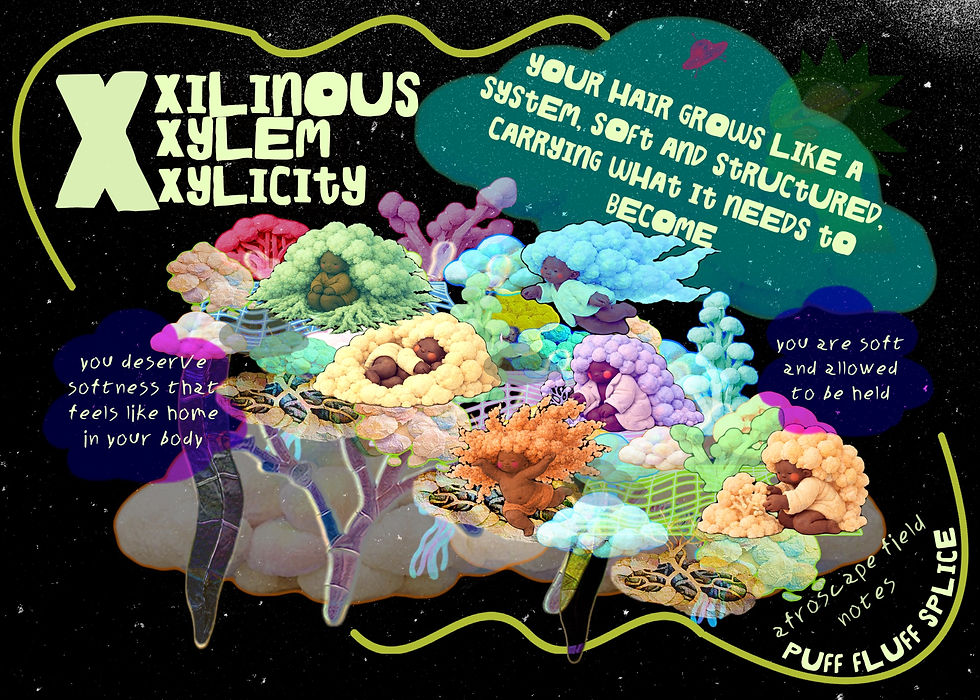
The Afro ABCs are not an alphabet for naming what Afro hair is. They are a field language for navigating Afro hair as terrain — 26 portals into tech (know) logy, ecology, archive, architecture and living Black embodiment.


Afro Hair Is Not a Problem to Be Solved

Afro hair is not a problem waiting for the right product, practitioner or rule to solve it. It is an individual terrain—layered, responsive, ecological and alive. It cannot be understood from a distance or ignored until it becomes inconvenient. It has to be entered. Observed. Listened to long enough for its patterns to become legible.
The Afro ABCs begin there:
not with correction, but with relationship.
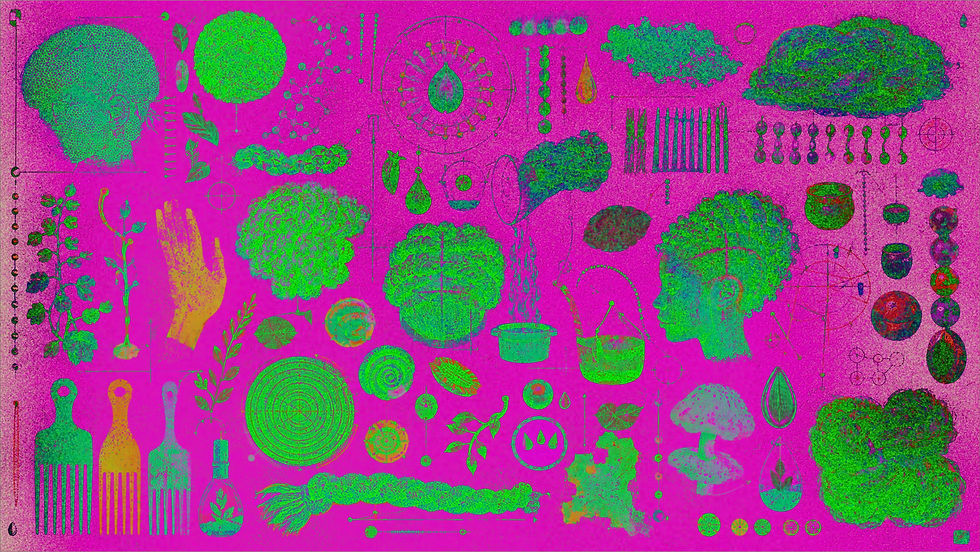

Before the License, There Was the Terrain

My maternal grandmother Mary Francis was a licensed cosmetologist, and my mother would not allow me to relax my hair before I turned eighteen. Growing up in the 1990s, that was a difficult boundary to inhabit. Straightened hair surrounded me as expectation, acceptability and assimilation.
Granny pressed hair into gravity
so my afro could fly free.
Her hands learned the language of assimilation
so mine could learn the language of return.
Everything in this book begins with her.
At the time, I could not fully understand what remaining with my unaltered texture was giving me. Looking back, I recognize that it kept me in relationship with my terrain long enough to begin learning how it moved—before culture and colonialism taught me to step onto the treadmill.


The License Was a Landscape, Not the Cosmos
I received my cosmetology license in 2014 believing I was entering a deeper framework for understanding Afro hair. Instead, I encountered a practice licensed by the state—and the state has never been neutral in its relationship to the Black body.
Cosmetology remains organized around European beauty standards, professional authority and the management of bodies into acceptable forms. It is one landscape I have traveled and a developed craft I still carry. But it is not the whole BespokeCurry Cosmos, and it cannot govern what Afro hair is allowed to know.


Care Cannot Require Dependence
Afro hair is not a problem waiting for the right product, practitioner or rule to solve it. It is an individual terrain—layered, responsive, ecological and alive. It cannot be understood from a distance or ignored until it becomes inconvenient. It has to be entered. Observed. Listened to long enough for its patterns to become legible.
The Afro ABCs begin there:
not with correction, but with relationship.


Natural Is Not the Same as Free
Returning to my own body made the terrain visible again. The natural-hair marketplace had converted confusion into consumption: more products, more routines, more intervention and more opportunities to believe that someone else possessed the answer.
Afro hair requires deep tending, but deep tending is not constant doing. In the practice I have developed, a roughly monthly wash cycle is a grounding rhythm; some scalp conditions and body needs may call for ten to fourteen days. This is not another universal rule. Every Afro body is a different terrain, and every terrain must reveal what it requires.

There Is No Product List

Afro hair does not need another shopping list. It needs moisture architecture.
You will not find recommended brands here. Brands change, reformulate and disappear. Long-term observation has brought me to an elemental architecture: water, glycerin, gel, curl mousse and curl cream. I am sticking to that. This excludes blow-dry styling, a separate terrain requiring its own preparation.
Glycerin is the moisture anchor.
Professional backbar systems prove that the industry can formulate specifically for Afro hair, yet that depth of care is rarely available over the counter. Instead, generalized products are stretched across every curl.
That exclusion is a choice.
Safety matters, but clean-girl purity is not liberation if removing functional ingredients leaves Afro hair unable to retain moisture.
Product is only part of the architecture. Afro hair must also be allowed to remain clumped and low-manipulation. Protective styling is not synonymous with adding external hair; it is the condition that protects healthy coils from one monthly cycle to the next.
The brand is not the knowing.
The relationship is.


Afro Hair Has No Gender

The service may be divided by the binary. The terrain is not.
Afro hair is Afro hair.
It does not become masculine when it enters a barbershop or feminine when it enters a salon. Binary gender does not change the terrain. It changes who is permitted to touch it, what service is offered, how much time is considered reasonable, what price is demanded and what the finished body is expected to communicate.
Barbering has been compressed into a colonial timeframe: move faster, serve more bodies, charge more money and call speed expertise—even when the hair has not received the tending it requires. Salon culture can reproduce a different form of harm, turning overexposure, intrusion and dysregulated group energy into part of the price a person is expected to pay for care.
Meanwhile, everybody’s hair is being undertended.
Afro hair is energy work.
Touching someone’s scalp, entering their hair, moving around their head and being given access to their body is an exchange between people. It requires consent, attention, regulation, boundaries and reciprocity. If that exchange is out of balance, the style may be technically complete, but the care cannot be sustainable.
The problem is not simply where Afro hair is being done. It is the social architecture surrounding the doing. No amount of technical skill can compensate for a relationship that teaches the body to brace itself.
The Afro ABCs refuse the idea that hair belongs to a binary before it belongs to the body. The terrain leads. The person living within it remains the primary knower.


The Coil Is Not a Grade

Curl Typing Is Not Hair Science
Curl typing is not a biological truth. It is a classification system born from celebrity hairstyling and repeated by marketing and state-authorized cosmetology until it began to feel anatomical.
The grid is not neutral. It is a hierarchy: straight hair first, Afro hair last. Proximity to Whiteness is coded as softness and desirability, while tighter spiraling, contraction and hair that refuses market-approved visibility are placed at the bottom.
I understand why 4C became a site of belonging. People denied affirming language for their coils found one another there.
That community is real.
The category is not.
The inability to see a pattern does not mean the pattern is absent. Afro hair is circular, spiral, recursive and fractal. It holds pattern inside pattern—contracting, expanding, repeating, returning and connecting. Water, glycerin, clumping, movement, weather and touch may change what becomes visible, but its geometry does not need a grade to exist.
The question is not, “What curl type am I?”
How does this terrain receive water and hold moisture? How does it gather? How does it respond to touch, time, atmosphere and weight? What relationship allows it to remain whole?
Afro hair does not need a type.
It needs to be known.

A Field Guide, Not Another Rulebook

The Afro ABCs are part of my decolonizing from cosmetology—not a rejection of craft, but a refusal to let cosmetology remain the authority over Afro knowing.
These letters are not commandments.
They are 26 portals into Afroscape: coordinates for reading Afro hair as technology, ecology, archive, architecture and living Black embodiment.
The terrain rotates through Mycelial Sankofa and ecological attunement. We return, observe, listen and adjust as the body changes.
The field guide does not replace your knowing. It helps you find your way back to it.


Enter the terrain. Each letter is a coordinate. None is the whole map.