


A Living Journal of Plant Medicine and the Neurodivergent Body


The Six Waters Cannabis Field Notes
A Living Journal of Plant Medicine and the Neurodivergent Body
Cannabis has lived alongside me for more than twenty years, though it took time for us to recognize each other. What began as casual observation slowly became a practice of listening — to the plant, to the nervous system, and to the waters moving through the body.
These field notes are a living archive documenting how cannabis interacts with a neurodivergent body through ritual, observation, and the Six Waters framework.


Cannabis has lived alongside me for more than twenty years now, though it took time for us to recognize each other.
I was not a teenager sneaking off to smoke behind the bleachers. I was the opposite, in fact — a rule-following kid, president of Club Pride, sitting through D.A.R.E. assemblies and absorbing the message that cannabis was something reckless, dangerous, and decidedly unladylike.
Still, there were mysteries in my childhood home.
Drawers that smelled like nag champa and street prescriptions.
Objects that adults pretended were not there.
The quiet knowing that a parallel world existed just outside the official story.
My first time smoking came later, in college, with a then best friend. The experience was surreal and almost theatrical. I remember sitting there convinced I could feel tiny chinchillas scratching at my knees.
Cannabis, from the beginning, was strange and sensory.
In those early years I associate it with very specific memories:
wine poured into coffee mugs, late-night conversations, old Lincoln Town Cars rolling slowly through the night while Robin Thicke played through the speakers.
But cannabis did not become a practice until much later.
It wasn’t until graduate school that the plant began appearing in my life with consistency. Not long after that it became something closer to a daily ritual.
Over time I began noticing something important: cannabis was not just changing my mood.
It was changing my waters.
As someone living with neurodivergence, obsessive thought looping, and a body that experiences intensity in cycles, I began tracking the ways cannabis moved through my nervous system. Not casually, but with attention.
What began as simple observation slowly grew into a framework.
This archive is the result.
The Six Waters Cannabis Field Notes are my attempt to document how plant medicine interacts with the neurodivergent body — not as a clinical study, but as a living record of relationship.
Cannabis is not a drug here.
It is a teacher, a collaborator, and sometimes a mirror.
And like water, it reveals itself differently depending on how we meet it.


For many years my relationship with cannabis looked like the relationship many people inherit through culture.
Dry smoking.
Blunts, wraps, and funnel — the large tobacco leaf common in Washington DC smoking culture, shredded and mixed with cannabis. It was the way many of us were introduced to the plant, particularly within Black smoking culture.
But tobacco is drying to the body.
Over time people talk about tolerance.
They say the plant “doesn’t hit the same anymore.”
I began to suspect something else was happening.
Cannabis interacts with the endocannabinoid system, a regulatory system woven throughout the body. And the human body itself is largely composed of water.
So the question emerged:
What happens when we change how the plant enters the water of the body?
Water carries information.
Anyone who has lived through a humid southern summer understands this instinctively. Moisture lingers in the air, holds sensation, carries memory.
When cannabis is consumed through water — water pipes, infused preparations, tinctures, or RSO — the interaction becomes different.
More conversational.
Water meets water.
Instead of the sharp ignition of dry smoke, the plant arrives buffered, cooled, and integrated.
When I began shifting from purely recreational smoking to ritualized, water-informed consumption, the plant changed for me entirely.
My nervous system responded differently.
My body listened differently.
The plant began to speak more clearly.





Fire, Smoke, and Cultural Memory
colonial wild fire vs indigenous wildfire
Dry smoke burns quickly Water carries memory
There is also a deeper metaphor here.
Dry smoking, to me, resembles colonial wildfire.
Fast.
Extractive.
Burn everything quickly and move on.
But when plant medicine is combined with water — when ritual and relationship are introduced — it becomes something closer to indigenous wildfire.
The kind that clears space intentionally.
The kind that regenerates ecosystems rather than exhausting them.
In this framework, the plant is not something we simply burn and inhale.
It is something we work with.
A cycle of fire and water.
Destruction and renewal.


Still Water — Regulation
The nervous system settles. Muscles soften. Breath deepens.

Flowing Water — Movement
Energy moves through the body. Creativity, conversation, and emotional motion emerge.

Deep Water — Memory
Subconscious layers surface. Reflection, ancestral memory, and introspection.

Turbulent Water — Conflict
Friction appears. Overstimulation, agitation, or challenge.

Tidal Water — Rhythm
Cycles of activation and rest. The body finds its natural tempo.

Sacred Water — Devotion
Moments of reverence, ritual, and connection with the plant itself.


Dawn
First contact with the plant.
The nervous system begins to awaken or soften.
(Flowing + Still Water)

River
Energy begins moving through thought, conversation, or physical sensation.
(Flowing Water)

Deep
Introspective layers open. Memory, reflection, or emotional processing.
(Deep Water)

Still
The body settles. Pain releases. Regulation returns.
(Still Water)

Mist
Subtle lingering effects. Light rhythm remains in the system.
(Tidal Water)

boil
Intensity rises. The strain activates the nervous system strongly or creates friction.
(Turbulent Water)


Cannabis does not work alone.
It arrives in conversation with other plants — herbs, teas, resins, and roots that support, extend, or reshape how the medicine moves through the body. Where cannabis may lift, another plant may ground. Where the mind opens, another may soften the edges.
Plant companions allow for a more intentional relationship with the body.
They help prepare the system, support the nervous system, and deepen the ability to receive what the plant is offering. This is not about mixing for effect, but about understanding that plants have always worked in dialogue.
When approached this way, cannabis becomes part of a larger ecosystem of care.
Plant Companions


Terpenes: The Steering Wheel of the Plant

If cannabis is the car, terpenes are the steering wheel, a stellar budtender in PDX told me this and I will never forget.
THC may determine potency, but terpenes determine direction — how the experience moves through the body and nervous system.
Below are several terpenes frequently encountered in cannabis and their common effects.
TERPENES - PINENE
Alertness, focus, and mental clarity. Often associated with pine-like aromas.
TERPENES - MYRCENE
Deep body relaxation and sedation. Common in many indica strains.
TERPENES - LIMONENE
Mood elevation, stress relief, and energetic brightness. Citrus-forward.
A top terp in the Bespokecurry Cosmos
TERPENES - BETA-CARYOPHYLLENE
Anti-inflammatory properties and potential anxiety reduction.
TERPENES - LINALOOL
Calming, relaxing, often associated with lavender-like scent.
TERPENES - TERPINOLENE
Uplifting, creative, and slightly stimulating.
TERPENES - HUMULENE
Appetite suppression and anti-inflammatory qualities.
TERPENES - OCIMENE
Clear-headed energy and mood elevation.
TERPENES - NEROLIDOL (TRANS & BETA)
Sedative, grounding terpene associated with deep relaxation.
TERPENES - EUCALYPTOL
Mental clarity and respiratory openness.
TERPENES - FARNESENE
Stress relief and calming effects.
TERPENES - BISABOLOL
Anti-inflammatory, soothing, often associated with chamomile.
TERPENES - GERANIOL
sweet floral terpene linked to mood elevation.
TERPENES - VALENCENE
citrus terpene associated with uplifting energy
TERPENES - CAMPHENE
cooling terpene potentially linked to anti-inflammatory effects.
TERPENES
Tracking terpene profiles alongside strain effects allows patterns to emerge over time.


Methods of Consumption

Methods of Consumption
The way cannabis enters the body changes the entire experience.
Methods tracked within these field notes include:
• Water pipe (bowl)
• Joint
• Concentrates / budder
• RSO (Rick Simpson Oil)
• Edibles
• Vaporization
Each method interacts differently with the body’s waters and the nervous system.


Neurodivergent Body Tracking
These notes specifically observe cannabis through the lens of a neurodivergent nervous system. Key factors include: • OCD thought loop disruption • sensory regulation • pain relief • sleep support • emotional regulation • creativity and focus Loop disruption is tracked on a 1–10 scale.

i am no longer working with the brand below it is here to show that i am commited to working with what is indeed the perfect plant.

Monthly Plants in Practice
The plants documented here shift monthly. Field notes track how each strain interacts with the body’s waters over time.
March 2026 Strains
Strains change monthly as new plant relationships are explored.

flower
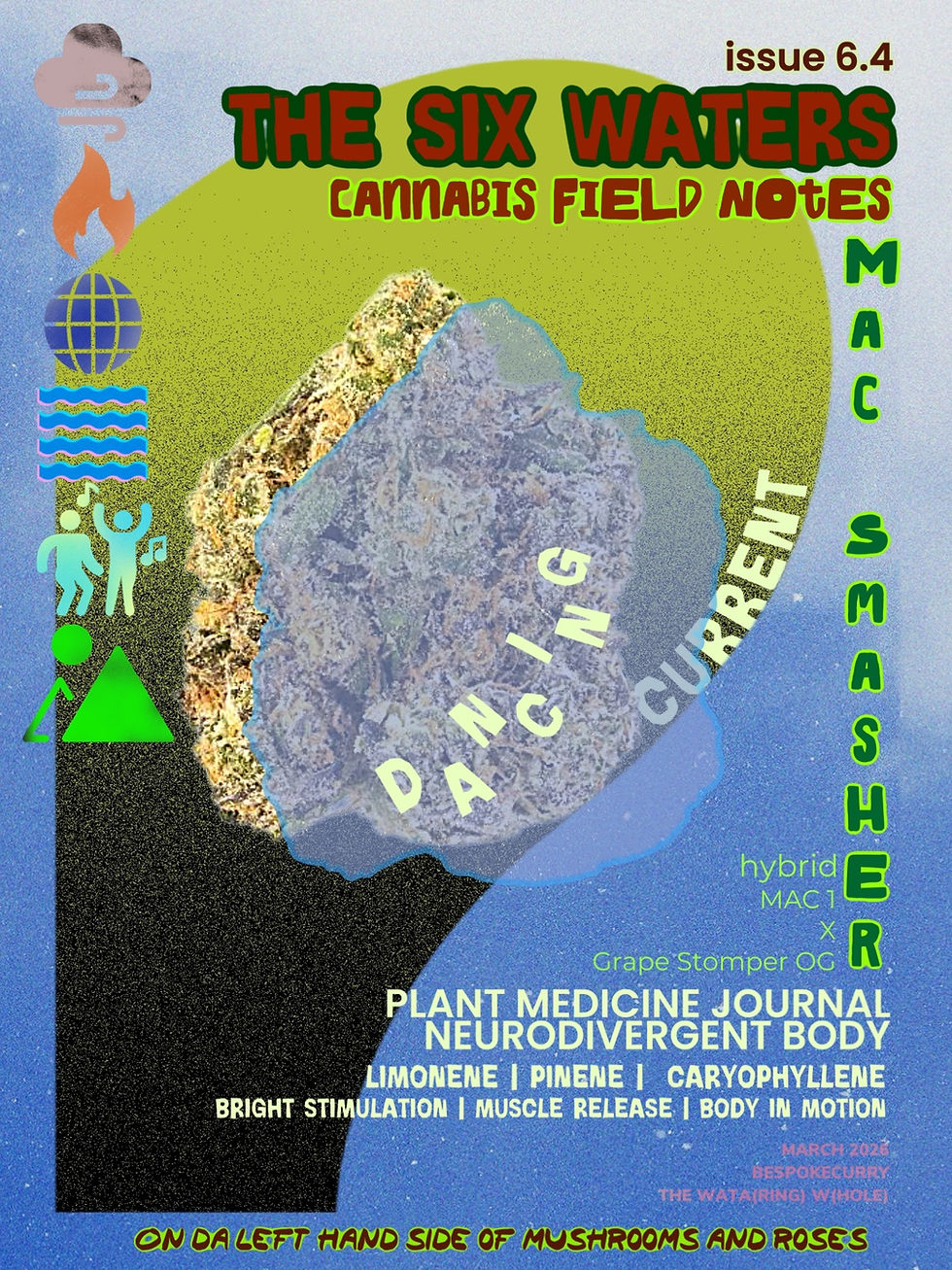
Grape Frost (indica) Lemon Truffle (hybrid) Permanent Runtz (hybrid) MAC Smasher (hybrid) Purple Tangie (sativa)

Concentrates
Concentrates Gary Satan Truffle Cake Watermelon Zkittlez Marshmallow OG RSO Strawberry Cough — daytime regulation Granddaddy Purp — sleep support


On Da Left Hand Side of Mushrooms and Roses
The phrase on da left hand side of mushrooms and roses did not arrive randomly.
It comes through sound, memory, and correction.
From the song “Pass the Kutchie” by The Mighty Diamonds — a song rooted in Rastafari culture, where kutchie refers to a sacred vessel used for smoking cannabis in ritual and communal practice.
Over time, that song was widely appropriated and transformed into “Pass the Dutchie” by Musical Youth — removing cannabis, removing context, and softening the cultural and spiritual grounding that the original held.
Kutchie became dutchie.
Sacred became palatable.
And an entire cultural shift followed.
That slippage matters.
Because it reflects how often Black spiritual and cultural practices are taken, renamed, and redistributed without their original meaning intact — especially when it comes to cannabis and plant medicine.
Mushrooms and roses enters from another direction.
From Janelle Monáe and the world-building of Mushrooms & Roses — one of the few moments where Black queer presence on a mainstream scale openly engages altered states, pleasure, and expanded consciousness without flattening them.
Where fungi is not hidden.
Not reduced.
But present.
So this phrase is doing multiple things at once:
It is remembering kutchie.
It is naming appropriation.
It is restoring language.
It is holding lineage.
And it is placing cannabis and fungi in the same field of conversation — not as trend, not as aesthetic, but as practice, portal, and relationship.
The left hand side is where that work happens.
Not the surface.
Not the performance.
But the side where you sit with the plant, where you listen, where you track what it actually does in the body.
Where the sacred is not renamed to be easier to consume.
Where the original signal is still intact.
In Western culture, the left is often treated as a defect.
Secondary.
Incorrect.
Something to be corrected or moved away from.
But in the Bespokecurry cosmos, the right does not exist without the left.
The left is not deviation.
It is origin.
It is where meaning is held before it is translated.
So what I mean to hold sacred, I pass to the left.
What I mean to undo, to rework, to rewrite — I pass to the right.


