


≋✺Terpene Index — Six Waters Cannabis Field Notes


This index organizes the archive through chemistry as well as experience.
If the strain name tells part of the story, the terpenes tell how the story moves.
Over time I’ve learned that my body does not simply respond to indica, sativa, or hybrid language. It responds to terpene balance — how the plant lifts, grounds, slows, sharpens, or softens the waters of the body.
This page gathers the field notes by terpene so the archive can be read another way: not just by plant name, but by how the chemistry moves.


On Terpenes
Beyond Flavor

Terpenes are often reduced to flavor — citrus, sweet, pine, gas — as if their primary purpose is taste.
That reduction is a distraction.
When flavor is placed above function, the deeper relationship between plant and body is flattened into something consumable, aesthetic, and easy to market. This is a familiar pattern — a colonial framing that prioritizes surface experience while stripping away structure, chemistry, and meaning.
Terpenes are not just flavor compounds.
They are molecules with specific shapes and arrangements that determine how they bind, signal, and move within the body. Their structure influences whether the nervous system softens, sharpens, settles, or lifts.
And they are not unique to cannabis.
These same terpenes exist across many plants — in herbs, flowers, resins, and trees — working in different combinations to create different effects.
Over time, learning these profiles — and their sometimes very specific scent signatures — can support immediate recognition of whether a strain may work for your body or not. That kind of knowing is not instant.
It requires time, attention, and an embodied system that can track what is being felt, not just what is being labeled.
To understand terpenes is not to chase flavor.
It is to understand how plants communicate through structure, and how the body receives that communication.


THE TERPENE FIELD SYSTEM
not categories. not effects. these are:
The Six States


Entry Air

Structure Body

Soften Body

Field Perception

Clarity Lift

Integration Body

I. ENTRY STATES — “OPENING THE DOOR” AIR
these are the first points of contact. they shift perception and create access.
LIMONENE — THE BRIGHT EXPANSION
opens / uplifts / activates
pulls you outward
creates immediate awareness
initiates movement

I. ENTRY STATES — “OPENING THE DOOR” AIR
these are the first points of contact. they shift perception and create access.
EUCALYPTOL — THE CLEARING
clears / circulates / resets
-
removes fog
-
creates internal space
-
prepares the system
Eucalyptol + Limonene you can’t go deep if you can’t open + clear first

II. STRUCTURE STATES — “HOLDING THE BODY” Structure
these define how safe it is to be inside the experience
CARYOPHYLLENE — THE PROTECTIVE DENSITY
boundary / containment / safety
-
creates edges
-
reduces overwhelm
-
stabilizes entry


II. STRUCTURE STATES — “HOLDING THE BODY” Structure
these define how safe it is to be inside the experience
CARYOPHYLLENE — THE PROTECTIVE DENSITY
boundary / containment / safety
-
creates edges
-
reduces overwhelm
-
stabilizes entry
Caryophyllene + Humulene - this is what stops expansion from becoming chaos
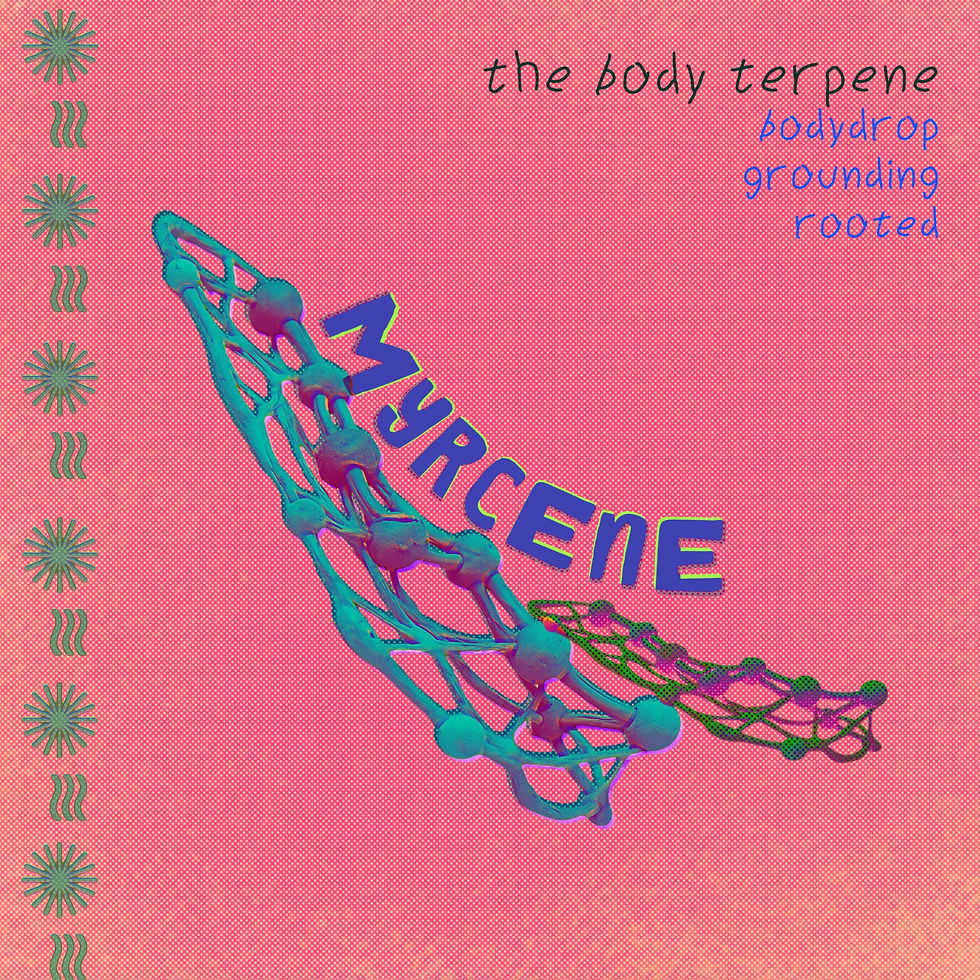
III. BODY STATES — “DROPPING INTO SELF” SOFT
these pull you into embodiment
MYRCENE — THE GROUNDED BODY
weight / rest / descent
-
brings you down
-
slows everything
-
anchors sensation

III. BODY STATES — “DROPPING INTO SELF” SOFT
these pull you into embodiment
BISABOLOL — THE SOFT HEALING
soothing / repair / closeness
-
calms irritation
-
softens edges
-
restores gently
Myrcene + Bisabolol this is where the body becomes the center

IV. ATMOSPHERIC STATES — “FIELD + PERCEPTION” Field
these affect how you move through space and thought
FARNESENE — THE DRIFTING FIELD
expansion / diffusion / distance
-
stretches perception
-
creates openness
-
less defined edges

IV. ATMOSPHERIC STATES — “FIELD + PERCEPTION” Field
these affect how you move through space and thought
OCIMENE — THE FLICKER
movement / light instability
-
quick shifts
-
playful unpredictability
-
not fully grounded
IV. ATMOSPHERIC STATES — “FIELD + PERCEPTION” Field
these affect how you move through space and thought
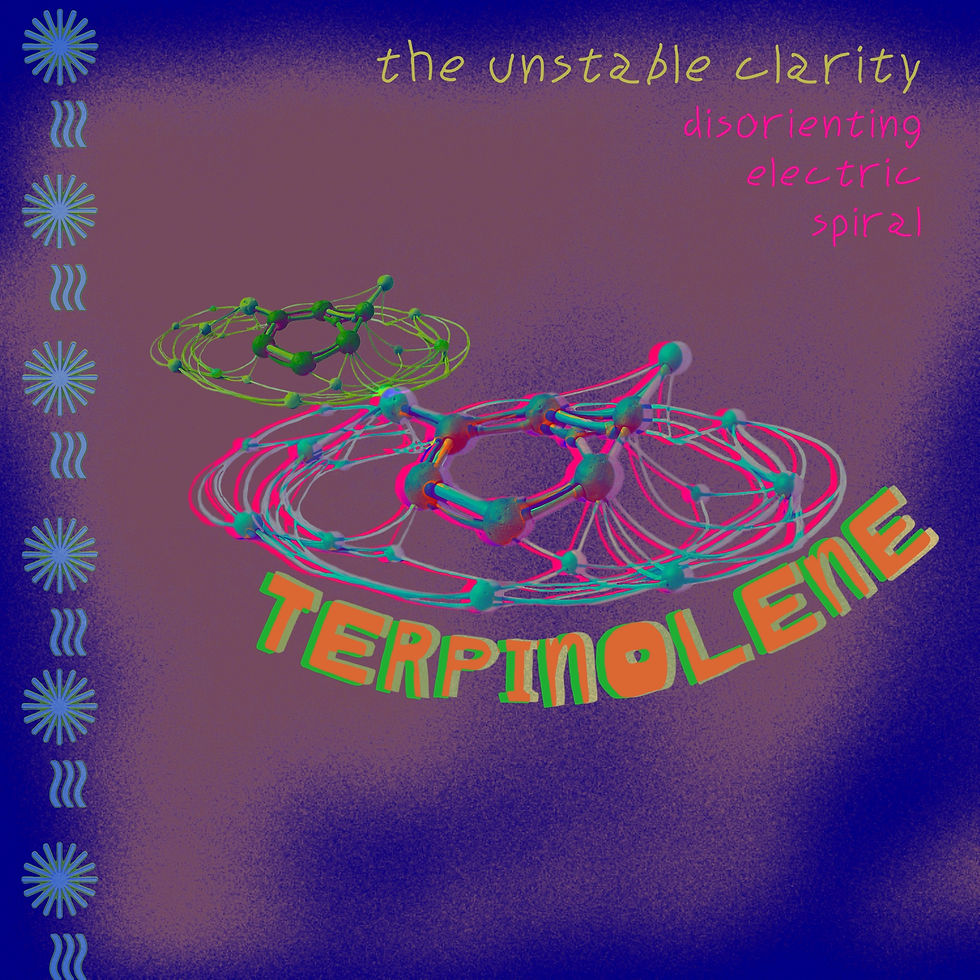
TERPINOLENE — THE UNSTABLE LOOP
cycling / mental motion / repetition
-
looping thoughts
-
unstable focus
-
heightened activity
Farnesene + Ocimene + Terpinolene this is where people either explore… or get lost
V. ELEVATION STATES — “LIFT + CLARITY” Clarity
these sit above the body but still connected to it
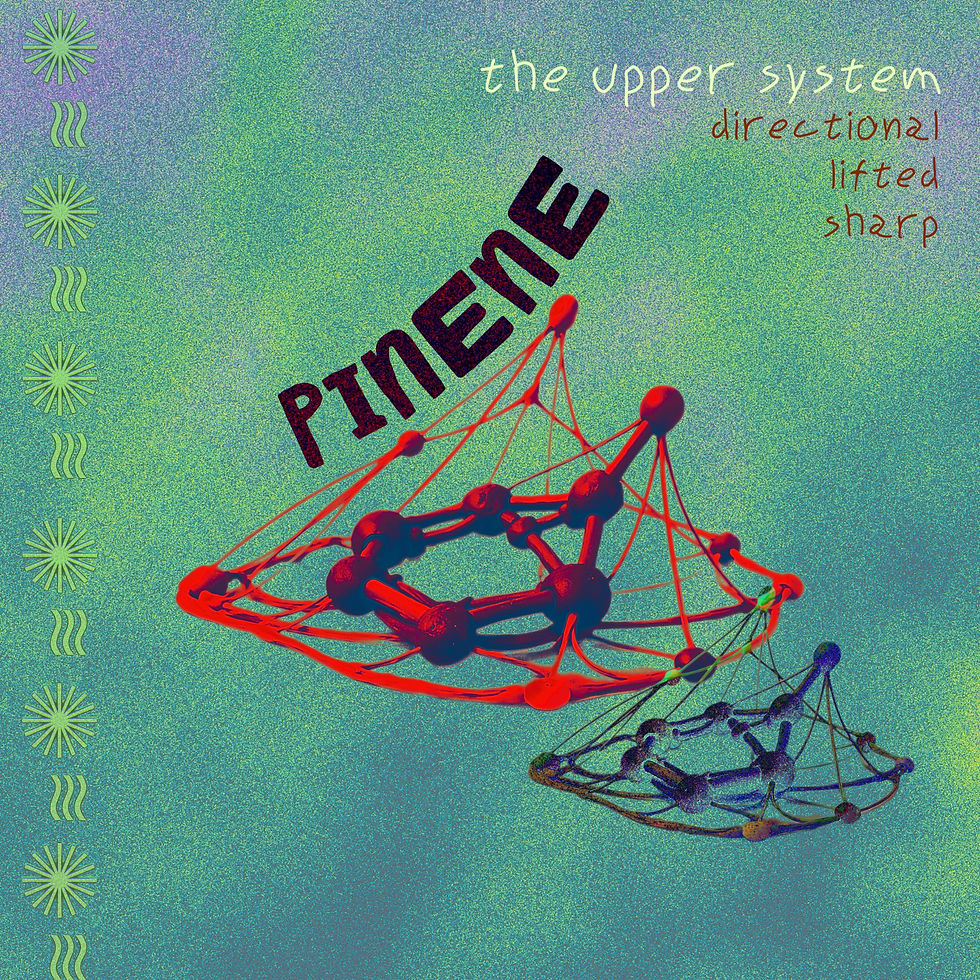
PINENE — THE UPPER (SHARP) SYSTEM
alert / focused / upward
-
cuts through fog
-
sharpens perception
-
adds precision

V. ELEVATION STATES — “LIFT + CLARITY” Clarity
these sit above the body but still connected to it
LINALOOL — THE SOFT FLOATING
calm / ease / light release
-
softens the system
-
reduces tension
-
creates gentle distance
Pinene + Linalool clarity + calm without heaviness

VI. INTEGRATION STATES — “COMING BACK” Body
these bring everything together
NEROLIDOL — THE DEEP SOFTENING
immersion / full-body calm
-
slows the entire system
-
wraps experience
-
supports rest

VI. INTEGRATION STATES — “COMING BACK” Body
these bring everything together
P-CYMENE — THE QUIET CARRIER
subtle / supportive / background
-
holds everything underneath
-
not dominant
-
stabilizes the blend
Nerolidol + P-Cymene this is how the experience lands and settles

CATEGORY SYSTEM (BASED ON THE SIX WATERS TERPENE MAP)
Indica. Sativa. Hybrid. These categories are often treated as fixed, but in practice they are only starting points. Terpenes expand the language. They allow us to understand how a strain actually moves — how it settles, lifts, softens, or sharpens the body — beyond the stereotypes those labels carry. For example, a recent profile we’re calling an “air indica” holds grounding without heaviness.
The body relaxes, but the mind remains light, open, and easy to move with. It does not drop you into stillness — it supports transition. This is where the archive is headed. Strains will be tracked not just by name or category, but by how their terpene structures express through the Six Waters. The full field notes for this profile are coming.
AIR TYPES
light / lifted / perceptual / unstable
includes:
-
pinene
-
ocimene
-
terpinolene
examples:
-
Air Lift (pinene dominant)
-
Air Flicker (ocimene dominant)
-
Air Loop (terpinolene dominant)


BODY TYPES
grounded / heavy / sensory / slow
includes:
-
myrcene
-
bisabolol
examples:
-
Body Drop (myrcene)
-
Body Soothe (bisabolol)


STRUCTURE TYPES
containment / stability / balance
includes:
-
caryophyllene
-
humulene
examples:
-
Structure Hold (caryophyllene)
-
Structure Steady (humulene)


FIELD TYPES
expansive / atmospheric / diffused
includes:
-
farnesene
-
ocimene (overlap intentional)
examples:
-
Field Drift (farnesene)
-
Field Light (ocimene blend)


CLEAR / OPEN TYPES
clarity / reset / circulation
includes:
-
eucalyptol
-
limonene
examples:
-
Clear Open (eucalyptol)
-
Bright Open (limonene)


INTEGRATING SOFTNESS TYPES
calm / integration / landing
includes:
-
linalool
-
nerolidol
-
p-cymene
examples:
-
Soft Float (linalool)
-
Deep Soft (nerolidol)
-
Quiet Base (p-cymene)
≋✺ Full Terpene Index — Six Waters Breakdown
(Completed system — all include waters + translation)


Linked field notes - Soon Come
Linked field notes - Soon Come

Linked field notes - Soon Come
Linked field notes - Soon Come
Variation notes

Not all terpene expressions behave the same way.
A body may respond differently to:
alpha pinene
beta pinene
delta limonene
other structural variations
The archive tracks those differences when available, especially when they clearly shape the movement of the waters.

Para (p-) — Structural Variation
You may see some terpenes written with a small letter in front, such as p-cymene.
The “p” stands for “para,” which refers to how the molecule is arranged.
In simple terms, it means parts of the terpene structure sit across from each other, creating a more evenly spaced and balanced form.
This does not make it a different terpene.
It is the same terpene,
held in a different arrangement.
Why This Matters
That structure affects how the terpene moves.
Para forms tend to feel:
• more stable
• less sharp
• more blended in the body
They often do not lead the experience directly, but instead support how other terpenes land.
In the Six Waters System
Para expressions most often show up as:
Mist (blending, atmosphere)
with support in River (smooth movement)
They help:
• soften transitions between effects
• extend how long the experience lingers
• reduce jagged or abrupt shifts
Translation
If terpenes are steering the waters,
para forms help keep the movement smooth.
They do not push the current.
They make sure the current can move without breaking.

Read by water and chemistry
Some strains repeat the same chemistry but move differently because of method, timing, body state, or supporting herbs.
That is why the archive tracks both:
-
terpene profile
-
Six Waters experience
Chemistry is one truth.
Embodiment is another.
The field notes live in the space where those two meet.

≋✺ Terpene Variations — Structural Language
You may see terpenes labeled with prefixes such as: α (alpha) β (beta) γ (gamma) δ (delta) p (para) cis / trans These are not different terpenes. They are different structural expressions of the same terpene — how the molecule is arranged, and therefore how it moves. Same compound. Different position. Different behavior.
Core Variations
Alpha (α)
Forward, sharp, immediate.
• fast-acting
• mentally activating
• can tip toward overstimulation
Six Waters: River → Boil (if unbalanced)
Beta (β)
Stable, grounded, integrated.
• smoother in the body
• less sharp
• easier to regulate
Six Waters: Still → River
Delta (δ)
Lifted, open, bright.
• mood elevation
• expansion without force
• forward but not sharp
Six Waters: River → Dawn
Gamma (γ)
Less common, but important.
• sits between beta and delta
• subtle lift with softness
• often not dominant but supportive
Six Waters: Mist → River (light)
Para (p-)
Evenly spaced structure.
• blending
• stabilizing
• extends effects
Six Waters: Mist (binder)
Cis / Trans
Refers to spatial orientation.
• cis → softer, more internal
• trans → more outward, active
Six Waters:
cis → Still / Deep
trans → River / Dawn
Translation
The terpene tells you what is present.
The variation tells you:
how it will move through your water

Current body map emerging from the archive

Supportive
≋✺beta-myrcene ≋✺beta-caryophyllene ≋✺delta limonene when balanced ≋✺P-cymene for sustained slow release of medicine ≋✺beta-pinene for integrated energy without headache
Use with care
≋✺high pinene, especially when sharp and unsupported and not beta ≋✺limonene without grounding support ≋✺terpinolene without grounding support can spike thought looping ≋✺ocimene without grounding support and softening


≋✺ Current linked archive
Regulation / Still-leaning
-
≋✺ Strawberry Cough — Morning Key — Six Waters Cannabis Field Notes
-
≋✺ Permanent Runtz — Slow Current — Six Waters Cannabis Field Notes
River / Movement-leaning
-
≋✺ Purple Tangie — River Tongue — Six Waters Cannabis Field Notes
-
≋✺ MAC Smasher — Dancing Current — Six Waters Cannabis Field Notes
Chemistry notes
-
≋✺ Terpenes — Steering the Waters — Six Waters Cannabis Field Notes (soon come)
-
≋✺ THC, Threshold, and the Body — Six Waters Cannabis Field Notes (soon come)


