


≋✺̱ Mycelial Sankofa: Bridging the Network Again

Updated: Sep 21
Mycelial Sankofa asks what happens when healing stops searching for the other side and begins tending the network already moving underneath.

On Da Left Hand Side of Mushrooms and Roses
Beauty, Decay, Grief & Regeneration
On Da Left Hand Side Mushrooms & Roses explores the coexistence of tenderness and rot, grief and bloom.
This terrain honors the cycles of composting that make beauty possible—where what falls away feeds what grows.
A study in living with softness while staying rooted in what is real.
≋✺̱ Mycelial Sankofa: Bridging the Network Again
The Bridge Existed. The Connection Did Not.
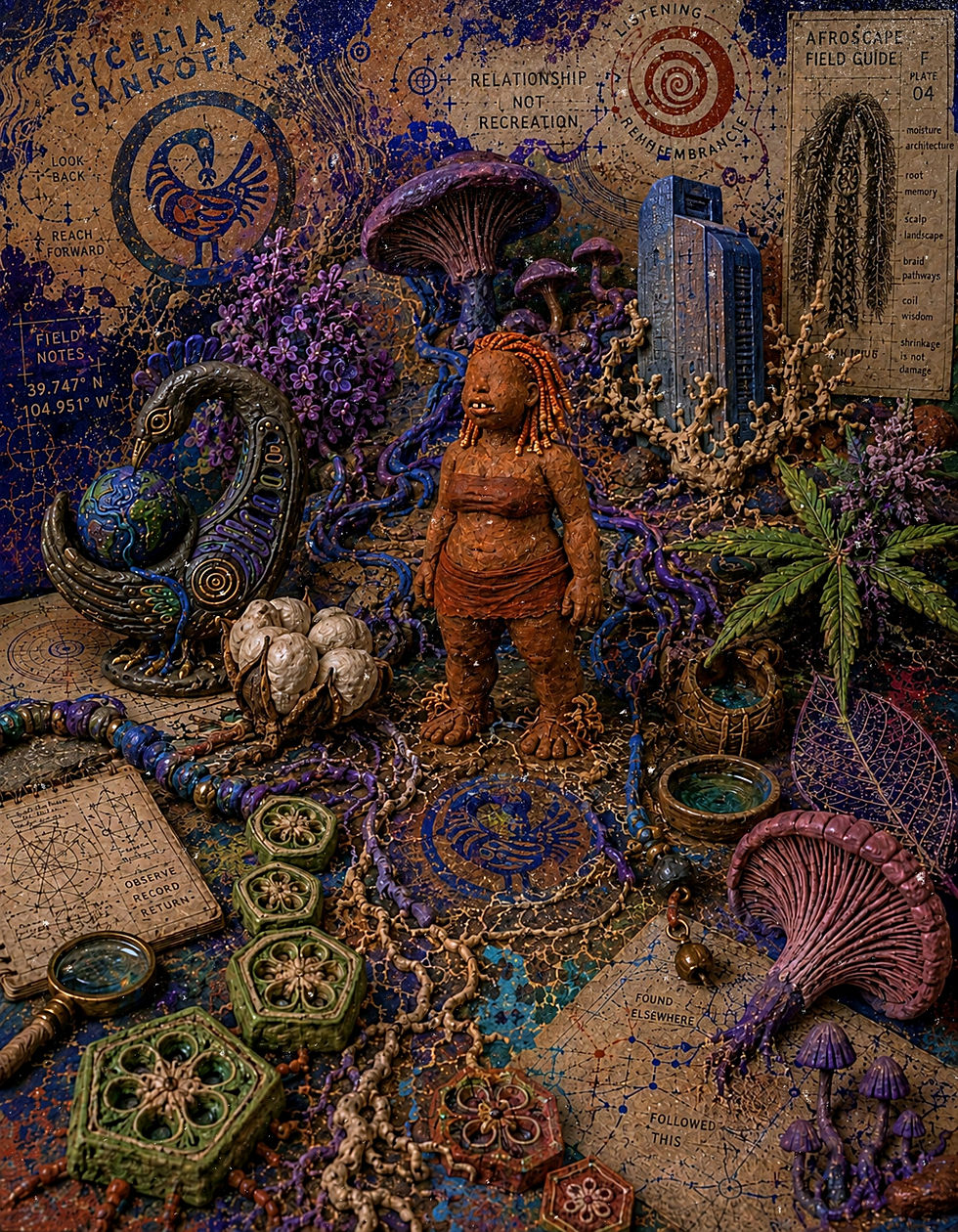
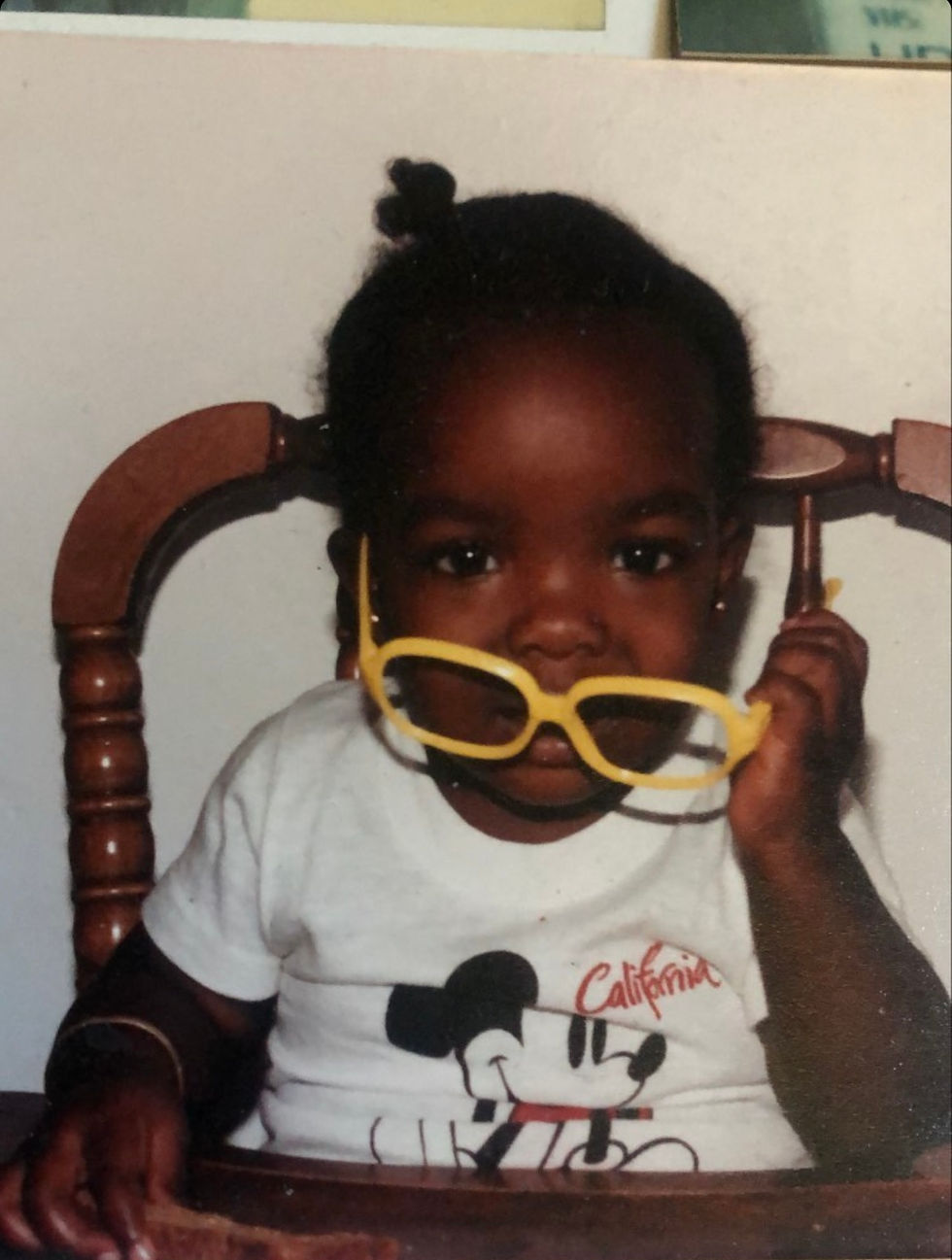
I was born in Denver.
At Mercy Hospital just outside city park, it is now a luxury apartment complex.
For much of my childhood, a medical system bridged across my body.
Doctors. Appointments. Tests. Questions. Records. Professionals with language for bodies and institutions built around knowing what bodies do.
The bridge existed.
The connection did not.
Because I still moved through that system completely unidentified. A Black neurodivergent body being observed without being understood. A body communicating without the people charged with reading it being able—or perhaps equipped—to understand what it was saying.
And when the connection was not made, I did not simply miss a diagnosis.
I missed access.
I missed accessibility.
I missed accommodation.
I missed language that might have allowed me to understand why environments moved through me the way they did. Why sensory experiences could become enormous. Why I needed particular forms of movement, repetition, food, rest, space, clarity, ritual, regulation. Why some things settled my body while other things seemed to set the whole ecosystem on fire.
There was access to a system.
There was not access to myself.
Those are not the same thing.
And I have had to think about what it means that this happened inside a country that has never lacked relationship to the Black body.
America knows how to extract from Black bodies.
Labor.
Knowledge.
Culture.
Performance.
Medical information.
Creativity.
Money.
Even our suffering can become profitable once somebody figures out how to package it.
The Black body has been made commodity over and over again.
Commodity creates connection.
But commodity does not require relationship.
Relationship asks something else.
It asks you to listen to the thing you are touching.
It asks you to recognize that knowledge might move in more than one direction.
It asks what is being exchanged.
It asks whether the relationship nourishes both participants.
It asks whether the body you are studying is also capable of studying you.
I had bridges everywhere.
The bridge existed.
The connection did not.

My Body Knew Before I Had Language for Knowing
I could tell this story as a progression.
I could tell you that first I learned one thing about myself, and then another, and then eventually I arrived here.
That would make a nice clean story.
It would also be a lie.
There has been nothing particularly linear about coming into relationship with my body.
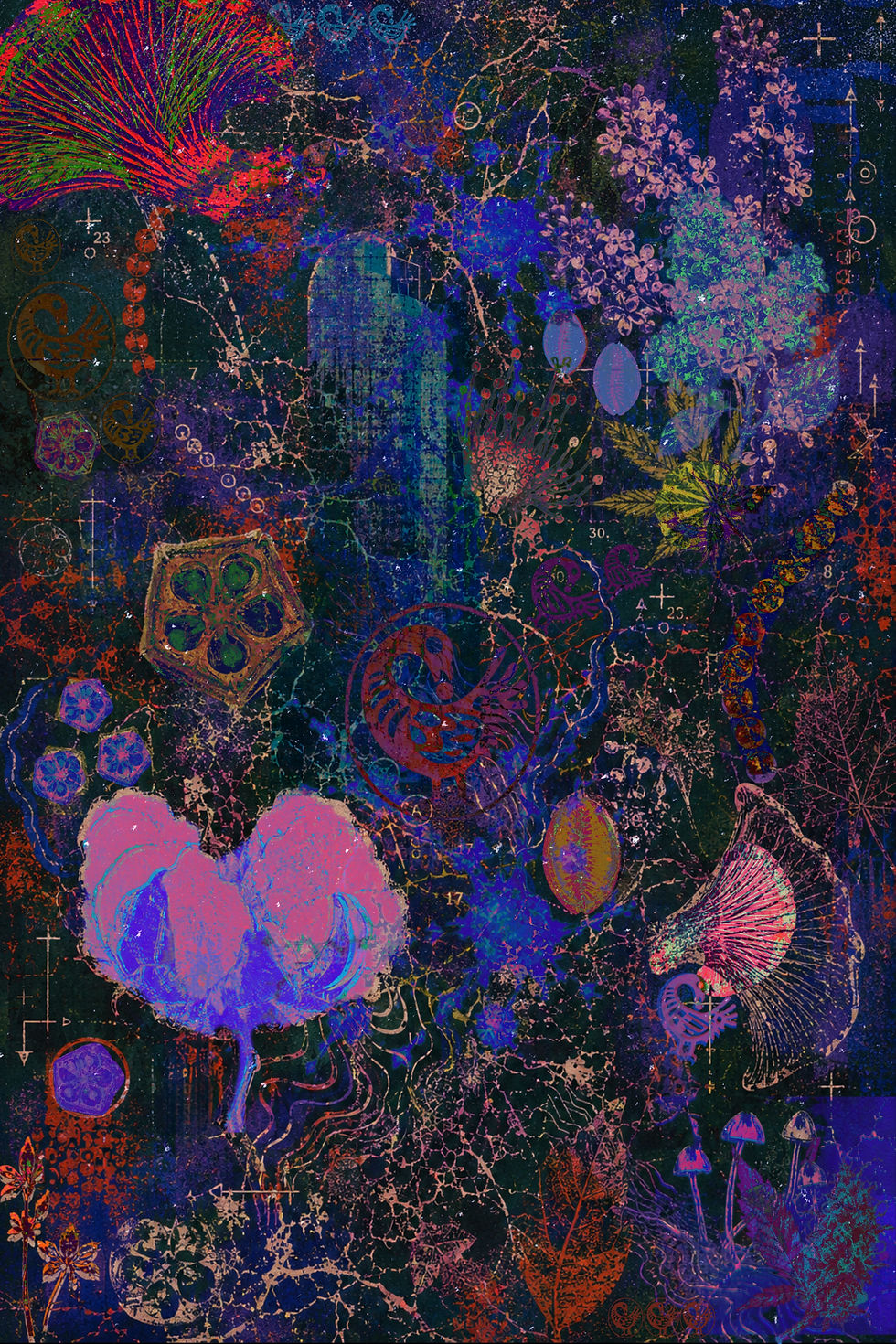
Sometimes I followed food.
Sometimes movement.
Sometimes smell.
Sometimes an herb.
Sometimes cannabis.
Sometimes fungi.
Sometimes a book.
Sometimes something my body rejected so immediately that the rejection itself became information.
Sometimes I understood what was happening.
Sometimes understanding came years later.
Sometimes I still don’t understand.
What I know is that my body has repeatedly moved toward relationship before I possessed the language to explain why the relationship mattered.
That has changed the way I understand knowledge.
Because I was taught, like so many of us are taught, to imagine knowledge as something that arrives from somewhere else.
Someone tells you.
Someone diagnoses you.
Someone publishes it.
Someone teaches it.
Someone credentials it.
Someone proves it.
And then you know.
But what happens when the body knows something before the institution gives you language for knowing it?
What happens when you encounter history and instead of learning something entirely new, you experience recognition?
This is part of what has happened as I have moved deeper into Black herbalism, Indigenous African healing praxis, fungi, cannabis, food, ecology, and texts like Malidoma Patrice Somé’s The Healing Wisdom of Africa and Sobonfu Somé’s The Spirit of Intimacy.
The text does not authorize my body.
History does not give my body permission to know.
Instead, history sometimes gives me language for relationships my body had already begun building.
My body did not need history to begin remembering. I needed history to understand some of what my body had already begun retrieving.
And I use remembering intentionally.
I am not particularly interested in flattening it into one explanation.
I do not need to decide that everything my body recognizes is genetic memory.
I do not need to reduce it to metaphor.
I do not need to make it entirely spiritual.
I do not need neuroscience to arrive and tell me which category of remembering is acceptable.
I know what recognition feels like in my own body.
I know what it feels like when something I encounter gives language to something I have already been sensing.
And I know that Black people did not begin knowing because somebody finally wrote us down.
But knowing is not enough if there is nowhere for the knowing to live.
Reading Malidoma and Sobonfu has sharpened something I had already been circling in my own life:
Gifts require ecology.
A gift does not become meaningful simply because it exists inside a body. It requires relationships capable of recognizing it, receiving it, challenging it, tending it, and giving it somewhere to move.
My gifts had no ecology.
That changes the story I have been told about what happened to me.
I did not simply fail to orient myself inside the systems around me. There was no system through which this particular body could fully arrive and orient.
The things I carried could be observed as problems. Excess. Difficulty. Contradiction. Maybe even potential.
But there was no ecology capable of recognizing how those things belonged together.
My gifts had no ecology, so suddenly I become another lost body to the system when there was no system for me to arrive and orient.
That is different from saying I had nothing.
It means what I had had nowhere to go.
And a gift with nowhere to go can begin to look like dysfunction.
Sankofa Does Not Walk a Straight Line
Se wo were fi na wosankofa a yenkyi.
It is not wrong to go back for that which you have forgotten.
That is the Akan proverb from Ghana carried by Sankofa.
The word is often shortened in translation to go back and get it: san, return; ko, go; fa, fetch, seek, take. But I need more than the shortened translation because Sankofa is not asking me simply to walk backward and retrieve an object I misplaced.
The Sankofa bird is already holding multiple directions at once.

Its feet remain oriented toward where it is going. Its head turns toward where it has been. It retrieves what is valuable because movement forward does not require abandonment of what came before.
Past, present, and future are therefore not three sealed rooms.
They remain in relationship.
That becomes especially important to me as a Black person living inside the aftermath—and continuation—of colonial rupture.
What happens when what I am supposed to retrieve has been deliberately made difficult to find?
What happens when the archive was burned, stolen, renamed, translated through somebody else’s worldview, placed behind institutional walls, or never intended to be written in the first place?
What happens when memory lives in an oral history?
A practice?
A preparation?
A relationship with an herb?
A rhythm?
A sensory recognition?
A story repeated until nobody remembers who first told it?
A body?
What happens when I cannot walk backward along one uninterrupted road because coloniality deliberately fractured the road?
I still retrieve.
I just have to understand retrieval differently.
That is where Sankofa becomes mycelial for me.
Mycelial Sankofa does not require an uninterrupted line in order for memory to move.
It reaches.
Across.
Under.
Around.
Through.
A written archive can become one point of connection without becoming the authority over every other point.
Oral history is another.
Embodied knowing another.
Ancestral practice another.
Land another.
Herbalism another.
Fungi another.
A book another.
Community another.
And none has to become the permanent center from which every other form of knowing receives legitimacy.
This is also why Mycelial Sankofa must remain decolonial.
Mycelial Sankofa isn’t decolonial simply because it incorporates African knowledge. Its architecture is decolonial.
The moment I require everything retrieved through Mycelial Sankofa to become legible through the same systems that participated in making it illegible, I have returned authority to the colonial archive.
Mycelial Sankofa depends upon what dominant systems might call nontraditional systems of memory and remembering precisely because coloniality has spent so much time determining which traditions count.
It allows memory to remain plural.
Oral.
Embodied.
Ecological.
Communal.
Ancestral.
Sensory.
Spiritual.
Written.
Unwritten.
And sometimes unresolved.
Memory does not need permission.
It does not require one form to authenticate all the others.
Nor does retrieval mean pretending rupture never happened. Some things were lost. Some relationships were severed. Some histories cannot be reconstructed cleanly.
But loss is not the same thing as emptiness.
And an interrupted lineage is not necessarily a dead network.
Some tings survived.
Some tings changed form.
Some tings traveled through bodies.
Some tings traveled through stories.
Some tings may become recognizable only after I encounter another point in the network.
And some tings are being made now from the relationships between what survived, what I retrieve, and what I am becoming.
Retrieval therefore does not end when I find something.
What I retrieve enters relationship with everything already here.
It changes because I touched it.
I change because it touched me.
The network changes because another connection has been made.
Sankofa, then, is not only retrieval. It is also the ecology into which the retrieved thing returns.
A practice enters another historical moment.
An herb enters another body.
A story enters another household.
An ancestral way of knowing encounters technologies, identities, environments, and conditions it may never have encountered in precisely this configuration before.
So the question cannot stop at:
What did I retrieve?
I also have to ask:
What relationships become possible because it has returned?
And what static from the present will try to make what returned illegible before it can be fully integrated into the future ecosphere?
Mycelial Sankofa is perspectival.
Rotate the network.
Something else comes into view.
Coloniality Depends Upon the Delusion of Disconnection

Knowledge did not simply wander underground.
Some of it was pushed there.
Some of it is meant to live there.
That matters.
Coloniality depends upon producing disconnection and then making the disconnection feel natural.
Body from land.
Medicine from ecology.
Knowledge from community.
Blackness from ancestry.
Human from more-than-human.
Healing from environment.
Mind from body.
Past from present.
Science from spirit.
And once everything has been separated into discrete categories, capitalism becomes very good at selling the pieces.
The herb becomes the supplement.
The plant becomes the active ingredient.
The fungus becomes the compound.
The knowledge becomes the credential.
The practice becomes the service.
The culture becomes the product.
The body becomes the consumer.
Something that once existed inside an ecosystem can be extracted, renamed, packaged, and sold back without the relationships that made it intelligible in the first place.
Then we are told we have discovered something new.
Colonial Wild Fire does not only burn what was there.
It burns relationship.
It burns routes between body and land. Body and ancestor. Body and herb. Body and fungi. Body and community. Body and its own ways of knowing.
Then the same colonial architecture can construct another route toward what it severed and name that route progress.
Medicine.
Innovation.
Technology.
Discovery.
Malidoma Patrice Somé asks in The Healing Wisdom of Africa why we would rebuild the road we intend to travel when such a road already exists.
That question has stayed with me because Colonial Wild Fire can destroy an existing route toward nature and then sell the bridge back to us.
The new bridge may be tech(no)logically sophisticated.
It may be evidence-based.
It may be profitable.
It may even help people.
But I still want to know what burned underneath it.
This is part of why Sankofa matters to me.
Retrieval interrupts the delusion that whatever the dominant system can currently see is all that has ever existed.
Mycelium makes that even clearer.
What is visible above the surface is not the entirety of what is alive.
You Can Use Fungi Without Learning Anything From Fungi
I keep returning to this as psychedelics become increasingly legible to medicine, capitalism, research, wellness, and popular culture.
Because fungi can enter the system without fundamentally changing the system.
A profoundly relational organism can be made to march through an incredibly linear architecture:
symptom → molecule → dose → intervention → outcome
And the outcome might even be beneficial.
I am not interested in pretending otherwise.
But efficacy and liberation are not synonyms.
A substance can help someone while the architecture surrounding that substance remains intact.
The fungi have simply been made to meet the system.
Using fungi is not the same thing as learning from fungi.
Learning from fungi asks me to pay attention to relationship.
To multiplicity.
To environment.
To what becomes possible through contact.
To decomposition as transformation rather than simply ending.
To networks without one permanent center.
To what happens when one part of an ecosystem changes and something seemingly distant responds.
I had encountered fungi before.
At another point in my life, I understood that encounter through the category available to me: recreation.
What changed was not fungi’s availability to me.
What changed was my capacity to recognize the encounter as relationship.
And once that capacity changed, recreation could no longer contain what was happening.
Because the body came too.
History came.
Grief came.
Pattern came.
The things I had not moved through came.
The relationships I had not understood came.
My brain and body kept positioning me with what needed attention.
I could intend recreation.
The fungi did not have to agree to remain inside that category.
This is part of what coloniality does so effectively: it gives us commodified categories through which to encounter living things.
Drug.
Product.
Recreation.
Supplement.
Medicine.
Commodity.
Those categories tell us what something is for while obscuring what it is in relationship with.
My relationship with fungi has not clarified one thing.
It has clarified my relationship to many things.
My body.
Blackness.
Neurodivergence.
Herbalism.
Cannabis.
Food.
Movement.
Sensory knowing.
History.
Ancestry.
Community.
Environment.
Accessibility.
The more I understand one relationship, the more another begins to move.
That is not a treatment plan.
It is an ecosystem.
And that distinction matters when I think about liberation.
Because I want to ask more than whether an intervention reduced suffering.
I want to know:
Did the intervention help the person live more freely, or did it help them tolerate the conditions that were harming them?
Those are not the same outcome.
Ecological Attunement

If this is an ecosystem, then I need a methodology capable of studying an ecosystem without destroying its relationships in the process.
This is where I have had to reconsider what I mean by rigor.
Rigor is often attached to sameness.
Can I reproduce the conditions?
Can I isolate the variable?
Can I repeat the intervention?
Can I produce a sufficiently similar outcome?
There are questions for which that kind of rigor is necessary.
But relationship creates another kind of problem.
And the work is just giving binary masculinity for me
I cannot reproduce yesterday’s body.
I cannot reproduce yesterday’s fungi.
I cannot reproduce yesterday’s sleep, food, movement, grief, sensory environment, nervous system, memory, weather, expectation, or everything else already moving through the Wata(ring) W(hole).
That does not make observation impossible.
It changes where consistency lives.
Ecological Attunement locates consistency in the quality of attention rather than the production of identical conditions.
I return with the same depth of attention.
To body.
To organism.
To environment.
To relationship.
To context.
To change.
I ask what is happening here.
Then I return again.
And again.
Not because repetition will eventually force the relationship to produce the same answer.
Because repeated attention teaches me how to perceive the relationship more fully.
This is something my relationship with cannabis has already taught me.
I often think of cannabis as the car and terpenes as the steering wheel.
Having the vehicle does not tell me where I am going.
THC percentage does not tell me where I am going.
Even the name of the cultivar cannot tell me exactly where I am going.
The terpene constellation helps me understand direction. The body participates in navigation. Dose matters. Time matters. Food matters. Movement matters. physiological state matters. Environment matters.
The plant is a vehicle.
It is not the destination.
The body is not cargo.
The body participates in steering the relationship.
This is why my Cannabis Field Notes increasingly ask something different from What does this strain do?
I want to know:
What relationship does this constellation make possible in this body, at this dose, at this time, under these conditions?
That is Ecological Attunement.
And fungi asks the same depth of attention from me.
If my methodology requires a living ecosystem to remain still before I am willing to call my observation rigorous, I have misunderstood the thing I am observing.
A network moves.
A body moves.
Relationships change.
Conditions change.
The attunement is in continuing to notice.
Malidoma writes about ritual as repeated practice. Sobonfu writes about relational and ancestral ties requiring regular tending.
What I recognize in both is not an instruction to reproduce Dagara practice as my own.
I recognize an architecture of return.
Return.
Attention.
Relationship.
Practice.
Change.
Return again.
Not identical conditions.
Consistent tending.
That is the attunement.
Consistency Becomes Second Skin
At first, this attention has to be deliberate.

What changed?
What did I eat?
How did I sleep?
What happened when I moved?
What happens at this dose?
What happens when cannabis enters the relationship?
What happens when fungi enters?
What happens when I am alone?
What happens when I am in community?
What happens when my body is already overwhelmed?
What happens when it feels safe enough to become curious?
But repetition changes the observer too.
I begin recognizing relationships before I consciously name them.
I become more capable of feeling when something has shifted.
I notice one point in the network and understand that I may need to rotate before I decide what I am seeing.
Consistency becomes embodied.
It becomes second skin.
And once consistency becomes second skin, I can shift the bridge.
The network can expand farther into self because I can perceive more of what is happening there.
Then it can move outward.
Into relationship.
Into organism.
Into environment.
Into community.
This is where Ecological Attunement differs from obsessive self-observation.
The self is not the final destination.
Attention becomes capacity for relationship.
And relationship creates the possibility of expansion.
The mycelial network does not end at the self.
Mycelial Sankofa Created Community in Me
For much of my life, connection was something I was expected to accomplish inside environments that would not take responsibility for whether connection was actually possible.
The body had to adapt.
The body had to communicate differently.
The body had to regulate itself.
The body had to make itself legible.
The body had to cross the bridge.
And when the bridge failed to produce relationship, the body could still be blamed for not arriving correctly.
Fungi did not solve that.
They did something stranger.
Mycelial Sankofa created connection and community in me when those responsible refused to take accountability.
I mean in me intentionally.
Before the network could expand outward, something had to become relational internally.
My body had been taught fragmentation.
This part is wrong.
That part is excessive.
This part needs discipline.
That part needs diagnosis.
This sensation is irrelevant.
That knowing requires proof.
This relationship counts.
That one does not.
Mycelial relationship began allowing things that had been separated to encounter one another.
Cannabis could speak to movement.
Movement could speak to sleep.
Food could speak to sensory regulation.
History could speak to intuition.
Fungi could speak to grief.
Ancestral knowledge could speak to something I had already begun building without knowing its lineage.
Nothing had to become the singular answer.
There could be a network.
And once that relationship became sufficiently practiced—once Ecological Attunement began becoming second skin—I could shift the bridge again.
Outward.
Toward community.
A Bridge Cannot Have Only Two Sides

I have been thinking a lot about bridges.
But the longer I sit with the bridge, the less interested I am in one that only travels between two points.
Because even the familiar image of a bridge can become a problem if I allow it to convince me that connection requires two sides.
It has relationships.
It has points of contact.
It has organisms reaching toward other organisms.
It has movement within itself and movement between other ecosystems.
It has connections that strengthen, weaken, disappear, regenerate, reroute.
And so the bridge I am interested in has to rotate.
An ecosystem cannot be understood any other way.
A bridge can be a mycelial connection.
A bridge can be ancestral.
A bridge can be oral history.
A bridge can move between body and herb.
Between body and body.
Between human and fungi.
Between history and sensation.
Between community and land.
Between one ecosystem and another.
Sobonfu Somé writes of many gates connecting a village to other worlds.
That image has stayed with me because it gives me another way of troubling the bridge.
Maybe there was never one bridge.
Maybe there were always many gates.
Many thresholds.
Many ways of entering relationship.
And if there are many gates, then the question cannot simply be whether somebody crossed.
I have to ask:
Which gate opened?
For whom?
Under what conditions?
In relationship with what?
And where does that opening allow the network to move next?
Sometimes the bridge needs to rotate.
That rotation matters because there is no permanent center.
Rotate toward medicine and one set of relationships becomes visible.
Rotate toward the Black body and the entire network reorganizes.
Rotate toward capitalism and ask who profits.
Rotate toward an ancestor and time changes.
Rotate toward fungi and the distinction between individual and environment becomes harder to maintain.
Rotate toward accessibility and ask whether the environment changed with the body.
Rotate toward liberation and ask whether the person became more free.
This is what I mean when I say:
Mycelial Sankofa is perspectival.
Bridging inside an ecosystem requires learning the relationships already there.
Bridging between ecosystems requires something else: learning how to encounter another system without demanding that it become yours.
That is relationship.
And relationship cannot simply be declared because infrastructure exists between two points.
I know that intimately.
The bridge existed.
The connection did not.
Where Is Everybody Else?
But if Ecological Attunement becomes second skin and the network begins moving outward, another question becomes unavoidable.
Where is everybody else?
Sobonfu writes about the strangeness, within Dagara understandings of relationship, of imagining two people as a complete community.
That matters to me because ecological attunement cannot culminate in becoming extraordinarily good at knowing myself.
Where is everybody else?

If I become better at perceiving my body but build no relationships capable of receiving what I perceive, the network stops.
If fungi helps me retrieve something but there is nowhere for that knowledge to move, the network stops.
If I discover my gifts but no ecology exists in which those gifts can circulate, the network stops.
Gifts require ecology.
And this changes what integration means to me.
A psychedelic experience can be profound.
A person can see something.
Feel something.
Remember something.
Retrieve something.
And then what?
What ecology exists capable of receiving what emerged?
A person can return from an extraordinary encounter to the same inaccessible workplace.
The same racism.
The same family architecture.
The same medical system.
The same poverty.
The same isolation.
The same absence of community.
The same conditions that made orientation difficult in the first place.
Insight does not automatically alter ecology.
We can give someone an extraordinary experience and return them to an environment with nowhere for that experience to live.
Malidoma calls some unfinished passages “unresolved initiations.”
I keep thinking about that.
Seeing the shore is not the same as docking.
Using fungi is not the same as learning from fungi.
Having insight is not the same as having an ecology capable of receiving it.
Integration cannot only mean helping the individual accommodate revelation.
Integration also has to ask whether the surrounding ecology can receive transformation.
Otherwise we risk reproducing something I already know intimately:
a gift with nowhere to go.
Community, then, cannot be an optional aftercare service attached to an intervention.
Community is part of the relational technology through which what emerges becomes livable.
The network does not end at the self.
The Network Again

I was born in Denver.
A medical system spent years bridging across my body.
There were people with degrees. Institutions. Records. Appointments. Knowledge. Infrastructure.
And there was my body, communicating the entire time.
The bridge existed. The connection did not.
I used to think understanding myself meant eventually finding the missing thing.
The right diagnosis.
The right language.
The right history.
The thing that would finally make the rest of me make sense.
I don’t believe that anymore.
There was never one missing thing.
There was an ecosystem I had not been taught how to see.
Fungi did not give me Sankofa.
Sankofa did not give me my ancestors.
History did not give me intuition.
Diagnosis did not give me my body.
Malidoma did not give me the network.
Sobonfu did not give me relationship.
But each can become another point through which something already moving becomes perceptible.
Put your hand into the soil and eventually you stop asking which root began the forest.
Something touches something.
An herb touches memory.
A mushroom touches perception.
Movement touches cannabis.
A book touches something the body already knew.
An ancestor touches a story.
A story touches somebody still living.
The body touches the environment.
The environment answers back.
And somewhere inside all of that touching, something that had been made illegible becomes perceptible again.
Not restored.
Not returned untouched.
Related.
That is the difference.
Mycelial Sankofa does not promise to take me backward to some unbroken before.
It asks me to become attentive to what is alive now.
What survived.
What decomposed and became nourishment for something else.
What is reaching.
What is refusing.
What is growing around the obstruction.
What becomes visible when I rotate.
There are still ruptures here.
There are also roots.
There are histories I can name and histories I cannot.
There are bridges I inherited, bridges I am rebuilding, bridges I need to stop crossing, and connections I am only beginning to recognize.
And there are bridges that arrive through sound.
Back in Park Hill, at Macedonia Baptist Church in Denver, Granny used to sing:
Like a bridge over troubled water,I will not be moved.
I understand the contradiction differently now.
A bridge moves me between things.
Mycelium reaches.
Water flows.
Sankofa turns.
The network rotates.
And still—
I will not be moved.
Not because I am fixed.
Because I am rooted.
Because movement does not require disconnection from what holds me.
Because a root can remain rooted while reaching somewhere it has never been.
Because water can move without forgetting the watershed.
Because I can rotate the network without abandoning where I stand inside it.
Maybe that is what my body has been trying to tell me all along.
The bridge existed.
The connection did not.
So I stopped looking for the other side.
I looked down.
And there was the network.
Still reaching.
Granny still singing.
Water still moving.
Roots still holding.
So am I.
≋✺̱ Mycelial Sankofa: Bridging the Network Again
Cosmos Watershed
Mycelial Sankofa: Bridging the Network Again develops a decolonial, ecological methodology for understanding memory, fungi, healing, and relationship through a Black neurodivergent body. Beginning and returning to Denver, the essay moves from a childhood medical system that built infrastructure across the body without creating connection toward a mycelial understanding of Sankofa: memory moving across fractured archives, embodied knowing, ancestral practice, Black herbalism, fungi, cannabis, land, oral history, and community. Through Colonial Wild Fire and Ecological Attunement, the essay asks what changes when healing is understood not as an isolated intervention but as the cultivation of relationships within a living ecosystem. The bridge becomes multipoint, rotating, and perspectival. The network does not end at the self; gifts require ecology. What begins with a body searching for orientation returns through Park Hill, Granny’s voice, Black church memory, water, roots, and the relationships that were reaching underneath all along.
Watershed | Tributaries |
Watershed | Sacred Water |
Relationship | Fungi as relational organism, ecological teacher, and living participant in remembering, orientation, and reconnection |
Hom(e)ie | Fungi · Cannabis · Herbs · Water · Body · Ancestors · Community |
Origin | Denver, Colorado · Park Hill · childhood medical systems · Black embodied knowing · Granny at Macedonia Baptist Church |
Expansion | Mycelial Sankofa · Ecological Attunement · Colonial Wild Fire · relational healing · plural memory · gifts requiring ecology · community beyond the individual |
Application | Psychedelic practice · Black herbalism · neurodivergent embodiment · plant/fungi relationship · accessibility · community building · decolonial methodologies of knowing |
Lineage | Akan Sankofa · Indigenous African relational and healing praxis · Malidoma Patrice Somé · Sobonfu Somé · Black oral history · Black church memory · embodied and ancestral knowing |
Counter Currents | Linear psychedelic intervention models · extraction · commodification · colonial archives as sole authority · individualism · standardized sameness mistaken for rigor · access without relationship · efficacy mistaken for liberation |
Cosmos Coordinates
Coordinate | Entry |
Primary Portal | ≋✺̱ Fungi Tings |
Connected Waters | ≋ The Six Waters · ≋✺ Six Waters—Cannabis |
Tings Connections | ◉≋ Afro Theory / Afroscape · I Know Tings · I Move Tings · I Eat Tings · Reading Rainbow Tings |
Primary Methodology | Mycelial Sankofa |
Methodological Practice | Ecological Attunement |
Cosmos Concepts | Colonial Wild Fire · The Wata(ring) W(hole) · Terpene Constellations · Relationship Thresholds |
Geographic Coordinate | Denver, Colorado · Park Hill · Macedonia Baptist Church |
Relational Coordinate | body ↔ fungi ↔ herb ↔ cannabis ↔ ancestor ↔ memory ↔ land ↔ environment ↔ community |
Temporal Coordinate | ancestral ↔ remembered ↔ embodied present ↔ becoming |
Orientation | Perspectival · ecological · multipoint · rotational · decolonial · embodied |
Core Refrain | The bridge existed. The connection did not. |
Expansion Principle | Gifts require ecology. The mycelial network does not end at the self. |
Cosmos Constellations
Constellation | Connection |
≋✺̱ Fungi Tings | Primary constellation. Fungi as relationship, network, perception, retrieval, and ecological teacher rather than isolated psychedelic intervention. |
≋ The Six Waters | The Wata(ring) W(hole) provides the larger ecological architecture: movement, regulation, relationship, environment, and the understanding that no element exists alone. |
≋✺ Six Waters—Cannabis | Cannabis practice provides an embodied precedent for Ecological Attunement: repeated observation across dose, time, physiological state, environment, movement, and terpene constellation. |
◉≋ Afro Theory / Afroscape | Black embodied knowing, Indigenous African healing praxis, Sankofa, colonial rupture, Colonial Wild Fire, and the recovery of relational ways of knowing outside colonial authorization. |
I Know Tings | Embodied recognition before institutional language; the body as a participant in knowledge-making rather than merely an object being interpreted. |
I Move Tings | Movement as regulation, information, ecological change, and one of the relationships through which the body learns how to receive other relationships. |
I Eat Tings | Food, herbs, preparation, sensory knowing, and nourishment as relational technologies within the same ecosystem rather than separate wellness practices. |
Reading Rainbow Tings | Malidoma Patrice Somé and Sobonfu Somé enter as relational nodes: texts that give language, lineage, complication, and recognition to work already emerging through the body. |
Mycelial Sankofa | Retrieval without requiring an uninterrupted lineage; plural memory moving across body, ancestor, archive, organism, land, oral history, community, and what is still becoming. |
Ecological Attunement | Methodological consistency located in the repeated quality of attention rather than identical conditions; through repetition, attention becomes second skin and expands from self toward community. |
Colonial Wild Fire | Names the destruction of existing ecological and relational routes followed by the construction, legitimization, and commodification of replacement routes back toward what coloniality helped sever. |


Comments