


✺≋ The Six Waters of Food


I Eat Tings
I Eat Tings centers nourishment as a daily spiritual practice and food as creative material—how what we ingest shapes mood, memory, energy, imagination, and capacity.
Here, cooking, African diasporic foodways, styling, photography, bodies, and environments meet. The plate is not a prop; it is part of an entire sensory and visual world. The food, creative director, model, and photographer build an image you can see yourself eating within.

This is a grounded approach to feeding the body and directing the frame with care, rhythm, vibrancy, and relationship—not perfection.
Eating here is not discipline, and beauty is not decoration. Both are devotion.
Each dish is a portal.
Field Notes from a Tongue in Transit.
✺≋ The Six Waters of Food

I spent most of my childhood being encouraged to eat foods that muted flavor, while my adult body is increasingly seeking foods that deepen it.
I did not realize food was moving through the Six Waters until I was on my third pot of okro soup.
That feels correct.
Not the first pot.
Not the second.
As of this posting, I am on my fifth or sixth pot, still perfecting my flavors and techniques.
Because the first pot introduced itself.
The second pot corrected me.
The third pot began speaking in system language.
And every pot after that continues to evolve across that multipoint bridge.
This one has smoked turkey leg.
The last one taught me that too much tomato-heavy pepper mix can overwhelm the okro.
I have also learned that tomato can be tempered with a little baking soda.
There was a small volcanic eruption in my last pot, and third-grade me was squealing with joy.

The draw thinned.
The mucilage faded.
The soup started tasting closer to soup kandja.
Not bad.
Just not mine.
The tomato was doing too much work.
The fish became too loud.
The iru disappeared behind the brightness.
And then I added more okro.
Immediately, the pot returned to itself.
The flavor restored.
The draw restored.
The iru came back.
The smoked fish sat down.
The tomato stopped chairing the meeting.
That was when I realized okro is not just texture.
Okro is relationship infrastructure.
Okro is mediation.
Okro is body.
Okro is memory.
Okro is almost like β-caryophyllene in the way it helps the other things settle into place.
Not because they taste alike.
Because they behave alike inside a system.
Some ingredients do not simply add flavor.
They organize flavor.
◉ Food Does Not Sit Still
For a long time, I thought food belonged in categories.
Healthy.
Unhealthy.
Comfort food.
Special occasion food.
Good.
Bad.
Breakfast.
Dinner.
Snack.
But my body is teaching me something different.
Food moves.
Food shifts.
Food teaches.
Food regulates.
Food returns.
Food remembers.
Food leaves residue.
And the foods I keep returning to are not simply foods I like.
They are waters I am learning to recognize.
Still Water.
Flowing Water.
Deep Water.
Turbulent Water.
Tidal Water.
Sacred Water.
The Six Waters were never only about emotion.
They were always about movement.
And lately, food has become one of the clearest ways I can see that movement happening in my body.
◉ Still Water — The Food That Holds

Still Water is the fermented millet and sorghum porridge.
The thing I eat almost every day.
And babyyyyyyy, has that pot evolved.
The food that does not need to be exciting in order to be powerful.
It began simply.
Millet.
Sorghum.
Water.
Fermentation.
Then plantain entered.
Then I learned that Jamaican porridge traditions often include green plantain.
That discovery felt like permission.
Permission to treat porridge as an ancient diasporic kitchen tool rather than a fixed recipe.
Permission to experiment.
Permission to play.
Then extra-ripe plantain entered.
Then Japanese sweet potato.
Then purple yam.
Red garnet yam.
Garri.
Now roasted sweetness folds itself back into fermented grain.
Now burnt cinnamon.
Now spices that arrive in larger quantities than what I was raised with in Black American cooking.
Not a sprinkle for nostalgia.
Not a whisper for decoration.
Real spice.
Daily spice.
Body-level spice.
The porridge has become foundation.
Not restriction.
Not diet food.
Not punishment.
It gives my gut something consistent.
It gives my morning something steady.
It gives the rest of the day permission to be curious.
The porridge is also teaching me about seasons.
Summer fermentation moves differently than winter fermentation.
Right now, the weather is warm enough that millet and sorghum move quickly on their own.
The fermentation window shortens.
The observation window shortens.
The system asks for simplicity.
So the sweet potatoes and purple yam are entering after fermentation rather than during it.
When cooler weather returns, I will begin experimenting again.
The seasons are teaching the recipe.
I am simply listening.
Still Water holds the shoreline.
≋ Flowing Water — The Food That Teaches

Flowing Water is okro soup.
Because okro soup refuses to let me pretend I know everything after one pot.
One pot taught me the joy of eating with my hands.
One pot taught me about smoked fish.
One pot taught me about iru.
One pot taught me about the ultimate slime when I added ewedu.
One pot taught me that prawn powder is an ocean memory I did not know my kitchen needed.
One pot taught me that too much tomato can reduce the draw.
One pot taught me that mucilage is not only texture.
It is integration.
It carries flavor.
It suspends.
It slows.
It coats.
It lets the fish, the pepper, the iru, the okro, and the broth become one system.
But okro has also taught me something else.
I realized I never had language for the flavor of okra itself.
We talk constantly about draw.
We talk about texture.
We talk about mucilage.
Almost nobody talks about the taste.
The closest language I have right now is nutty verdancy.
Seed-like.
Green.
Grounded.
Not grassy.
Not bitter.
Something deeper.
Something that feels both vegetal and rooted.
When I added additional okro to the tomato-heavy batch, I expected the draw to return.
What surprised me was the flavor.
The soup immediately became itself again.
The okro had not only thickened the pot.
It had restored its center.
And now this pot, with smoked turkey leg, is teaching me something else.
That Southern Black smoke and West African draw can meet in the same bowl without needing to explain themselves.
That the pot can hold multiple histories at once.
That smoke can enter the okro without taking it over.
The recipe is not fixed.
The relationship is alive.
✺ Deep Water — The Food That Remembers

Deep Water is iru.
Dawa Dawa

Smoked fish.
Prawn powder.

Nokoss.
Rof.
Fermented grains.
The ingredients that seem small until they open.
The ingredients that do not always announce themselves at first but keep leaving something behind.
A smell.
A residue.
A question.
A return.
These are the foods that remind me there is so much left unsaid in African cooking.
Not because people are hiding it.
Because some knowledge is assumed.
Some knowledge is embodied.
Some knowledge is learned by standing close enough to the pot.
Jollof is teaching me patience.
More specifically, jollof is teaching me how flavor deepens.
For most of my life, tomato was expected to do all the work.
Tomato was the flavor.
Tomato was the destination.
But the pepper mix keeps teaching me something different.
The pepper mix is infrastructure.
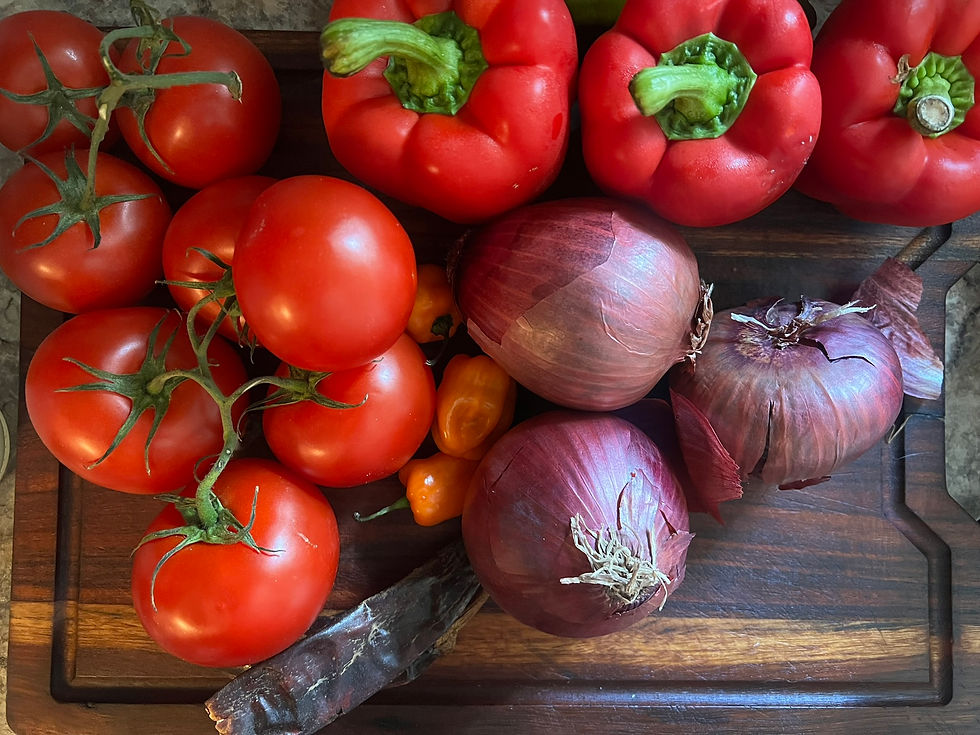
Tomatoes.
Onions.
Peppers.
Heat.
Char.
Time.
The mix changes from dish to dish, but the language remains.
Increasingly, I freeze portions of pepper mix rather than making it from scratch every time.
Because I am beginning to understand it as a living foundation.
Jollof.
Okro soup.
Future stews.
Future experiments.
The pepper mix is becoming a house language.
I now make and freeze it monthly, and we go through all of it.
And then there is the suya pizza with plantain, onion, and spicy, smoky pepper mix.
Sweeeetest baby Jesus.
(Though I do not know him.)
And I am still learning how depth emerges from ingredients that initially appear ordinary.
Deep Water is the part of food that carries memory beneath the recipe.
The thing that makes me ask:
What is this flavor doing?
Where did this smell come from?
Why does my body recognize something I was never directly taught?
Sometimes memory arrives as funk.
Sometimes memory arrives as smoke.
Sometimes memory arrives as fermented grain.
Sometimes memory arrives as the smell of locust beans blooming in oil and awakening a room my body had been waiting to enter.
≋ Turbulent Water — The Food That Disagrees

Turbulent Water is the pot that does not work.
Or rather, the pot that teaches through imbalance.
The tomato-heavy batch.
The bowl where I tasted it and thought:
This is not my soup.
Not because it was ruined.
Because the relationship was off.
Tomato is necessary.
But tomato can be rude.
Tomato can try to run the room.
Ketchup has trained too many of us to think tomato should be the flavor.
But in the foods I am learning now, tomato is often infrastructure.
It is not always meant to lead.
When tomato led too strongly, the okro lost authority.
The draw thinned.
The soup became too bright.
The fish got too loud.
The iru disappeared.
That imbalance taught me what I actually wanted.
More okro.
More draw.
More integration.
More body.
More relationship.
Turbulent Water is the food that shows me what matters by letting something go missing.
◍ Tidal Water — The Food That Returns

Tidal Water is the third pot.
The next batch.
The adjustment.
The seasonal ferment.
The mini rice-ball dumplings I now make for okro soup because I want the starch to carry the soup, not dominate it.
I am not avoiding starch.
I eat porridge almost every day.
Millet.
Sorghum.
Plantain.
Japanese sweet potato.
Purple yam.
My body is getting what it needs.

So later in the day, I do not need every meal to be starch-led.
I want variation.
Depth.
Soup.
Fish.
Greens.
Draw.
Smoke.
Fermentation.
The starch becomes transportation.
A small rice ball.
A dumpling.
A carrier.
A punctuation mark.
Not the whole paragraph.
This is Tidal Water.
The returning meal.
The repeated practice.
The thing that comes back different because I have learned something since the last time.
✺ Sacred Water — The Food That Connects

Sacred Water is plantain.
Plantain has been sacred for me from the beginning.
Not because it is rare.
Because it keeps opening doors.
Plantain taught me that the banana was not the whole story.
Plantain taught me that sweetness can have depth.
Plantain taught me that color on the plate matters.
Green.
Yellow.
Black.
Starch.
Sugar.
Memory.

Plantain belongs to Sacred Water because it keeps connecting me to African and diasporic foodways in ways that feel immediate and ancient.
It also reminds me that color on the plate is not decoration.
Color is information.
Fresh vegetables over eggs.
Fruit in the morning.

The brightness of food after the palate has been cleansed.
I did not understand how much my palate had been muted until fresh food began leading me somewhere else.
Vegetables and fruit started opening the day differently.
Even butter feels different now.
I don't need it all the time but there are times.
That is not small.
That is evidence.
The body is proof.
Sacred Water is akara.

What magical fluffiness is this that Black-eyed peas—cowpeas—hold?
And why did I not know?
There is also a sacred patience required in removing that chaff when it is your first time.
All the fancy secrets aside, it is still a relationship that must be practiced and learned.
Sacred Water is the food that makes me realize I am not just learning recipes.
I am returning to relationship.
✺ The Meal Refuses to Be Microwaved
One of the things African and diasporic cooking has been quietly teaching me is that these meals refuse to be microwaved.
I do not mean that literally.
But I do actually, because we do not have a microwave.
It was one of the first things we chose to remove from our home as we moved into deeper embodiment with ourselves.
But I also mean that these meals resist a way of living that believes every relationship can be compressed into efficiency.
The base of African cooking it the stockfish.
The broth.
The turkey in broth asks me to slow down.

I simmer it.
I let it cool.
Then I pull every piece from the bone with my hands.
The fish asks the same of me.
The flavor after an hour or boiling is alchemichal.
I sit with it.
I carefully remove every bone after it has mingled in the pot.
The pepper mix asks me to watch until the rawness disappears.
The okro asks me to slice every pod.
Sometimes I blend.
The dawadawa asks me to let it bloom before it speaks.
None of these moments feel unnecessary.
They are the meal.
They are the relationship.
I realized the other night that there was something unexpectedly healing about knowing I had touched every portion of the food before it reached my bowl.
Not because touching the food magically changes it.
Because touching the food changes me.
I know where every piece of turkey came from.
I know which fish carried more bones.
I know when the pepper mixture stopped smelling raw.
I know when the dawadawa opened.
I know when the okro gathered the pot back into itself.
Those are not simply cooking techniques.
They are moments of attention.
And attention is one of the oldest forms of care.
It also made me rethink the phrase soul food.
For much of my life, soul food referred to a particular menu.
Now I wonder if soul food has always been describing something much older.
Not simply food that feeds the soul.
Food that first passes through the soul of the person preparing it.
Through waiting.
Through smelling.
Through touching.
Through tasting.
Through adjusting.
Through remaining present long enough for the meal to become itself.
Perhaps that is why these foods have begun restoring something in me.
Not because they are magical.
Because they keep asking me to enter into relationship before they ask me to eat.
✺ Indigo Water

And then there is Indigo Water.
Humid Dawn Tea.
Gotu kola.
Green oat tops.
Damiana.
Mullein.
Butterfly Pea.
Lemon balm extract.
Strawberry Cough.
Soursop syrup.
Which the Asian market stopped carrying.
And I am sad.
But we shift.
Almond milk.
A tea that helps clear the night static.
A tea that moves me from indigo toward cloudy dawn.
A drink that reminds me liquid can be atmosphere.
Not productivity.
Not optimization.
Atmosphere.
Indigo Water is part of this food system too.
Because I am not simply feeding hunger.
I am feeding regulation.
I am feeding breath.
I am feeding transition.
I am feeding the movement from one body state into another.
◉ The Body Is Reprogramming

What I am experiencing now is not simply a palate shift.
It is a body shift.
A gut shift.
A nervous system shift.
A spiritual shift.
A sensory shift.
A full reprogramming.
Not through restriction.
Through relationship.
My body is consuming more spice.
More fermentation.
More smoke.
More funk.
More vegetables.
More fruit.
More color.
More draw.
More broth.
More foods that carry depth instead of muting it.
Foods I spent years eating no longer call to me in the same way.
Foods I was never encouraged to know now feel like they are meeting me at the door.
African and diasporic foodways are becoming an automatic home in my body.
And they should.
I am a descendant of that lineage.
Black American foodways bridge directly to African foodways, to Caribbean foodways, to wherever we are in the diaspora.
Not as a straight line back.
As a multipoint bridge alive with crossings, adaptations, memory, and return.
Some dishes require more curiosity than others.
Some are not yet mine.
Some may arrive later.
But the system is changing.
I used to think I was learning recipes.
Increasingly, I think I am learning relationships.
Relationships between ingredients.
Relationships between seasons.
Relationships between diaspora communities.
Relationships between memory and taste.
Relationships between what my body was taught to crave and what it is learning to desire now.
My body is no longer asking only to be full.
It is asking to be in relationship.
◉ At the Table

Right now, the table is fermented millet and sorghum porridge in the morning.
Okro, fish, greens, smoke, and a few mini rice-ball dumplings later in the day.
There is pepper soup with goat in the evening and akara.
Humid Dawn Tea carrying me from one body state into another.
Nothing has to dominate the plate in order for the meal to be complete.
Each thing carries what it is meant to carry.
The meal is not a pyramid.
It is an ecosystem.
◉ The Tongue Ritual — Tongue Check
Taste the air.

Taste the plate.
Taste what remains.
What is sweet.
What is bitter.
What is missing.
The tongue always knows.
✺≋ The Six Waters of Food
Cosmos Watershed
The Six Waters of Food develops I Eat Tings as an embodied methodology for understanding African and diasporic foodways through movement, memory, regulation, repetition, and relationship. Beginning with the third pot of okro soup—and continuing through the fifth or sixth—the essay follows a body learning that food does not remain inside fixed categories. Fermented millet and sorghum porridge holds. Okro teaches. Iru remembers. Tomato disagrees. The next pot returns. Plantain and akara connect. Humid Dawn Tea changes the atmosphere. Through Mycelial Sankofa, Black American foodways bridge toward African, Caribbean, and wider diasporic foodways without pretending that return moves in a single straight line. The kitchen becomes a multipoint bridge where ingredients carry memory, organize one another, and teach the body how to enter relationship. The recipe is not fixed. The relationship is alive.
Watershed | Tributaries |
Watershed | Still Water · Flowing Water · Deep Water · Turbulent Water · Tidal Water · Sacred Water |
Relationship | Food as a living relational system through which ingredients, body, memory, season, preparation, and diasporic foodways continually alter one another |
Hom(e)ie | Okro · Millet · Sorghum · Plantain · Akara · Iru · Smoked Fish · Smoked Turkey · Prawn Powder · Pepper Mix · Fermentation · Humid Dawn Tea · Tongue · Gut · Hands |
Origin | A Black American childhood shaped by muted flavor · an adult body seeking depth · the third through sixth pots of okro soup · daily fermented porridge · a home kitchen without a microwave |
Expansion | Mycelial Sankofa · relationship infrastructure · food as movement · ingredients as organizers · pepper mix as house language · body-level spice · soul food as preparation passing through the preparer |
Application | Diasporic cooking · sensory regulation · seasonal fermentation · eating with the hands · repeated tasting and adjustment · embodied food knowledge · building a personal house language |
Lineage | African and diasporic foodways · West African okro traditions · Jamaican porridge traditions · Black Southern smoke · Black American foodways · Caribbean foodways · embodied and assumed kitchen knowledge |
Counter Currents | Muted flavor · food binaries · diet culture · restriction · fixed recipes · tomato dominance · starch hierarchy · convenience as the highest good · efficiency mistaken for care · ancestral return imagined as a straight line |
Cosmos Coordinates
Coordinate | Entry |
Primary Portal | ✺ I Eat Tings |
Connected Waters | ≋ The Six Waters |
Tings Connections | ◉≋ Afro Theory / Afroscape · I Know Tings · I Move Tings · Black Herbalism · The Wata(ring) W(hole) |
Primary Methodology | Mycelial Sankofa |
Methodological Practice | Repetition · tasting · sensory observation · adjustment · embodied recognition · seasonal listening |
Cosmos Concepts | Relationship Infrastructure · The Multipoint Bridge · House Language · Food as Movement · The Body Is Proof · The Meal Refuses to Be Microwaved |
Geographic Coordinate | Black American foodways ↔ West African foodways ↔ Caribbean foodways ↔ the wider diaspora |
Relational Coordinate | tongue ↔ gut ↔ hand ↔ ingredient ↔ pot ↔ season ↔ memory ↔ lineage ↔ body |
Temporal Coordinate | childhood muting ↔ adult recognition ↔ repeated practice ↔ embodied return ↔ future experimentation |
Orientation | Embodied · sensory · relational · diasporic · multipoint · seasonal · ecological |
Core Refrain | Some ingredients do not simply add flavor. They organize flavor. |
Expansion Principle | The recipe is not fixed. The relationship is alive. |
Cosmos Constellations
Constellation | Connection |
✺ I Eat Tings | Primary constellation. Food becomes a portal into tongue, memory, diaspora, sensory knowing, regulation, and the politics of what the body was taught to desire. |
≋ The Six Waters | The essay makes the full Six Waters visible through food: porridge holds, okro teaches, iru remembers, imbalance disagrees, practice returns, and plantain and akara connect. |
◉≋ Afro Theory / Afroscape | African and diasporic foodways are approached as living systems rather than disconnected cuisines, trends, ingredients, or consumable cultural objects. |
Mycelial Sankofa | The body does not return through one uninterrupted recipe or lineage. Memory moves across ingredients, smoke, fermentation, hand knowledge, Black American foodways, African foodways, Caribbean foodways, and what the kitchen is still becoming. |
Relationship Infrastructure | Okro does not merely thicken the soup. Its mucilage carries, suspends, coats, slows, integrates, and helps the other ingredients settle into relationship. |
House Language | Pepper mix moves from one recipe into jollof, okro soup, suya pizza, future stews, and future experiments. Repetition transforms a prepared ingredient into the developing language of the home. |
The Meal Refuses to Be Microwaved | Simmering, cooling, deboning, slicing, blooming, smelling, touching, and tasting resist the belief that every relationship should be compressed into efficiency. Preparation is part of the meal. |
Indigo Water | Humid Dawn Tea functions as atmosphere and transition, feeding regulation, breath, and the movement from night static toward cloudy dawn. |
I Know Tings | The body recognizes flavors, smells, textures, and relationships it was never directly taught to name. Embodied recognition becomes part of knowledge-making. |
The Body Is Reprogramming | The palate shift is also a gut, nervous-system, sensory, spiritual, and relational shift. The body is not being disciplined through restriction; it is changing through deeper relationship. |
The Plate Is Never Alone | Every bowl holds ingredients, hands, preparation, lineage, environment, memory, season, and the relationships through which the meal became possible. |


Comments