


V is for Voltaic Vision — Imagine Your Afro Beyond Survival

IMAGINE YOUR HAIR BEYOND SURVIVAL.
THE RUPTURE MAY BE THE EXPERIMENT WORKING.

Afro Hair Tings
The Afro ABCs are a developing educational language for reading Afro hair as communal practice, signal, technology and transformation. Through Afro Hair Tings, each letter opens a portal into the lived, cultural and political questions surrounding our hair and bodies. Together, these fields contribute to The Afroscape Book, the larger art book and field guide being written in real time.

V is for Voltaic Vision
Voltaic Vision asks us to imagine Afro hair beyond survival. What would Afro hair culture look and feel like if it were no longer filtered through Western beauty systems or organized around their standards of cleanliness, control and acceptability? What futures become possible when we stop treating frizz, rupture and excess as failures—and recognize them as information, movement and creative force?
This is an invitation to dream beyond visibility. To remove our sacred strands from the hands of empire, return them to Indigenous embodied practice and build new ways of seeing, speaking about and caring for Black hair. The pressure has been building. The rupture may be the experiment working.
◉)) I Hear Tings — Aural World

For V, seeing becomes an insurgent practice. “All I See Is Melanin” does not ask Blackness to become more legible within somebody else’s visual system; it recenters melanin as the field through which the world is witnessed, imagined and rebuilt. The track enters Voltaic Vision as a refusal of disappearance: Black bodies seeing one another beyond surveillance, beauty standards and survival—and generating the images, futures and worlds we were told did not exist.
V is for Voltaic Vision — Imagine Your Afro Beyond Survival

Imagine your Afro Voltaic.

AfABC · V/22
What would Afro hair culture look like if it were not filtered through Western beauty systems?
Not adjusted to fit them.
Not translated for them.
Not made legible through their cameras, classrooms, salons, products or screens.
What futures become possible when Black people stop asking how our hair can survive the dominant culture and begin asking what our crowns might invent without it?
That question requires more than representation.
Representation can place a Black body inside the same machine without changing what the machine asks that body to become. A coil can appear in the advertisement while the product continues teaching us that softness must feel one particular way. An Afro can enter the film while the story still treats shrinkage, density and rupture as problems awaiting correction. A Black stylist can enter the room while the craft remains organized around speed, replication and palatable Afro(ness).
Visibility is not automatically vision.
Voltaic Vision begins after visibility.

It begins when we imagine Afro hair as a site of energy, communication and cultural production—not material waiting to be disciplined into beauty.
The Volcano Was Never a Failed Experiment

The old-school science volcano was built to rupture.
Construction paper formed the mountain. A cup disappeared inside it. Baking soda waited beneath the surface. Then somebody poured in the vinegar, and the structure performed exactly what it had been designed to do.
It erupted.
The mess was not separate from the experiment. The overflow was the evidence.
But Black bodies are taught to fear this kind of evidence.
We are instructed to conceal the pressure, smooth the rupture and wipe away every sign that the body has moved beyond its assigned container. Frizz becomes neglect.
Shrinkage becomes inconvenience. Unevenness becomes failure. A strand leaving the style becomes proof that the entire crown must be corrected.
Colonial cleanliness gives us a structure we can never completely climb into. The closer we appear to reach it, the more labor it demands.
Another pass of the comb.
Another layer of control.
Another edge pressed into silence.
Another sacred strand returned to the hands of empire.
But what if the Afro does not need to remain inside the model?
What if the rupture is the experiment working?
What if fraying tells us where the structure needs to breathe?
What if frizz records atmosphere, movement and contact?
What if the hair expanding beyond its intended silhouette is not abandoning the design—but revealing another one?
Imagine your hair beyond survival.
Imagine it volcanic.
Voltaic Vision

Voltaic does not only describe electricity. Here, it names the current generated when material relationships meet.
Water meets fiber.
Hands meet memory.
Pressure meets rupture.
The crown meets atmosphere. Imagination meets the material world.
Voltaic Vision is the ability to recognize that current and ask where it might carry us.
What would Afro hair craft become if its primary purpose were healing rather than correction?
What tools would we make if we designed from the density, sensitivity and growth direction of actual Black crowns?
How would we teach braiding if the scalp were understood as living terrain rather than graph paper?
What stories would television and film tell if Black hair were allowed to communicate grief, pleasure, weather, disability, gender, memory, ritual and transformation without becoming shorthand for respectability or decline?
What would circulate through the internet if Black bodies were not dependent upon stock libraries, beauty corporations and recommendation systems to decide how we can be seen?
Voltaic Vision does not ask the dominant culture to imagine us more accurately.
It asks what becomes possible when we take responsibility for imagining ourselves.
The Blilliputians Are Coming

The Blilliputians are small Black bodies carrying enormous worlds.
They are not miniature versions of a white literary world recolored Black. They do not emerge from the fairytale canon that failed to hold us. They belong to the Afroscape.
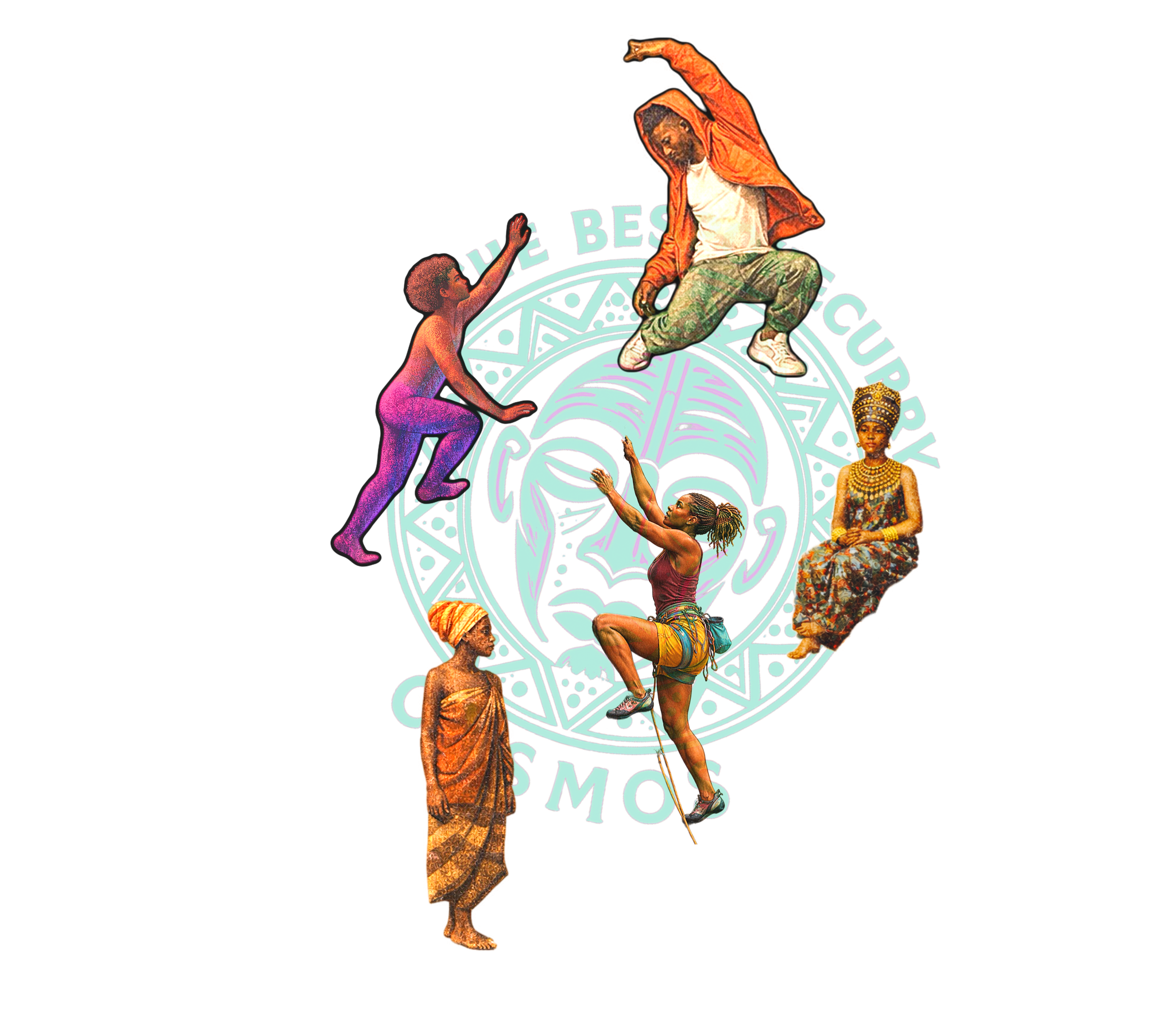
They are the bodies I needed when I was a child and the bodies I still need as an adult: Black, strange, tender, disabled, gender-expansive, adorned, imaginative and fully occupied with building their own material culture.
Their scale allows them to enter the hidden architecture of the crown. They move between coils. They study pressure chambers. They follow water routes, repair broken bridges, collect abandoned beads and listen to what the scalp has been trying to communicate.
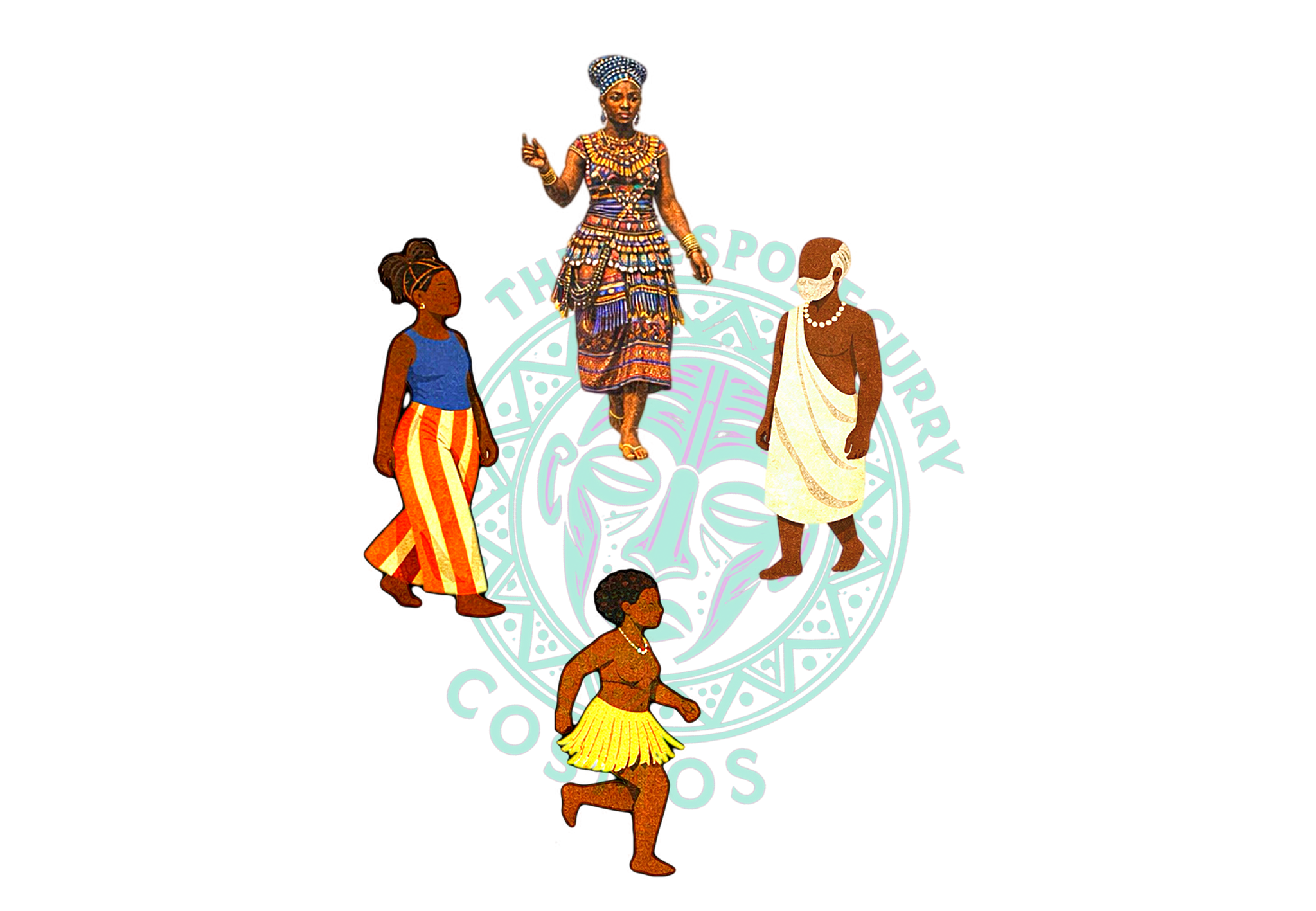
They do not arrive to tame the Afro.
They arrive because the Afro is already a world.
The Blilliputians also begin the construction of another kind of image library. Black graphic design cannot remain dependent upon stock systems that flatten Black life into a limited set of poses, professions, hairstyles and commercially recognizable emotions.
I am building my own library of Black bodies, Black cultural tings, Black tools, Black environments and Black ways of moving through scale.
That library belongs to the Afro ABCs. It belongs to the Afroscape. It belongs to the

book. It belongs to the larger world I was repeatedly told could include me only after I had made myself acceptable to everyone else.
Here, acceptance is not the entrance requirement.
Assimilation is not the architecture.
The Blilliputians are already home.
Remove the Sacred Strands From Empire

Returning Afro hair to Indigenous embodied practice does not mean pretending that we can step backward into an untouched past.
The rupture has already happened.
Techniques have been interrupted.
Products have been industrialized.
Images have been extracted.
Black hair knowledge has been separated from bodies and resold as trend, entertainment and intellectual property.
Mycelial Sankofa does not ask us to recreate a pure origin. It asks us to excavate the living connections that remain, carry what can nourish the present and build new relationships across the breaks.
That return may happen through hands.
Through water.
Through slower styling.
Through refusing to duplicate a photograph at the expense of the scalp beneath it.
Through creating film, illustration, animation and graphic systems in which Black crowns are not decorative evidence of diversity but active environments shaping the story.
Through making tools and practices accountable to the bodies they touch.
Through allowing rupture to become information.
Is it possible to remove every sacred strand from the hands of empire?
Perhaps not all at once.
But we can interrupt its grip.
We can stop treating Western recognition as the final destination of Black craft. We can refuse beauty systems that require endless evidence of cleanliness, submission and control. We can build archives the dominant culture does not own and images its algorithms did not authorize.
We can imagine our hair beyond survival.
Frayed.
Frizzy.
Expanding.
Overheated.
Unfinished.
Voltaic.
The pressure rises because something is moving.
Let the eruption carry you forward.
Afro ABC Letter Field
Field | Entry |
Letter | V |
Field Element | V/22 |
Letter Phrase | Voltaic Vision |
Series | The Afro ABCs |
Primary Portal | The Afroscape • Afro Tings |
Book Connection | The Afroscape: Hair as Tech(know)logy — A Field Guide |
Central Thesis | Afro hair culture cannot be liberated by perfecting its participation in Western beauty systems. Voltaic Vision asks us to imagine and build futures organized around Black embodiment, healing, rupture, experimentation and cultural sovereignty. |
Body Coordinate | Crown · Eyes · Hands · Imagination |
Primary Methodology | Mycelial Sankofa |
Core Refrain | Imagine your hair beyond survival. |
Secondary Refrain | Let the eruption carry you forward. |
Banner Marker | AfABC · V/22 |
The Afroscape Connection
Voltaic Vision expands The Afroscape from a study of Afro hair as living technology into a practice of Black speculative design. The crown is not only terrain shaped by inherited systems. It is also a site from which Black people can construct new tools, images, practices and worlds.
The Blilliputians make this shift visible. These tiny Black bodies move through the hidden architecture of the crown as builders, listeners, artists and archivists. They do not arrive to tame the Afro. They arrive because the Afro is already a world.
Cosmos Watershed
Voltaic Vision moves through every Water of the BespokeCurry Cosmos. Still Water creates enough regulation to imagine beyond immediate survival. Flowing Water carries the eruption forward. Deep Water holds the childhood worlds, interrupted knowledge and cultural memory being retrieved. Turbulent Water names the conflict between Black embodiment and colonial cleanliness. Tidal Water follows pressure, rupture and rebuilding as recurring rhythms. Sacred Water returns Black hair, image-making and embodied craft to relationship rather than empire.
Watershed | Tributaries - Movement Through V |
Still Water — Regulation | Creates the internal room required to imagine Afro hair beyond correction, emergency and survival. |
Flowing Water — Movement | Carries lava, strands, images and Black imaginative energy beyond the structures designed to contain them. |
Deep Water — Memory | Holds the childhood worlds, Black visual languages and embodied hair knowledge that assimilation interrupted but could not erase. |
Turbulent Water — Conflict | Names the collision between living Afro terrain and beauty systems organized around cleanliness, replication and control. |
Tidal Water — Rhythm | Follows the recurring cycle of pressure, rupture, release, return and rebuilding. |
Sacred Water — Devotion | Returns Black hair craft, cultural images and sacred strands to Black stewardship and embodied relationship. |
Cosmos Coordinates
Coordinate | Position |
Cosmos | The BespokeCurry Cosmos |
Planet | The Wata(ring) W(hole) |
Primary Ting | Afro Tings |
Primary Portal | The Afroscape |
Series | The Afro ABCs |
Field Element | V/22 |
Body | Crown · Eyes · Hands · Imagination |
Medium | Intuition · Movement · Integration |
Methodology | Mycelial Sankofa |
Primary Current | Black speculative design |
Pressure Field | Colonial cleanliness and Western beauty systems |
Release Field | Rupture, frizz, experimentation and visual sovereignty |
Book Expedition | The Afroscape: Hair as Tech(know)logy — A Field Guide |
Publishing Season | Fall 2026 |
Cosmos Constellations
Constellation | Relationship to Voltaic Vision |
The Four-C Fallacy | Names the beauty language that reduces living Afro terrain to fixed categories and prescribed outcomes. |
The Scalp Is Not Graph Paper | Establishes that Black hair craft must negotiate with living terrain rather than impose replication upon it. |
Mycelial Sankofa | Provides the methodology for retrieving interrupted relationships without pretending the rupture never occurred. |
Black Palm Trees | Extends the crown into ecology, growth cycles and forms that refuse a single calendar or controlled silhouette. |
Wild Wavy Wata | Connects the crown’s atmosphere to water, infrastructure, material memory and the body’s capacity to receive. |
The Blilliputians | Introduces the Black builders, listeners and archivists who make the Afroscape’s hidden architecture visible. |
V is for Voltaic Vision — Imagine Your Afro Beyond Survival


Comments