


Mycelial Sankofa — Bespokecurry’s Foundational Pedagogy

Mycelium carries. The body receives. Material answers back. The archive returns. Go back and get it. Then let it live.

Mycelial Sankofa is BespokeCurry’s foundational pedagogy: a nonlinear practice of returning to what the body, archive, ancestor and ecology already know, then carrying that knowledge into new relationship. It does not retrieve the past to preserve it unchanged. It goes back, gets what remains alive and lets it transform the network.
Mycelial Sankofa — Bespokecurry’s Foundational Pedagogy

Water, Embodiment, Material Practice + the Living Architecture of Return
I thought I was naming a way of returning.
I was.
I just did not yet understand how much of my work had already been built that way.
When I first began articulating Mycelial Sankofa, I was thinking about Sankofa differently.
Not abandoning the return.
Expanding its architecture.
What happens if going back to get what has been left behind does not require one straight route backward?
What if I can return through my body?
Through food.
Through fungi.
Through Cannabis.
Through my Afro.
Through water.
Through an object I made fifteen years ago.
Through a song.
Through a photograph.
Through an essay I wrote months ago that I can now read differently because I have changed.
What if return is not a road?
What if it is mycelial?
Threads.
Some visible.
Most not.
Something encountered here becoming useful somewhere seemingly unrelated.
Something forgotten becoming accessible because another relationship finally created the conditions for me to recognize it.
The longer I have lived inside the Bespokecurry Cosmos, the clearer it has become:
Mycelial Sankofa is not simply one concept within the Cosmos.
It is one of the ways the Cosmos learns.
And increasingly, I understand that the threads do not move through dry ground.
There has always been water here.
◉ The Pedagogy Was Growing Before I Named It

I can see this now because I can go back.
Which feels appropriate.
There are notebooks where I was drawing relationships between Mind, Body, Water, Breath, Meditation, movement, Black study, trauma, relationship and healing before I had language for what those drawings were doing.
There are other diagrams where Season, Region, Ritual, Water, Mood + Life and Astrology overlap instead of arranging themselves into a hierarchy.

There are notes telling myself:
Intuition + Care.
There are pressed plants beside:
Teaching in a new way not western forms of study.
And:
my Performance is my Praxis.
Body notes.
Discernment notes.
Water keeps appearing.

Not as decoration.
Not as metaphor I added afterward because water sounds pretty.
Water was already moving through the work.
None of those pages is the origin of Mycelial Sankofa.
I don’t need to go backward and pretend I had already developed language I hadn’t developed yet.
They are more useful than that.
They show the pedagogy developing before I knew its name.
My work kept refusing separation.
My body kept refusing separation.
My art kept talking to other art.
My materials kept remembering other materials.
And eventually I stopped trying to make any of it behave like a filing cabinet.

Movement.
Intuition.
Regulation.
Integration.
That diagram sits close to the foundation of the Cosmos because those are not four achievements.
They move.

Sometimes movement produces information.
Sometimes intuition recognizes information before language can.
Sometimes regulation creates enough room for information to become legible.
Sometimes integration is the long process of discovering what the information actually means.
And then I move again.
I cannot Mycelial Sankofa entirely from my head.
I cannot simply learn a fact about Blackness, ancestry, ecology, neurodivergence, Cannabis, fungi, food or my own history and call the retrieval complete.
My body has to encounter what I retrieved.
Sometimes my body says yes.
Sometimes no.
Sometimes my body says,
Not like that.
Sometimes it says,
You weren’t wrong. Y
ou just couldn’t see all of it yet.
cue Moonchild's Sick
"It isn't hard 'cause you're doing it wrong
It hard because it's fucking hard"
Sometimes two tings touch and produce a third neither one contained alone.
That is pedagogy to me.
Knowledge is not a package being transferred from the person who knows to the person who doesn’t.
Knowledge moves.
It gets touched.
Sweated in.
Cooked.
Worn.
Misunderstood.
Returned to.
Corrected.
Composted.
Made again.
And movement requires a medium.
≋ The Mycelium Under the Wata(ring) W(hole)

A watering hole has never been only water.
Something comes to drink.
Something lives underneath.
Something shit nearby.
Something died there.
Something bloomed because of it.
Roots stretch toward the moisture.
Fungi thread through wet soil.

Mycelium moves beneath feet that may never know it is there, breaking down what has fallen, carrying and exchanging what the living ground can still use.
An animal enters.
Another leaves.
Rain changes the edge.
Heat pulls the waterline inward.
Mud records who passed through.
Seeds travel on bodies.
Spores travel too.
Then something arrives carrying a little bit of somewhere else.
That is a Wata(ring) W(hole).
Not a bowl.
A gathering ecology.
But water is not merely the location where the gathering happens.
Water is carrying information through it.
(float The Hidden Messages in Water by Masaru Emoto)
That has become one of the deepest threads in my work.
Water remembers conditions.
Temperature.
Minerals.
Salt.
Soil.
Pollution.
Bodies.
Pressure.
Weather.
The atmosphere itself tells me when water is gathering.

The information is no longer only down there in a river, lake, ocean or glass.
It is suspended around me.
I breathe inside it.
My skin meets it.
My hair receives it.
Plants respond to it.
The atmosphere has changed before rain ever reaches the ground.
That matters to how I think.
Because information does not have to arrive as an announcement.
Sometimes the atmosphere is already carrying it.
The body notices before language does.
≋ Water Has Different Ways of Speaking
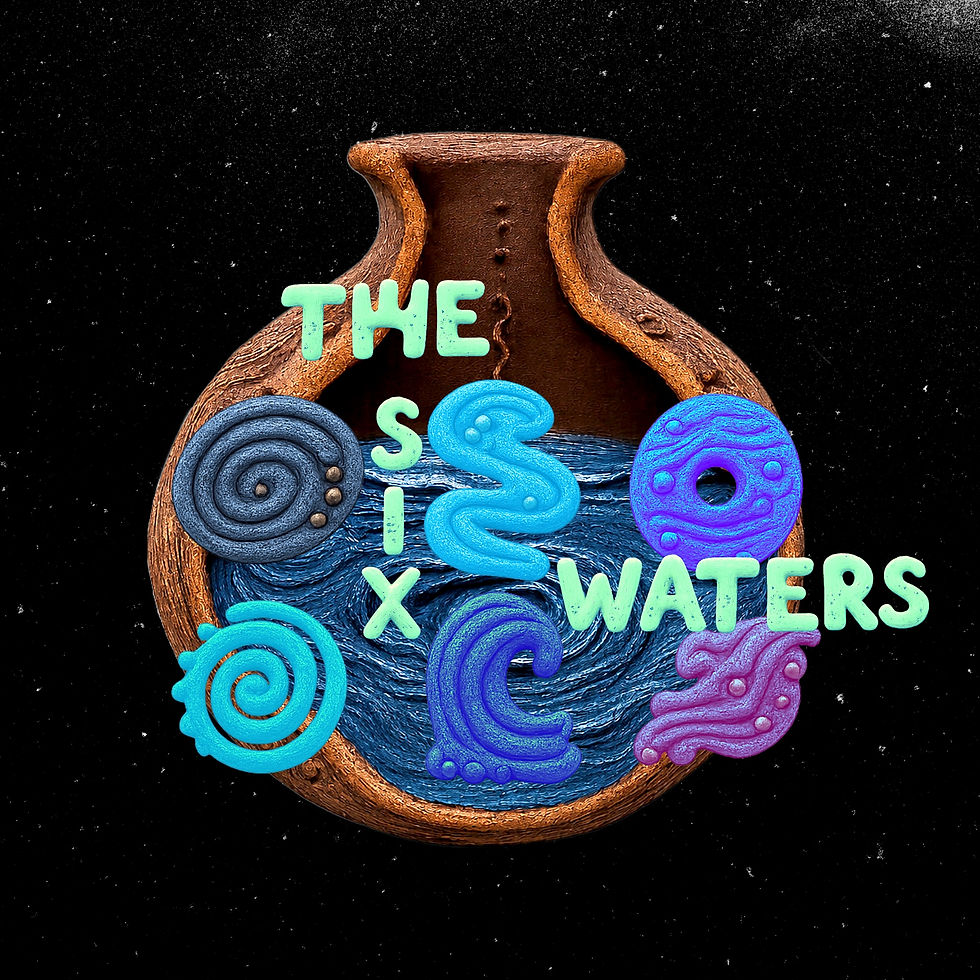
This is why the Six Waters cannot be six aesthetic categories.
Still Water.
Flowing Water.
Deep Water.
Turbulent Water.
Tidal Water.
Sacred Water.
They are different conditions of communication.

Still water holds differently.
It gives suspended material somewhere to settle. It lets me see what constant agitation kept disturbing.

Flowing water carries.
It moves material from one location into another. It connects places that can appear completely separate if I only look at the banks.

Deep water changes pressure.
What can survive near the surface may not survive below it. What becomes visible depends on how far I am capable of descending.

Turbulent water churns.
It brings buried material upward. It rearranges sediment. It makes clarity difficult while simultaneously exposing tings that stillness allowed to remain underneath.

Tidal water returns.
Not to the exact same place.
Not at the exact same height.
The shore remembers the previous contact, but every return encounters changed conditions.

Sacred Water asks what becomes possible when water is no longer treated only as resource, obstacle, commodity or scenery.
Water holds.
Water carries.
Water disturbs.
Water returns.
Water reveals.
And sometimes water obscures until I am capable of receiving what is there.
That is not separate from Mycelial Sankofa.
It is one of the ways I understand how the network communicates.
≋ Mami Wata, Simbi + What Lives Between

There is another reason water keeps returning.
Black water has never been empty.
Mami Wata.
Simbi.
Oshun.
Water beings.
Water memory.
Crossings.
Thresholds.
The knowledge that what appears to be a surface is not necessarily the limit of what is there.
What connects them for me is not that every Black water spirit is secretly the same being.
It is the insistence that water is inhabited.
Water has relationship.
Water has consequence.
Water can carry us somewhere the dry world cannot.
Shore.
Marsh.
River mouth.
Estuary.
Palm Crown.
The place where fresh water meets salt.

The surface between air and what lives underneath.
The moment before immersion.
The moment before emergence.
Neither entirely here nor there.
And more can become visible in that between.
Not because liminality is automatically sacred or comfortable.
Sometimes it is muddy as hell.
Sometimes I cannot see my feet.
Sometimes the whole point is that the categories I arrived with cannot survive the water.
Mycelial Sankofa needs that liminal capacity.
The thread can travel underground.
Water can carry it elsewhere.
And what emerges may not resemble what entered.
≋ Baptism Without the Exit Sign

I grew up with baptism as an event.
You enter.
Something is performed.
You emerge changed.
Clean.
Saved.
Identifiable.

There is a before and an after and somebody standing nearby who can tell you what the water meant.
But what happens if nobody rushes me out?
What happens if I am allowed to float?
What if the water is not there to certify that I have become something?
What if I stay long enough to feel temperature change across my skin?
To notice where my body fights buoyancy.
To stop fighting it.
To sink a little.
Kick.
Turn over.
Hear differently with my ears beneath the surface.
Find out that floating is also movement.
Find out that I don’t have to be going anywhere for water to be carrying me.
And while I float, I am exchanging information with the water.
My heat enters it.
Its temperature enters me.
My body displaces it.
It presses back.
My hair drinks.
My breathing changes.
My orientation changes.
The world sounds different.
That is relationship.
What if baptism is not purification but relationship with water long enough for water to teach me something about my body?

Then I can get out.
Come back tomorrow.
Find that the water has changed.
Find that I have too.
No single dunk is required to carry the whole meaning.
That is closer to the Wata(ring) W(hole) I have been building.
Not salvation through water.
Relationship through return.
And the ability to float long enough for something else to become perceptible.
◉ These Are Not Simple Tings

I Hear Tings.
I See Tings.
I Speak Tings.
I Eat Tings.
I Touch Tings.
I Move Tings.
I Know Tings.
I made the Tings and eventually understood:
these are portals.
And in the words of Minnie Riperton,
"This song is old, this song is new
This song is me, this song is you"
Hearing is not just hearing.
Eating is not just eating.
Touching is not just touching.
Moving is not just moving.
I can hear a song and enter an archive.
Taste something and enter geography.
Touch a material and remember a construction technique I have not used in years.
Move my body and find information that was inaccessible while sitting still.
See an image of myself from 2008 and suddenly understand something about 2026.
Know—and then discover that what I know needs to be disturbed.
And just like water, the portal changes depending on its condition.
I Hear Tings underwater differently.
I Touch Tings differently when they are wet.
I Eat Tings differently when water has transformed them.
I See Tings differently through steam, fog, reflection, refraction.
I Move Tings differently when I am floating.
The Tings became a way of honoring the fact that knowledge keeps entering through more than the front door.
And my art has always known this.
◉ The Body Is One of My Materials

I model.
That belongs here.
Because modeling, for me, has never only been about making an attractive photograph.
I use my body to make images. To tell a story.
Position.
Weight.
Gesture.
Hair.
Skin.
Fabric.
Face.
Stillness.
Tension.
What I reveal.
What I obstruct.
Where I look.
Where I refuse to look.
How much of the frame I occupy.

How an object changes when my body touches it.
How my body changes when the environment touches me.
Water changes that body too.
Sweat changes skin.
Humidity changes hair.
Rain changes fabric.
Submersion changes weight.
Reflection doubles the body and then distorts it.
The body can disappear beneath a surface while remaining completely present.
That is visual language.
That is material.
That is story.
A photograph can carry threads backward and forward at the same time.

An older image can become archive.
Archive can become evidence.
Evidence can enter an essay.
The essay can change how I understand the image.
Then I can return to my body and make another image differently.
My body is not merely the subject traveling through those encounters.
It is one of the places where the network stores information.
That is part of the depth of my craft.
I have been learning how to tell stories with this body for decades.
Onstage.
Backstage.
In rehearsal.
In photographs.
In clothes.
In movement.
In stillness.
In an Afro.
In a shaved head.
In a body somebody else interpreted incorrectly.
In a body I have learned to read for myself.
Mycelially, none of those bodies disappears because the next one arrives.
They remain available to one another.
◉ bead + cowrie studio: I Make Tings

This is why bead + cowrie studio cannot be reduced to jewelry.
I make tings.
I have been making tings.
Theatre taught my hands.
Stage management taught them too.
Acting taught the body what happens when material, space, timing and story meet.
Props.
Sets.
Clothes.
Adornment.
Beads.
Cowries.
Paper.

Paint.
Hair.
Food.
Plants.
Cannabis.
Images.
Words.
A room.
A schedule.
A table.
A system that has to hold while people move through it.
That is material practice.
Stage management taught me that an invisible structure is still material when twenty bodies depend on it.
Theatre taught me that cardboard can become architecture if I understand what the audience needs to believe and what the performer needs it to survive.
Modeling taught me that my body can be material without becoming object.
Cooking taught me that material transforms through heat, water, pressure, time and relationship.

Fungi taught me to notice networks.
Cosmetology taught my hands how to read Afro hair while Black life taught me how much of what the industry said about that hair needed to be discarded.
And water runs through almost all of it.
Steam.
Glue.
Paint.
Dye.
Tea.
Broth.
Wash day.
Humidity.
Sweat.
Plant tissue.
Clay that needs moisture.
Hair that tells me immediately when the atmosphere has changed.
Water is not merely another material on the table.
It is often the material allowing other materials to change.

Antenna.
Fiber.
Moisture architecture.
Memory.
Ecological material.
Something that stretches, shrinks, absorbs, releases, tangles, protects, conducts, records atmosphere and changes through relationship.
My artisanship does not live inside one medium.
It moves through them.
Thick.
Sticky.
Weedy.
Sweet like honey.
Sometimes precise.
Sometimes grimy.
Sometimes built to last.
Sometimes built specifically to break down.
The thread is not what object did I make?
The thread is:
What did making teach me that I can carry somewhere else?
◉ Return Is Not a Baptism Into Innocence

Going back does not wash anything clean.
That matters.
Especially after thinking about baptism.
I don’t enter the water of Sankofa dirty and emerge purified because I found something old.
Old harm is still harm.
Old hierarchy is still hierarchy.
Something being ancestral does not remove the conditions under which it was made.
Something surviving does not mean it should remain unchanged.
An elder is not infallible because they survived long enough to become old.
And something does not become lineage simply because somebody has repeated it for generations.
Colonial systems reproduce themselves through repetition too.
So do family systems.
So does anti-Blackness.
So does gender.
So does the state.
Mycelial Sankofa asks more of return.
What did I retrieve?
What conditions made it?
Who did it feed?
Who did it starve?
Was it medicine?
Was it survival?
Was it adaptation mistaken for tradition?
Did somebody hand me state violence dressed in ancestral clothing?
What happens when what I retrieved touches the body I have now?
Water doesn’t have to absolve the archive.
Water can disturb it.
Turbulent Water can pull sediment from the bottom.
Tidal Water can return what somebody thought had disappeared.
Deep Water can change the pressure under which I encounter it.
Still Water can finally give the sediment somewhere to settle so I can see through it.
I need enough relationship with the water to see what is actually moving inside it.
Some tings I retrieve, I keep.
Some I alter.
Some I understand and refuse.
Some I have to let rot.
◉ A Living Network Has a Compost Pile

I don’t believe in an ecology without death.
So I cannot believe in a relational pedagogy that requires every relationship to survive.
Mycelial does not mean everybody stays connected forever.
That would not be ecology.
That would be hoarding.
Relationships should be going through ecological processes too.
Growth.
Exchange.
Season.
Stress.
Adaptation.
Dormancy.
Repair.
Death.
Decomposition.
Compost.
And potentially another life that does not resemble the relationship that existed before.
Water is involved here too.
A compost pile with no moisture does not behave like one with enough water for decomposition to move.
Too dry and processes slow.
Too wet and the conditions change again.
Relationship has conditions.
It requires exchange.
It requires enough permeability for something to move.
If a relationship cannot metabolize new information, cannot change when conditions change, cannot receive accountability, cannot tolerate correction, cannot allow the people inside it to become different people—
what exactly are we preserving?
Sometimes the relationship is dead and everybody is standing around insisting that because the structure is still visible, it must still be alive.
No.
Some tings become compost.
Compost is not nothing.
Compost is not failure.
It is material whose previous form can no longer hold but whose matter does not have to be wasted.
I can learn from a relationship I will never return to.
I can retrieve myself from a family I will never rejoin.
I can understand why somebody harmed me without reopening access to my body.
I can take what a former version of my own practice taught me without continuing to practice that way.
The relationship can end.
The learning can travel.
The water can carry what is still usable somewhere else.
That is mycelial.
And sometimes cutting a connection is what allows the rest of the network to breathe.
◉ Afro Antenna: The Atmosphere Is Information
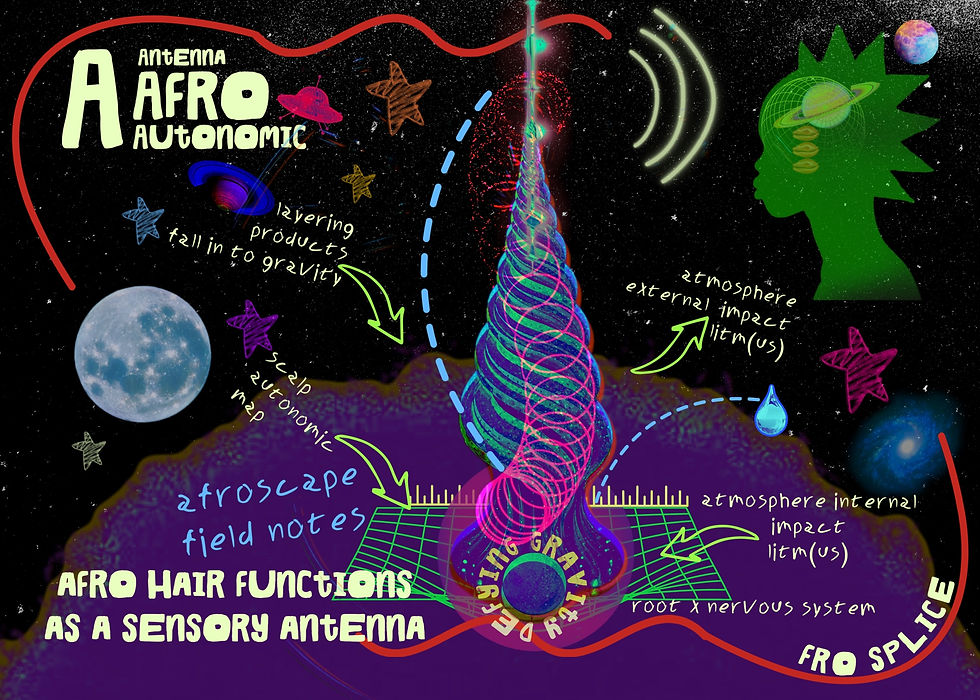
I am retiring crown from how I describe my hair.
Unless we are talking Palm Crown Ecology.
Because the more I understand my Afro ecologically, the less sense crown makes.
A crown is static.
Metal cast into a predetermined form.
Hard stones set into hard material.
An object placed on top of a body to signify authority.
My Afro is doing entirely too much to be reduced to that.
My Afro is an antenna.
It reaches.
Receives.
Shrinks.
Expands.
Drinks.
Dries.
Responds to humidity.
Responds to hands.
Responds to products.
Responds to seasons.
Responds to the chemistry of water.
Holds yesterday inside today’s shape.
Changes while I sleep.
Moves when I move.
And humidity makes the larger point impossible for me to miss.
The air is holding water.
I may not see rain.
I may not be standing beside a lake.
I can still read water in my hair.
My Afro receives information about the atmosphere and changes its behavior accordingly.
That is not failure.
That is not frizz.
That is communication.
After shaving my head and letting years accumulate, my Afro became a longitudinal ecological study whether I intended to make one or not.
A palm does not apologize because last year’s frond looks different from this year’s growth.
It responds to conditions.
So does my Afro.
My cosmetology education enters the network.
Weather enters.
My grandmother enters.
My mother enters.
The relaxer enters.
The shaved head enters.
Copper enters.
Water enters.
Black natural-hair culture enters.
My own hands enter.
And none of those nodes gets to declare itself the whole truth.
My Afro is not sitting on top of me waiting to symbolize royalty.
It is alive with me.
An antenna is useful because it is responsive.
Pull it permanently toward the ground, break it, coat it until it cannot receive, demand that it hold one static form forever—and then wonder why the signal changed.
That is not a crown problem.
That is ecology.
That is tech(know)logy.
That is Mycelial Sankofa.
◉ Mycelial Sankofa Can Cross Four Generations or Four Minutes

This may be the expansion that changed the framework most for me.
I originally understood return across large distances.
Ancestry.
History.
Diaspora.
What was interrupted.
What survived.
What can be retrieved.
I still understand it that way.
But return can be tiny.

Four generations.
Four years.
Four months.
Four days.
Four hours.
Four minutes.
Four Seconds.
I can return to what my body learned during yesterday’s workout.
I can return to a photograph.
A notebook.
A pot.
A rehearsal room.
An old bead.
An essay.
A mushroom experience I no longer need to reproduce in order to use what it taught me.
I can retrieve something from myself.
Water teaches me this too.
Return does not require sameness.
The tide comes back without bringing back the exact same water in the exact same arrangement.
Rain falls, moves into soil, enters roots, becomes plant, becomes vapor, gathers in air, falls somewhere else.
The form changes.
The relationship continues.
That matters because it means I do not have to continually manufacture revelation.
Sometimes the knowledge is already here.
Underground.
In the body.
Suspended in the atmosphere.
Waiting for enough moisture.
◉ The Cosmos Is the Classroom, the Studio, the Kitchen, the Wata(ring) W(hole)

This is why I can finally say that Mycelial Sankofa is a foundational Bespokecurry pedagogy.
Not the single foundation.
That would betray the entire point of a multi-point bridge.
A foundational thread.
The Cosmos is not a collection of unrelated interests connected because I happen to be interested in all of them.
Afro hair.
Food.
Cannabis.
Fungi.
Movement.
Adornment.
Sound.
Astrology.
Neurodivergence.
Performance.
Theatre.
Modeling.
Material.
Water.
Archive.
These are not subjects waiting for me to become disciplined enough to separate them.
They are living practices with their own integrity and underground relationships.
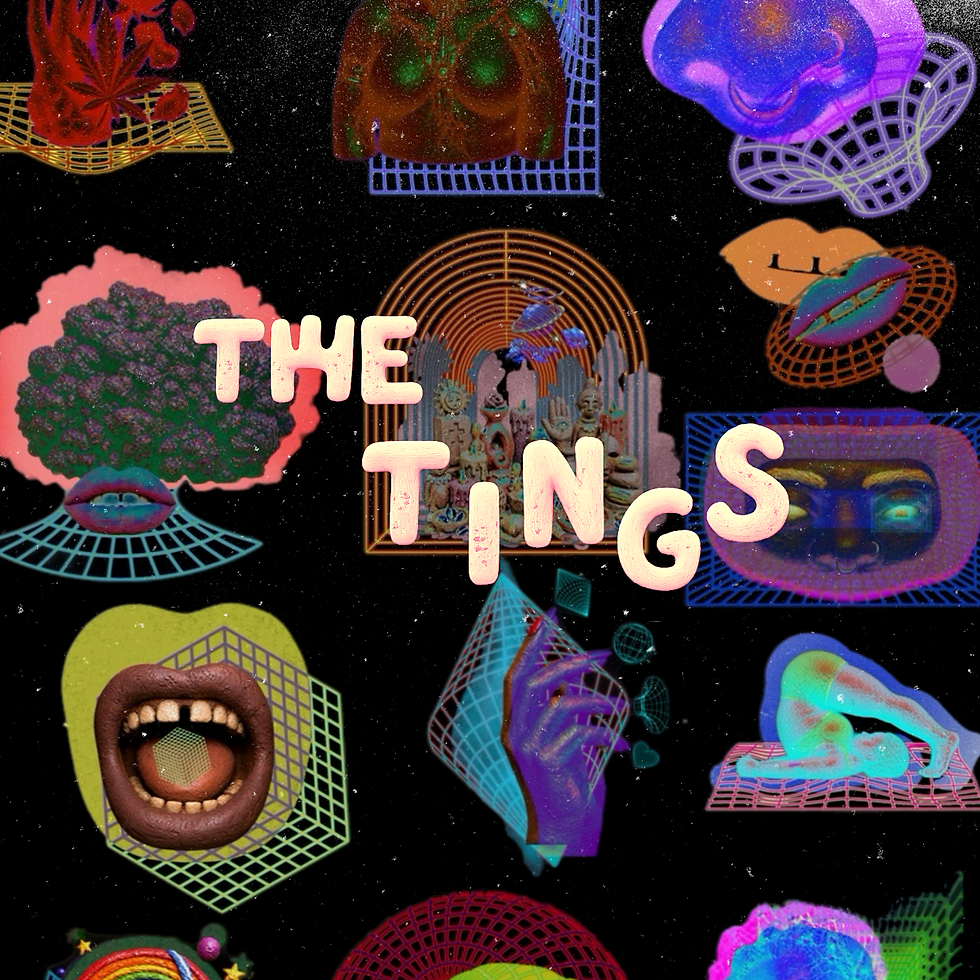
The Tings help me recognize the portals.
Embodiment gives me Movement, Intuition, Regulation and Integration.
The Wata(ring) W(hole) gives the network somewhere to gather, drink, exchange, float, sink and return.
The Six Waters teach me that information behaves differently under different conditions.
bead + cowrie studio gives my hands somewhere to think.
The Afroscape lets Afro hair remain alive enough to teach.
Cannabis and fungi let plant relationships remain relationships rather than becoming products or gurus.
The archive lets yesterday talk without giving yesterday absolute authority.
Mami Wata and Simbi keep water inhabited, relational and deeper than its surface.
Water is still tricky.
The Third gives liminal contact somewhere to produce what did not exist before.
And Mycelial Sankofa keeps asking:
Where else does this connect?
Not so I can make everything the same.
So I can become precise about difference without pretending difference means separation.
The mycelium carries.
The water communicates.
The body receives.
The Tings open.
The material answers back.
The archive returns.
And none of them gets to become the whole system alone.
◉ Go Back and Get It. Then Let It Live.
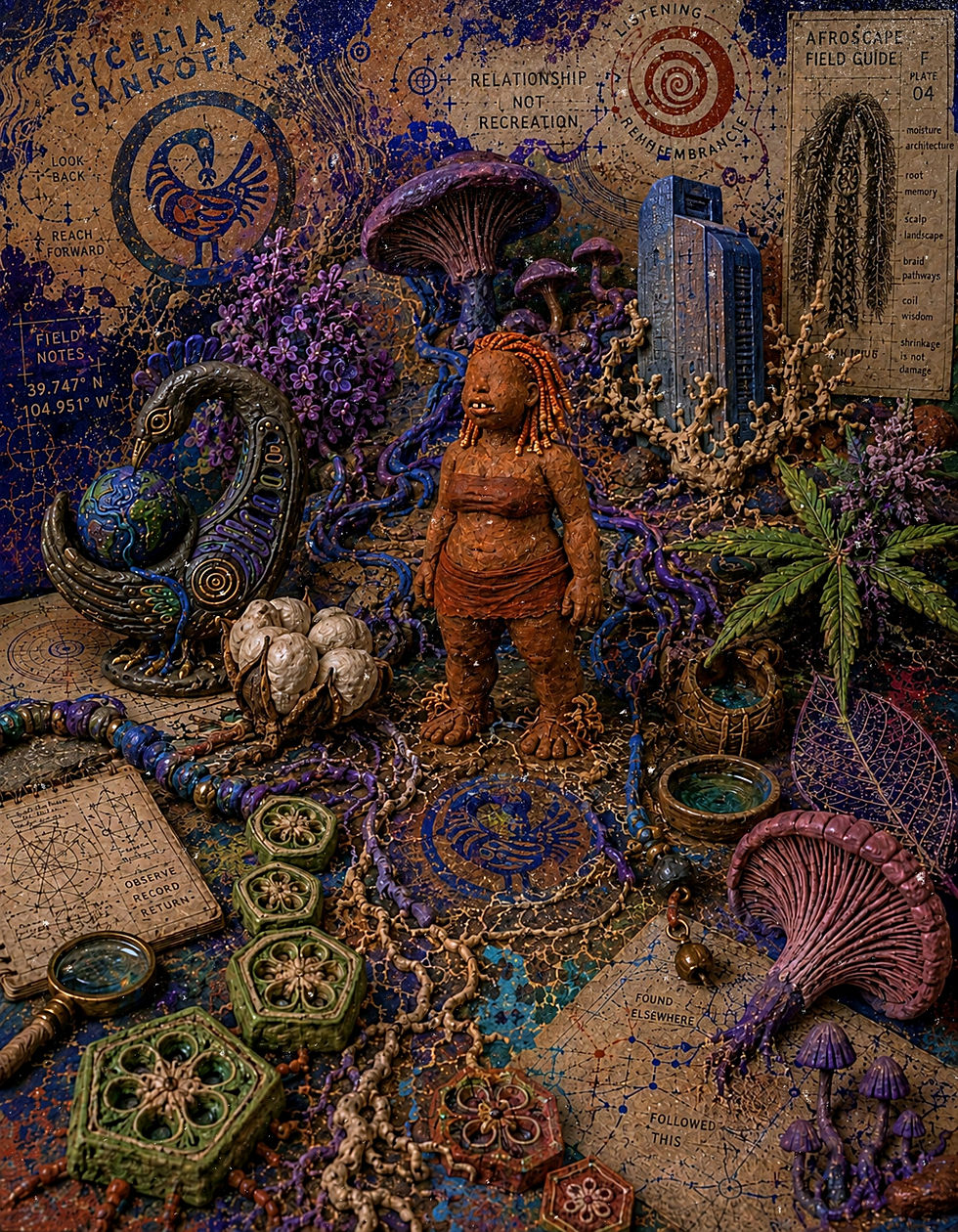
I am building this body of work while I am alive inside it.
I am supposed to change.
The work is supposed to change.
I will write an essay and return months later carrying a node that did not exist when I wrote it.
I will draw a diagram and realize years later that my hand understood an architecture before my language did.
I will model an image and discover later what my body was saying.
I will build something and let the material correct me.
I will make another pot.
Grow another inch of hair.
Smoke another cultivar.
Not smoke at all.
Move.
Rest.
Float.
Sink.
Come back.
That does not make the earlier work disposable.
It makes relationship possible.
The work does not need me to preserve it in amber to prove that I meant it.
I can go back.
Get it.
Bring it to the Wata(ring) W(hole).

Let it drink.
Let it float.
Let it sink far enough for pressure to change it.
Let Turbulent Water disturb what settled too comfortably.
Let Still Water show me what remains when the sediment falls.
Let Tidal Water return something I thought was gone.
Let humidity carry information beyond the visible edge of the water.
Let mycelial threads move underneath all of it, carrying pieces toward roots I cannot see from where I am standing.
Let it meet something it has never met before.
Let the body decide what still has signal.
Let some of it compost.
Let some of it root.
Let some of it remain submerged.
Let some of it float beside me awhile without demanding that I immediately know what it means.
There is no dry observation point outside of this.
I am in the water too.
I am carrying information too.
I am changing the conditions too.
And when I climb out of the water, I do not need anybody standing there to declare me transformed.
I can come back.
The water will have more to say.
So will I.
That is Mycelial Sankofa.
Not returning so I can become what I was.
Returning because what I retrieve deserves the opportunity to enter a living relationship with what I am becoming.
Mycelial Sankofa — Bespokecurry’s Foundational Pedagogy
COSMOS WATERSHED
Mycelial Sankofa began as an expansion of return and revealed itself as something larger: a foundational pedagogy already moving through the BespokeCurry Cosmos before it had a name.
Knowledge does not move here through one authorized route. It travels through mycelial threads and water; through Movement, Intuition, Regulation and Integration; through the Tings; through theatre, modeling, stage management and material practice; through Cannabis, fungi, food, Afro hair tech(know)logy, archive, sound and the body.
Water carries information. Mycelium carries information. The body receives and alters information. Material answers back. The archive returns without becoming absolute authority. Relationships grow, change, die and compost. What is retrieved through Sankofa does not have to remain what it was.
Mycelial Sankofa asks what happens when we go back and get it—and then allow what we retrieve to enter a living relationship with what we are becoming.
watershed
Watershed | Tributaries |
Watershed | Mycelial Sankofa as a foundational pedagogy of the BespokeCurry Cosmos |
Relationship | Return ↔ Water ↔ Mycelium ↔ Embodiment ↔ Material ↔ Archive ↔ Relationship |
Hom(e)ie | The living network |
Origin | An expansion of Sankofa beyond a singular route backward into multipoint, embodied, ecological return |
Expansion | From a named methodology within individual essays into recognition of an existing pedagogical architecture across the Cosmos |
Application | Returning, retrieving, observing, testing through embodiment, allowing correction, cultivating relationship, composting what cannot remain, and carrying viable knowledge into changed conditions |
Lineage | Sankofa • Black ecological knowledge • Black water cosmologies • embodied knowledge • performance praxis • material practice • ecological observation |
Counter Currents | Linear knowledge • mastery • disciplinary separation • static tradition • compulsory preservation • elder infallibility • extraction • purity • state knowledge disguised as lineage • disembodied learning |
COSMOS COORDINATES
Coordinate | Entry |
Primary Portal | ≋✺ The Wata(ring) W(hole) |
Connected Waters | Still Water • Flowing Water • Deep Water • Turbulent Water • Tidal Water • Sacred Water |
Tings Connections | I Hear Tings • I See Tings • I Speak Tings • I Eat Tings • I Touch Tings • I Move Tings • I Know Tings • Afro Tings |
Primary Methodology | Mycelial Sankofa |
Methodological Practice | Multipoint return • longitudinal embodied observation • material experimentation • relational study • retrieval • correction • composting • integration |
Cosmos Concepts | The Wata(ring) W(hole) • The Six Waters • The Third • Ecological Attunement • Afro hair as tech(know)logy • portals • water communication • material knowledge • living archive |
Geographic Coordinate | Waterways, bodies, Black diasporic movement, ecological place and the spaces through which knowledge travels |
Relational Coordinate | Knowledge changes through contact; connection alone is insufficient without exchange, permeability, accountability and changing relationship |
Temporal Coordinate | Four generations ↔ four years ↔ four months ↔ four days ↔ four hours ↔ four minutes |
Orientation | Return ↔ Encounter ↔ Relationship ↔ Change |
Core Refrain | Go back and get it. Then let it live. |
Expansion Principle | Difference does not mean separation. What is retrieved can remain distinct while entering relationships capable of producing knowledge neither node held alone. |
COSMOS CONSTELLATIONS
Constellation | Connection |
The Wata(ring) W(hole) | The gathering ecology through which bodies, materials, memory, mycelium and water meet. Water is not scenery: it receives, carries, disturbs, returns and changes information. |
The Six Waters | Still, Flowing, Deep, Turbulent, Tidal and Sacred Water describe different conditions through which information becomes held, transported, obscured, revealed, disturbed or returned. |
Embodiment | Movement, Intuition, Regulation and Integration provide the bodily movements through which retrieved knowledge is encountered rather than merely intellectually accepted. |
The Tings | Sensory and methodological portals that were already present in the practice before their function as portals became legible: hearing, seeing, speaking, eating, touching, moving and knowing. |
The Third | Relationship can produce knowledge that neither node possessed independently. Liminality becomes productive contact rather than an empty midpoint. |
Ecological Attunement | The practice of observing what a relationship is actually doing under present conditions rather than assuming its name, age or history determines its function. |
Mami Wata + Simbi | Water remains inhabited, relational and communicative. Their presence opens questions of crossing, depth, revelation, consequence and what becomes perceptible in liminal water without collapsing distinct traditions into one mythology. |
Baptism / Floating | Refuses water as a brief performance of purification. Floating makes immersion relational: the body remains long enough to receive, respond and discover what cannot be heard from shore. |
bead + cowrie studio | Material thought across adornment, theatre, stage management, acting, modeling, props, sets, objects, Afro hair, food and expanding material practice. The hand is another site of knowledge. |
The Afroscape / Afro Tings | Afro hair operates as living ecological material and antenna rather than static crown: absorbing, releasing, shrinking, expanding and communicating atmospheric conditions. |
Black Palm Trees | Longitudinal Afro ecology demonstrates how weather, water, cosmetology, time, memory and plant observation can enter relationship without one becoming permanent authority. |
Cannabis Field Notes | Cannabis becomes relationship rather than product: chemistry, cultivar, body, access, ecology, culture, memory and changing conditions remain connected without requiring one permanent answer. |
Fungi Tings | Fungi make network visible while also demonstrating that revelation is not integration. What becomes perceptible must still encounter body, relationship, community and time. |
Food / Cooking | Repeated pots enact Mycelial Sankofa: each preparation can retrieve, correct and alter knowledge from the previous encounter rather than becoming subordinate to an original recipe. |
Performance + Modeling | The body functions as material, archive, storyteller and site of retrieval across performance, image-making, gesture, hair, clothing, environment and changing embodiment. |
Theatre + Stage Management | Craft includes visible and invisible infrastructure. Space, timing, bodies, systems, materials and communal movement become part of the artisan knowledge carried into the Cosmos. |
Compost | Relationships are ecological and therefore capable of growth, dormancy, repair, death and decomposition. A relationship can end while what it taught continues traveling through the network. |
Archive | Earlier work is neither discarded nor granted automatic authority. It can be returned to, reread, corrected, recontextualized and brought into relationships unavailable when it was first made. |


Comments