


W is for Wild Wavy Wata — Water Remembers Before You Do

Your body is catching what never stopped moving.
What you feel is not random. It is inherited motion.
The water remembers what carried across—and what was lost within it.
W is for Wild Wavy Wata — Water Remembers Before You Do
Monthly washing, water stewardship and the Afro as a world-building ecosphere

W begins at the crown, where water becomes moisture architecture and monthly washing gives Afro hair enough time to build an atmosphere. But Wild Wavy Wata moves beyond Afro Tings, following water through pipes, filters, nervous systems, inherited motion, clean-girl infrastructure and the conditions determining whose bodies are permitted to retain evidence of living. This is a field note on what becomes possible when care stops erasing the world the body is trying to build.

The I Hear Tings stamp opens the Afro ABCs sound thread, where every letter asks what its field of hair, body and relationship sounds like. The curated Afro Tings Playlist evolves as the letters float.
W sounds like water carrying more than one time at once: ancestral presence, bodily memory, grief, movement, play and the strange living worlds that gather beneath the surface.
Aural World One — Water Arrives Carrying

Izinkonjana — “Water Spirits”
Water enters as presence before it becomes resource. “Water Spirits” opens W inside a field already inhabited, reminding us that water does not arrive empty. It carries relationship, memory and lives beyond the human body.
Miriam Makeba — “Meet Me at the River”
The water becomes a meeting place. The river does not belong to one body or move toward one destination; it gathers people, histories and currents into relation.
Hugh Masekela — “Mam Wata”
Water takes body, spirit and agency. “Mam Wata” refuses the colonial reduction of water to infrastructure alone. The water being piped, filtered, commodified and used to wash the crown remains part of a much older living field.
Aural World Two — The Body Enters the Current
Ibeyi — “River”
The river reaches the body as ritual, release and return. The voice moves through repetition like water passing through the same terrain without ever becoming exactly the same water.
Frank Ocean — “Swim Good”
The body does not enter water carrying only ease. “Swim Good” holds grief, escape and the desire to move beyond what has accumulated. W does not romanticize the current. Water can carry what the body is trying to survive alongside what it is trying to remember.
Aural World Three — The Ecosphere Refuses the Straight Line
Lianne La Havas — “Weird Fishes”
The current turns strange, layered and submerged. “Weird Fishes” sounds like surrendering the demand for a clean route and entering an environment whose movement cannot be flattened into one direction.
DOMi & JD BECK — “TWO SHRIMPS”
The final world is quick, irregular and alive. “TWO SHRIMPS” gives W its aquatic play: motion darting through motion, small lives generating complex rhythm and an ecosystem refusing to organize itself for easy interpretation.
Together, the seven tracks move from water as ancestral presence to water as meeting place, embodied current and living ecosphere.
“Water Spirits” opens the field. “Meet Me at the River” gathers us there. “Mam Wata” returns agency to the water. “River” carries that relationship into the body. “Swim Good” holds what the body is trying to move through. “Weird Fishes” descends beneath the clean surface. “TWO SHRIMPS” leaves the water wild, populated and fully alive.
The sequence sounds like a crown being allowed to build its own atmosphere: water entering with history, moving through the body and remaining long enough for another world to gather.
W is for Wild Wavy Wata

Water Remembers Before You Do

AfABC · W/23
Your body is catching what never stopped moving.
What you feel is not random. It is inherited motion.
The water remembers what carried across—and what was lost within it.
Water remembers before you do.
Not because water is a blank substance waiting for us to give it meaning. Water arrives already carrying evidence: minerals, salt, sediment, pressure, temperature, pollution, infrastructure, migration and touch.
It carries the route.
It carries what the route placed inside it.
It carries what survived the crossing and what the crossing refused to return.
Memory here is not a trick performed by a molecule. It is consequence continuing through a system. Water changes form, enters another body, moves through another terrain and keeps circulating.
Your body is part of that circulation.
Your Afro is part of that circulation.
What reaches the crown has already been somewhere.
Wild Wavy Wata

Wild Wavy Wata refuses the fantasy that water behaves one way.
Water pools.
Water beads.
Water evaporates.
Water rushes.
Water suspends.
Water floods.
Water pauses long enough to become habitat.
There is no one-size-fits-all product sequence because there is no universal crown, climate, density, porosity or water supply.
But the Afro ecosphere still requires time.
A world cannot form if it is erased every week.
I began seeing more of my hair’s capability when I stopped washing it according to a schedule built outside its ecology. Washing every four weeks allowed my crown to retain moisture, gather weight, build protection and show me what it could do when it was not being repeatedly returned to zero.
Monthly washing is care because it meets the atmosphere of Afro hair.
It gives the crown enough uninterrupted time to become a living world.
The Crown Must Be Allowed to Build Atmosphere

Afro hair is not an isolated fiber waiting to be cleaned.
It is an ecosphere.
The bends, crossings and spirals of the fiber create chambers, channels, shadows, pockets of air and places where water can pause. Moisture does not simply slide from root to end. It encounters structure.
That structure gathers material.
Water.
Oil.
Glycerin.
Cream.
Mousse.
Gel.
Sweat.
Air.
Weather.
Touch.
Each layer enters an existing relationship. Together, those layers create moisture, weight, protection, memory and manageability. They help the crown hold form while remaining responsive to the body and atmosphere around it.
It cannot be built in a day.
And it cannot become an ecosystem if we keep demolishing it every seven days.
The crown needs material time. It needs the weeks between wash days to settle, reorganize and reveal how it holds water. The products are not merely sitting on top of the hair. They are participating in a temporary architecture braided through the fiber.
You cannot keep building that world while washing its foundation down the drain every week.
Weekly washing is not care for the Afro ecosphere.
It is repeated erasure.

Much of what we have been taught about washing Afro hair is not actually about care.
It is about yt(ness).
It is about cleanliness being used as a measure of discipline, morality, femininity, proximity and acceptability. It is about a culture trained to distrust oil, scent, texture, accumulation and any visible evidence that the body has been living.
The clean girl aesthetic did not invent this system.
It gave the system a new interface.
Slick the hair down.
Erase the atmosphere.
Remove the scent.
Flatten the texture.
Make the labor invisible.
Return the body to something smooth, neutral, contained and ready to circulate without disrupting the room.
The problem is both the slicked bun itself and the infrastructure that makes compression the price of entry.
The clean girl aesthetic turns constant bodily management into the appearance of effortlessness. Underneath that apparent simplicity are water, products, time, money, surveillance and repeated labor. The body must be washed, reset, slicked and returned to the beginning before it has enough time to become visibly alive.
Palatable Afro(ness) allows Blackness to remain as color, language, rhythm, curve or cultural texture while removing the parts of Black embodiment that refuse easy consumption. The Afro may be referenced, borrowed or turned into an aesthetic source, but the actual crown must remain controlled.
Enough Blackness to texture the image.
Not enough Blackness to alter the atmosphere.
Palatable Afro(ness) is not merely a beauty preference. It is an infrastructure connecting the shower, product shelf, workplace, school, salon, algorithm and public gaze. Each location repeats the same instruction: Black hair may enter if its world has already been dismantled.
The weekly wash participates in that infrastructure by preventing the Afro ecosphere from reaching material maturity. Before moisture can settle, before weight can gather, before products can become architecture and before the crown can develop its own atmosphere, the world is erased and rebuilt from zero.
Again.
Again.
Again.
The freshly washed crown becomes the only crown considered clean enough to be seen.
But the freshly washed crown is not the entire life of Afro hair.
An ecosystem must accumulate.
Soil gathers organic matter.
A forest floor gathers leaves.
Clouds gather water.
Mycelium gathers information through contact.
An Afro gathers atmosphere.
Accumulation is not automatically neglect. It is how a living system builds complexity, protection and capacity.
Colonized care keeps confusing removal with health. It teaches us that anything accumulating on the body must be dirt, anything retained by the hair must be buildup and every trace of the body must be washed away before the body can be called clean.
But a clean scalp and a stripped crown are not the same ting.
Monthly washing interrupts the infrastructure of palatable Afro(ness). It gives the crown enough time to exceed the version of itself designed for public comfort. The hair becomes heavier, fuller, less recently arranged and more visibly responsive to its own ecology.
It builds a world that cannot pretend it appeared effortlessly.
Washing monthly does not mean abandoning the body. It means refusing to make erasure the primary evidence of care.
The Afro is allowed to retain.
The Afro is allowed to gather.
The Afro is allowed to become an atmosphere.
Monthly Washing Is Care

The monthly wash is not a delay between moments of care.
The entire month is care.
Care is happening while the crown receives moisture.
Care is happening while products settle through the fiber.
Care is happening while the hair gains weight and the shape changes.
Care is happening while the scalp reports its conditions.
Care is happening while the crown catches humidity, heat, friction, electrical charge and pressure from the atmosphere.
The wash is one movement inside that larger relationship.
It is a reset, but it is not supposed to become constant demolition.
A monthly rhythm creates enough time for observation. Instead of immediately removing every change, we can notice how long the hair remains moisturized, where it dries first, how the scalp responds, what the ends retain and how the crown shifts across weather and movement.
The month becomes a field note.
Week one is not week three.
The freshly washed crown is not the whole crown.
If we only study Afro hair immediately after washing, we never encounter the world it is capable of building.
Scalp Distress Is Not a Wash Schedule

Scalp concerns require their own inquiry.
They should not be flattened into a recommendation to wash Afro hair every week.
An irritated, inflamed, flaking or uncomfortable scalp is communicating that something is happening within or around the body. Repeated cleansing may remove what is visible without telling us why the condition continues to return.
A name for a scalp condition may describe what has appeared. It does not necessarily explain the entire ecology producing it.
What is happening with the water?
What is happening with the products?
What is happening with inflammation?
What is happening with stress, sensory overload and autonomic regulation?
What changed in the body before the scalp changed?
What environmental, hormonal, nutritional, microbial or medication-related conditions are also moving through the system?
The scalp is connected to the body.
The body is connected to the nervous system.
The nervous system is connected to the environment.
The environment is connected to the water.
An autonomic relationship must remain part of the inquiry because the crown is not separate from the systems regulating pressure, sensation, heat, inflammation and protection throughout the body.
This requires deeper study than telling someone to wash more.
The answer cannot always be another act of removal.
Sometimes the visible condition is the body asking us to investigate the whole terrain.
The Water Entering the System Matters

Wash day does not begin with shampoo.
It begins with the water.
The water coming through the pipe is not neutral. It may carry chlorine, mineral deposits, metals, sediment and the history of the infrastructure that delivered it. Hard water can leave material on the fiber, change how products perform and make hair feel coated, rough or resistant even when the ritual itself has not changed.
Sometimes what we interpret as a hair problem is a water relationship.
The shampoo did not suddenly forget its work.
The conditioner did not lose its language.
The water changed the conversation.
This is why a shower filter is one ting I will never willingly go without.
A filter cannot correct every condition or fully soften every water supply, but it can interrupt part of what would otherwise land directly on the scalp and fiber. It creates another membrane between my body and infrastructure that I did not build and cannot assume was designed with my Black body in mind.

The same infrastructure that tells us to wash more rarely asks us to examine the water doing the washing.
It individualizes the condition of the hair while hiding the condition of the pipes.
It sells another clarifying shampoo before questioning what the water is depositing.
It tells the Black body to work harder while leaving the system uninterrogated.
The clean girl aesthetic depends upon this disappearance. The infrastructure must remain invisible so the body can be blamed for failing to look effortlessly clean inside it.
Filtering the water is not purification of the body.
The body is not the contaminant.
The crown is not the disorder entering the system.
This is Reverse Osmo(cis): filtering coloniality, cisness and palatable Afro(ness) from the infrastructure through which we were taught to interpret ourselves.
Remove the demand that every crown respond identically.
Remove the clean-girl fantasy that care should leave no evidence of labor, ecology or bodily life.
Remove the belief that stripped means clean.
Remove the infrastructure that permits Blackness to circulate only after its atmosphere has been compressed.
Remove the weekly ritual of demolishing the world the Afro is attempting to build.
What must be filtered is the demand that the Afro erase its world before entering ours.

Water care is body care, but it cannot stop at the boundary of one body.
The water entering the shower came through land, treatment systems, pipes, labor and political decisions. The water carrying product away from the crown does not disappear because it leaves our sight. It enters another route.
Evaporation.

Atmosphere.
Humidity.
Rain.
Pipe.
Palm.
Scalp.
Drain.
River.
Return.

The Wata(ring) W(hole) reminds us that water changes form without leaving relationship. What moves through the crown continues beyond it. What is done to water elsewhere may eventually arrive at the body as pressure, scarcity, contamination or grief.
Water access is shaped by race, disability, geography, housing, infrastructure and money. The ability to choose a filter, trust the water coming through the wall or construct an unhurried monthly hair ritual is not distributed evenly.
There can be no honest water care without water stewardship.
Stewardship asks more than what water can do for my hair.

It asks:
What water is reaching my body?
What has been placed inside it?
What does my crown need time to build with it?
What am I placing back into it?
Who has access to water that is safe enough to drink, wash with and trust?
Whose water is treated as expendable so that someone else can experience abundance without consequence?
Relationship begins when water stops being treated as an obedient commodity.
Inherited Motion

What you feel is not random.
The body catches weather. It catches migration. It catches family ritual, interrupted knowledge, municipal neglect and the pressure of being taught not to trust its own signals.
Some of that motion began before us.
Some of it was carried across.
Some of it was lost within the water.
Some of it returned changed.
Some of it returned unchanged.
Inherited motion does not mean we are condemned to repeat every pattern that reached us. It means our bodies entered a current already moving.
Mycelial Sankofa helps us study that current through more than one point of return. We retrieve knowledge through bodies, crowns, waters, roots and the living relationships between them. We do not search for one untouched ancestral instruction and call it truth for everyone.
We gather what still nourishes.
We notice what became distorted under pressure.
We compost what cannot carry us forward.
Water Remembers Before You Do

Before you find the language, the body may already be responding.

The scalp tightens.
The fiber roughens.
The curl expands.
The crown holds or releases.
The body reaches for water, avoids it, rests inside it or prepares itself against what the water might carry.
Your body is catching what never stopped moving.
Wild Wavy Wata asks us to notice that movement without turning water into another weapon against the crown.

Wash monthly.
Let the architecture gather.
Let the moisture settle.
Let the products become part of the structure they were placed there to build.
Let the crown exceed the version of Blackness designed to remain palatable.
Filter what reaches the body when you can.
Learn the water where you live.

Investigate scalp distress as communication from an interconnected body—not as proof that the Afro needs to be stripped more frequently.
Tend the crown you actually have.
And remember that the water leaving your hands is still moving toward another body.
Water care is not domination.
Water stewardship is not control.
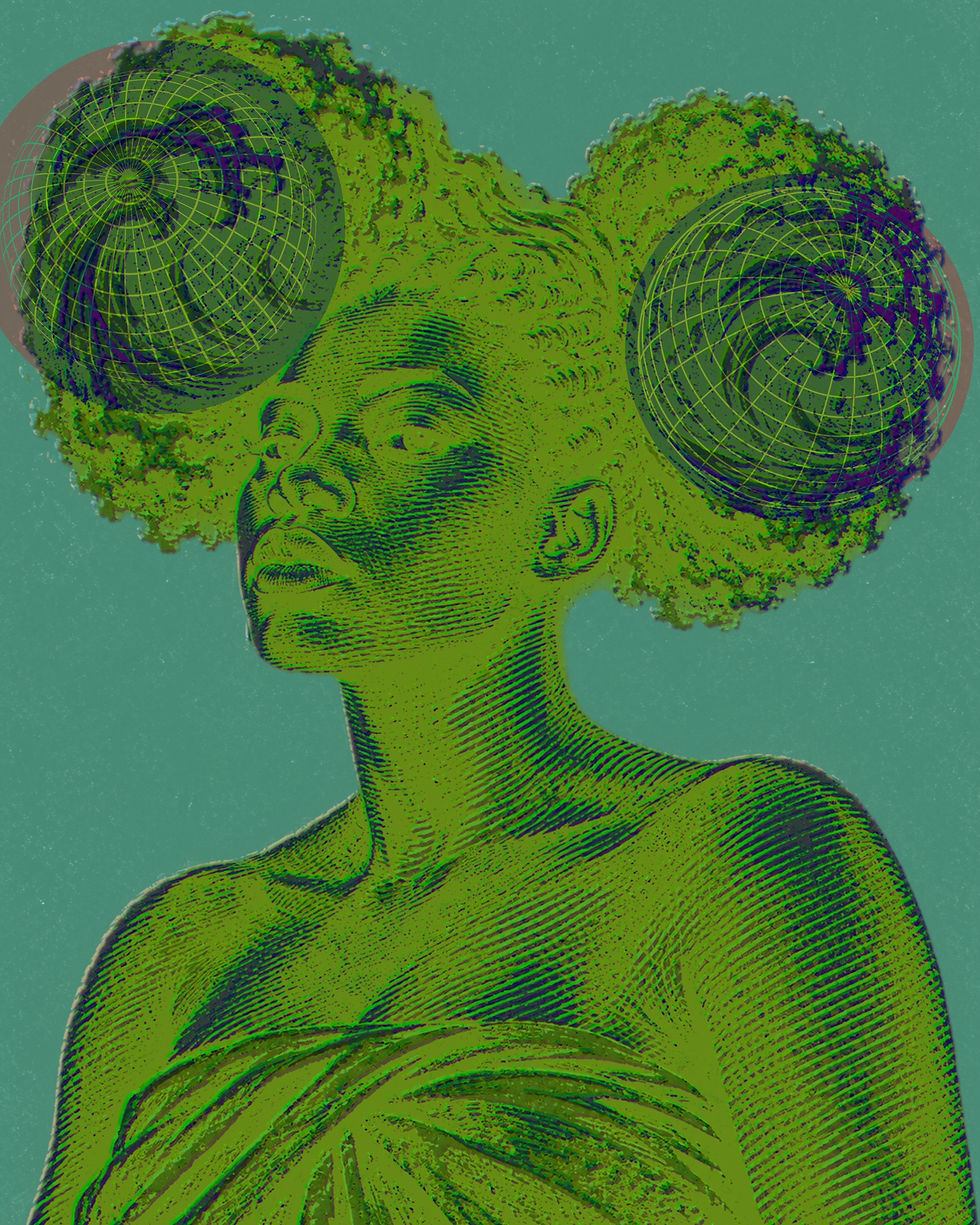
Both begin with listening to what the water carries, allowing the crown time to build its world and taking responsibility for what we ask the water to carry next.
The water remembers before you do.
But the body can remember with it.
W is for Wild Wavy Wata — Water Remembers Before You Do

Post Identity
Field | Entry |
Letter | W |
Letter Phrase | W is for Wild Wavy Wata |
Essay Title | Water Remembers Before You Do |
Published Title | W is for Wild Wavy Wata — Water Remembers Before You Do |
Series | The Afro ABCs |
Sequence | W/23 |
Primary Portal | The Afroscape • Afro Tings |
Book Connection | The Afroscape: Hair as Tech(know)logy — A Field Guide |
Central Thesis | Afro hair is an ecosphere that must be allowed to build atmosphere. Monthly washing gives its moisture architecture time to gather, settle and become a living world. Weekly washing participates in colonized cleanliness and palatable Afro(ness) by repeatedly erasing that world before it can mature. |
Body Coordinate | Crown • Scalp • Hair • Nervous System • Water |
Primary Methodology | Mycelial Sankofa |
Core Refrain | The Afro is allowed to retain, gather and become an atmosphere. |
Return | The water remembers before you do. But the body can remember with it. |
Banner Marker | AfABC · W/23 |
Opening Signal | Your body is catching what never stopped moving. What you feel is not random. It is inherited motion. |
Cosmos Watershed
W enters the Wata(ring) W(hole) through the water meeting the crown. Water arrives carrying minerals, sediment, pressure, temperature, pollution, infrastructure and history. The Afro receives that water within an existing ecosphere, where fiber, product, oil, sweat, air and time gather into moisture architecture.
Monthly washing allows that architecture to form. Weekly washing repeatedly returns the crown to zero, reproducing a colonized infrastructure in which cleanliness means removing every trace that the Black body has been living. The clean-girl aesthetic becomes the visible interface of that infrastructure, while palatable Afro(ness) determines how much Blackness may remain after the crown’s atmosphere has been compressed.
Reverse Osmo(cis) names the counterprocess: filtering coloniality, cisness and palatable Afro(ness) from the infrastructure through which the Black body has been taught to interpret itself. The body is not the contaminant. What must be filtered is the demand that the Afro erase its world before entering ours.
Watershed | Tributaries |
Watershed | The Wata(ring) W(hole) |
Relationship | Water moves through land, infrastructure, body, scalp, crown and atmosphere while carrying the material history of every system it has entered. |
Hom(e)ie | Water |
Origin | W is for Wild Wavy Wata |
Expansion | Monthly washing as ecological care and the Afro as a world-building atmosphere |
Application | Allow the crown three to four weeks to gather moisture, weight, protection and information before washing and rebuilding its architecture. |
Lineage | The Afro ABCs • The Afroscape • Hair as Tech(know)logy |
Counter Currents | Weekly washing, colonized cleanliness, the clean-girl aesthetic, palatable Afro(ness), repeated stripping, product solutionism, infrastructural invisibility and the separation of scalp from body |
Through the Six Waters
Water | Entry |
Still Water | A monthly rhythm that gives the crown enough uninterrupted time to settle, retain moisture and become a world. |
Flowing Water | Water moving through land, pipes, filters, scalp, crown, drain, river and atmosphere without leaving relationship. |
Deep Water | The inherited motion carried through water, body, migration, interrupted knowledge and ancestral memory. |
Turbulent Water | Weekly stripping, colonized cleanliness and the clean-girl infrastructure repeatedly demolishing the Afro ecosphere. |
Tidal Water | The crown changing across the month as moisture settles, products become architecture and the hair responds to weather, movement and the body. |
Sacred Water | Water stewardship as responsibility for what reaches the body, what the crown builds with it and what we ask the water to carry next. |
Cosmos Coordinates
Coordinate | Entry |
Primary Portal | The Afroscape • Afro Tings |
Connected Waters | Still Water • Flowing Water • Deep Water • Turbulent Water • Tidal Water • Sacred Water |
Tings Connections | I See Tings • I Know Tings • Afro Tings |
Primary Methodology | Mycelial Sankofa |
Methodological Practice | Reading across water, infrastructure, nervous system, scalp, hair and atmosphere without reducing care to cleanliness, frequency or product consumption. |
Cosmos Concepts | The Wata(ring) W(hole) • Moisture Architecture • Reverse Osmo(cis) • Afro Autonomic • Palatable Afro(ness) • Hair as Tech(know)logy |
Geographic Coordinate | The crown within municipal water infrastructure and the Wata(ring) W(hole) |
Relational Coordinate | Water, body, scalp, crown and atmosphere in continuous circulation |
Temporal Coordinate | The three-to-four-week wash cycle as a field of accumulation, observation and world-building |
Orientation | Inward • Circulating • Accumulative |
Core Refrain | The Afro is allowed to retain, gather and become an atmosphere. |
Expansion Principle | An ecosystem cannot form if it is erased every week. |
Body Coordinate | Crown • Scalp • Hair • Nervous System • Water |
Banner Marker | AfABC · W/23 |
Cosmos Constellations
Constellation | Connection |
The Afro ABCs | W/23 continues the reverse movement from Z toward A. |
The Afroscape | Positions Afro hair as an ecosphere whose moisture architecture requires material time. |
The Wata(ring) W(hole) | Follows water through land, pipes, filters, body, crown, drain, river and atmosphere as one circulating relationship. |
Reverse Osmo(cis) | Filters coloniality, cisness and palatable Afro(ness) from the infrastructure through which washing, cleanliness and care are interpreted. |
Moisture Architecture | Names the layered relationship among water, oil, glycerin, cream, mousse, gel, air, sweat, weather and Afro fiber. |
Afro Autonomic | Connects scalp communication to the nervous system, internal regulation and the body’s larger environmental relationships. |
The Clean-Girl Infrastructure | Reveals how smoothness, compression, repeated washing and invisible labor make controlled Blackness appear effortless. |
Palatable Afro(ness) | Allows Blackness to remain as cultural texture while requiring the actual Afro to dismantle its atmosphere before entering public space. |
Water Infrastructure | Makes pipes, mineral deposits, chlorine, filters, municipal systems and unequal access part of the hair-care conversation. |
Black Palm Trees | Extends the crown’s world-building capacity through ecology, atmospheric reception, weather and material time. |
Mycelial Sankofa | Retrieves water knowledge through multiple living connections among crown, body, infrastructure, environment and inherited motion. |
Field | Entry |
Atmospheric Field | Water • Humidity • Minerals • Sediment • Heat • Sweat • Friction • Product • Electrical charge |
Embodiment | The Afro does not merely receive water during washing. It continues building with water, product, air, sweat and bodily conditions throughout the month. |
Binary Disruption | Clean/dirty, fresh/old, maintained/neglected and controlled/uncontrolled cannot adequately describe a living ecosphere. |
Material Practice | Wash monthly, allow moisture architecture to gather, learn the water where you live and investigate scalp distress through the interconnected terrain rather than treating repeated stripping as care. |
W establishes Afro hair as an ecosphere whose world-building depends upon time.
The crown does not become moisturized through water alone. Water enters a layered architecture of fiber, product, oil, sweat, air, weather and touch. Those materials must be allowed to settle into relationship. Monthly washing provides the material time required for that relationship to develop.
W also expands the Afroscape beyond the visible strand. The water supply, pipes, filters, nervous system, scalp, atmosphere and colonial demand for cleanliness all participate in the condition of the crown.
The hair cannot be separated from the systems carrying water toward it.
W practices Mycelial Sankofa by following water through multiple living and infrastructural points rather than searching for one universal Black hair rule.
Water returns through cloud, pipe, shower, body, crown, drain, river and atmosphere. Knowledge returns through observation, bodily response, ancestral practice, environmental study and the crown’s changing condition across the month.
The return is not to an imagined untouched ritual.
It is to the relationship that survived beneath the demand for repeated erasure.
We gather what still nourishes.
We notice what became distorted under pressure.
We compost what cannot carry us forward.
Then we return differently.


Comments