


My Roots Keep Their Own Hours

The roots have returned. Before I mix the color, I read the atmosphere.
My Roots Keep Their Own Hours
Afro Hair Color Theory

The Afroscape is the living terrain of Hair as Tech(know)logy — A Field Guide. The Afro ABCs open letter-sized doorways into its pedagogy; these field notes follow that knowledge into practice. Afro theory takes material form here through hair ecology: strand, scalp, density, chemistry, season, and the atmosphere surrounding the crown. Color belongs within those relationships. Every mixture, section, processing interval, and period of rest becomes part of how I tend the terrain—and how the book continues to grow.

Spring and fall. Those are my two color-retouch seasons. I attend to atmosphere: seasonal shifts, electric charge in the air, and how the hair receives. This relationship comes from tending my own Afro and working with other Afros. My retouch rhythm makes room for observation, new growth, and long stretches between chemical processes. The crown has conditions. I work within them.
Your colonial cosmetologist keeps you on a booking schedule organized around how their business needs to profit, not how your scalp needs to thrive. The appointment returns before anyone asks whether the crown is ready.
In my Afro color pedagogy, summertime is not the season to begin that chemical relationship. Some of you are struggling to sustain color because you are starting in a season I would ask the crown to move through without that additional demand. The season belongs inside the consultation. Your scalp does not owe the salon another appointment.

I believe high lift deserves a foundational place in Afro hair-color education. But whose head establishes the teaching? Whose timeline becomes the standard? My pedagogy begins with Afro density, strand history, and the terrain receiving the color. A colonial timeline cannot stand in for that relationship. I have also watched favorite high lifts disappear from the market. The tools change; the need for Afro-centered education remains.

Mixing precisely is part of tending the body. I weigh what I am working with rather than asking an approximate squeeze to carry a chemical relationship. A box cannot assess the density of my crown, divide its sections, or tell me how much mixture will reach the terrain. The formula and the amount needed are related questions. Neither gets answered by pretending every head is the same.

In my practice, coloring Afro hair without bond support is not an acceptable shortcut. Showing that you can do it without one is not a demonstration of talent. I am thinking about the strand’s materiality, the conditions around it, and how it will remain through the seasons after this appointment. Fortifying belongs inside the process. I am tending beyond the reveal, with no interest in pushing the crown into a turbulent landscape.

Sectioning makes the work reachable. It lets me attend to placement, saturation, and the boundary between new growth and previously colored hair. I believe many Black folks can learn to color their own hair, but willingness to experiment is not the same as understanding the ecosphere. Care requires knowledge. This teaching also travels beyond the scalp: divide the work so you can move through it with intention rather than asking the whole body to hold everything at once.

Manufacturer directions cannot observe the head in front of me. Processing requires attention to strand history, existing color, density, application sequence, and the atmosphere of that particular crown. A printed time does not complete that assessment. My pedagogy asks me to stay in relationship with the material throughout the process. The clock is present. So are my eyes, my knowledge, and my responsibility to the body.

The fractal coil belongs in the processing conversation. In my pedagogy, I attend to its repeating turns, the density of the whole crown, and how warmth is distributed through that space. I cannot assume uniform conditions from the root through every section. The processing cap is part of how I attend to containment and consistency. I am working at home, without elaborate salon equipment, but the coil’s architecture still requires my attention. Heat distribution is a question of relationship, not simply more heat.

Fall is my last eyebrow-lightening season before winter. The break belongs to the practice. I recognize what bleach asks of hair, including the small strands above my eyes, and I make room for storage, rest, and winter interiority. Every part of my body does not need to remain available for another transformation. My eyebrows get to enter the season with me.
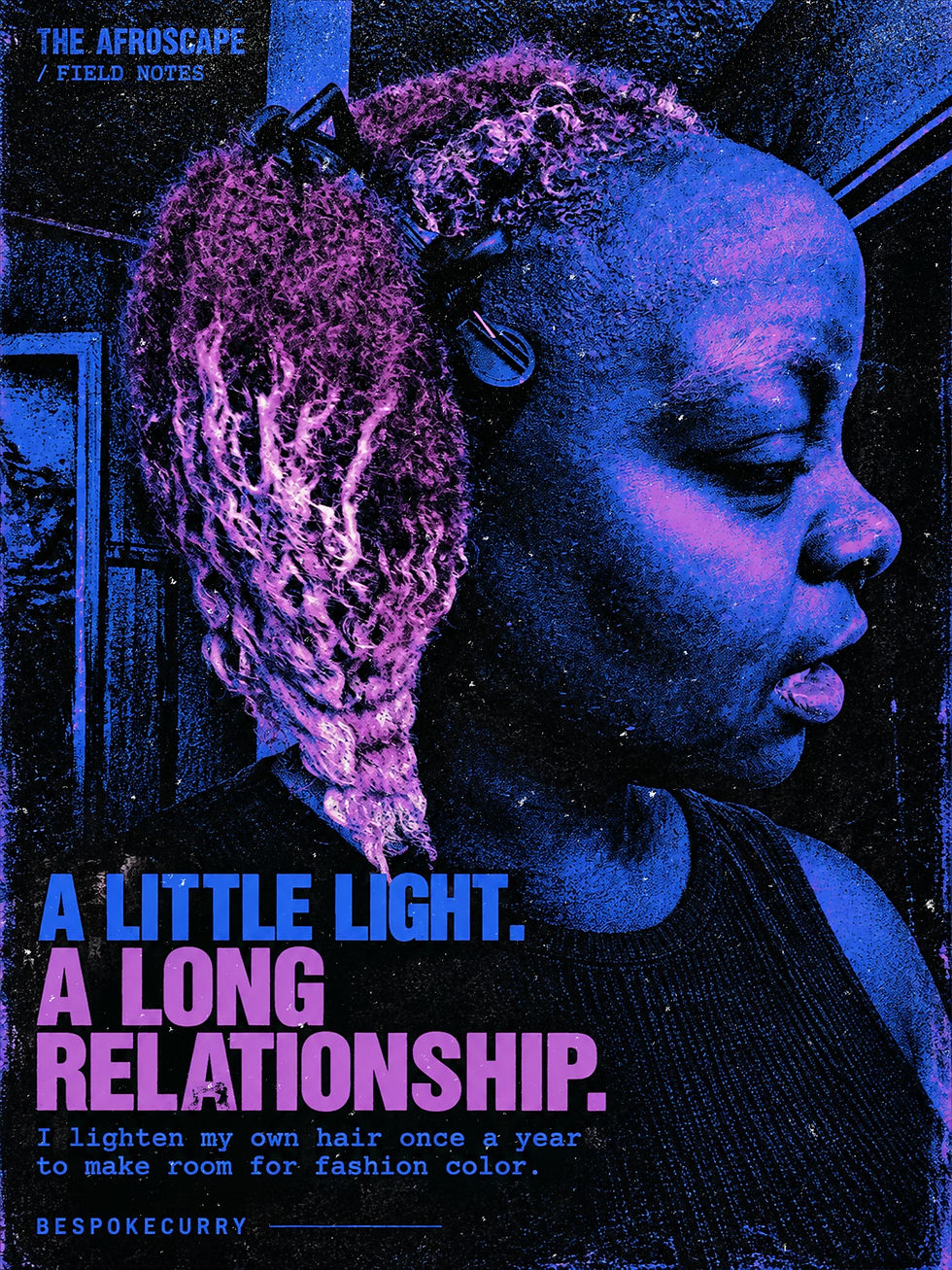
I likely will not lighten anyone else’s hair again. Even with bond support built into a product, I take seriously how rough lightening can be on the strand. For my own crown, I keep a limited relationship with it because I still enjoy fashion color: one lightening session a year, this time in fall. The color possibility has to remain in relationship with the material carrying it.

This fall, my own lightening session lasted 20 minutes. That is a record of what I did within a process I assessed for my own head. It is not enough information for someone to screenshot and repeat. A number cannot communicate the strand’s history, the placement, the mixture, or what I was observing. The information is here, but understanding requires the relationship around it. My formula is not your instruction. That's why there is no formula here.

A fashion shade meets the base already living in the strand. I am looking at the color present before the next color arrives: what has lifted, what warmth remains, and what relationship I want to build. The names on these boxes do not tell the whole story. Afro hair color theory has to account for the material receiving the pigment, not only the pigment I want to see.

I want room for strange color, bright eyebrows, and a face that refuses to behave for the photograph. Precision belongs in that play. So do restraint and attention to which part of the body I am working with. The eyebrow and the crown are different terrains within the same body. Fashion color does not suspend my stewardship. It gives that stewardship another ting to tend.

My wash day takes two days because the color process is only one part of the care. After a retouch, I give the hair time before moving into styling. That pause lets me pay attention to the crown and to the body carrying it. Rest and restoration belong within the sequence. I am not rushing from chemical work into a finished look just because the camera is ready.

The coil remains the subject after the color arrives. I attend to its repeating forms, its variations, and the material I will continue washing, moisturizing, sectioning, and styling. A photograph cannot tell me everything about that material. Ongoing care can. My color theory has to hold the next wash day and the next season, because the strand has a life beyond this reveal.

The gel, the brushes, the clips, the mug, the kettlebell: these tings share a care environment. My Afro does not live apart from the body that moves, rests, drinks tea, and makes room for the next task. Sectioning teaches me how to move through that work. Seasonal color teaches me when to return and when to pause. The mirror holds a whole practice. I tend the crown within it.
Cosmos Watershed
Color enters a crown already living in relationship with atmosphere, density, memory, and time. These field notes move through Tidal Water, where spring and fall hold my retouch rhythm, and Deep Water, where years of tending Afros become embodied pedagogy. Sacred Water holds the precision of mixing, sectioning, and fortifying the strand. Still Water makes room for a two-day wash process and winter rest. Flowing Water carries that knowledge into everyday practice, while Turbulent Water names what happens when a colonial timeline overrides the terrain. The color has a season. The body remains in the account.
Watershed | Tributaries |
Watershed | Tidal and Deep Water moving through Sacred Water, with Still and Flowing Water sustaining care and Turbulent Water exposing imposed conditions |
Relationship | Afro strand ↔ scalp ↔ atmosphere ↔ seasonal rhythm ↔ color chemistry ↔ whole-body care |
Hom(e)ie | The color-tending body whose crown carries its own conditions, history, and rhythm |
Origin | My fall color retouch, documented through photographs, tools, expressive faces, and the knowledge accumulated through tending my own and other Afros |
Expansion | High lift, precise mixing, sectioning, fractal-coil architecture, heat distribution, processing observation, bond support, fashion color, and seasonal rest enter one care ecosystem |
Application | Observe the terrain; measure precisely; divide the work with intention; attend to processing conditions; fortify the strand; allow rest before styling |
Lineage | The Afroscape; Hair as Tech(know)logy; Mycelial Sankofa; Black cosmetology lineage; embodied Afro pedagogy |
Counter Currents | Colonial processing timelines; one-size-fits-all instruction; careless mixing; experimentation without understanding; screenshot formulas stripped of context; spectacle prioritized over continuing care |
My Roots Keep Their Own Hours


Comments