


Black Palm Trees — The Ecology of Afro Hair

The blueprint belongs to the tree.
The blueprint of every Afro belongs to the person.

Afro Tings studies Afro hair as living relationship: body record, receiving architecture, ecological intelligence and Black tech(know)logy.
At the top of a coconut palm, the crown interrupts rain, gathers matter and holds an entire world in the sky. Afro hair does too. Beginning with the head I shaved in October 2022 and the crown approaching its fourth year in October 2026, this essay refuses the colonial calendar of compulsory trimming and asks what becomes visible when every Afro is tended as its own distinct ecosphere.
Black Palm Trees — The Ecology of Afro Hair

Black Palm Trees did not suddenly arrive.
I have always been looking up.
Even while we were homeless in Los Angeles, I kept photographing crowns—palms threaded through power lines, held beneath the moon, interrupting the built sky. I did not yet know I was gathering a field guide. The archive knew before I did: long before I named the ecology, my attention had already found its crown.

The city built the street below. The palms kept building another architecture overhead. 
Looking up was already a method: following the trunk past concrete until the crown opened into weath 
Even in motion, the crowns kept entering the archive—vertical witnesses along the road. The built grid crosses the living one. The crowns continue receiving atmosphere through every interr A crown beneath the moon, crossed by wires but never contained by the built grid. Palms & electrical lines share the sky, but only one system is commonly recognized as infrastructure 
At dusk, the crowns become silhouettes without becoming empty. Their ecologies continue beyond what 
No two crowns repeat one another. Height, weather, age and atmosphere keep writing different bluepri Before Black Palm Trees had a name, the archive was already holding its horizon. 
Arrival and departure beneath the crowns.
The crown does not obey the calendar.
I shaved my head in October 2022.
We are approaching October 2026 now.
Four years of growth.
Four years of learning what my hair does when I do not force it to prove itself through somebody else’s schedule. Four years of watching a crown build itself from nearly nothing. Not according to the six-week trim. Not according to the product launch. Not according to the cosmetology-school clock that taught us to make every head pass through the same sequence whether the hair requested it or not.
The journey begins with a bare crown. The crown begins again. New growth, already choosing its direction. A crown building density on its own clock. Shape changes. The terrain remains. The crown gathers upward. Coils learning their reach. Moisture makes expansion visible. The crown reorganizes without becoming less itself. 
Length begins to alter the architecture. Gravity enters the conversation. The body records every season of growth. The crown keeps exceeding its containers. Color becomes another form of atmosphere. The crown settles into its length. Every braid holds a route through the crown. Growth becomes recognition. Even the shadow carries the crown’s architecture. Afro crown meets palm crown in the same field of light.
If I had continued adhering to colonial natural-hair standards, I might not have seen any of this growth.
My hair would still have been growing. But I would have kept cutting away the evidence.
Then I might have called my hair slow.
Stagnant.
Difficult.
Broken.
I might have joined the long Black tradition of standing over our own bodies and repeating an accusation that began somewhere else: My hair just does not grow.
But it did grow.
The question was whether I could remain in relationship with it long enough to see what it was building.
A World in the Crown

At the top of a coconut palm, long fronds gather around a single living crown. Their bases overlap. Their angles interrupt rain. Water, dust, pollen, fallen flowers, leaf fragments, animal matter and whatever the wind has carried can settle into the spaces they make.
The crown does not merely wear the atmosphere.
It receives it.
In some palms and plant structures, rain caught by leaves and leaf axils forms small plant-held waters called phytotelmata. These waters can support bacteria, fungi, algae, protozoa, insects and other small lives. Organic matter decomposes. Nutrients circulate. Seeds and spores arrive by wind, water and animal. A pocket in the crown becomes reservoir, nursery, compost system and feeding ground.

Water was moving toward the ground.
The palm interrupted it.
Not to stop the water forever. To change what could happen before it continued.
Not an antenna imagined only as a metal rod sending a clean signal into an empty sky. An antenna as reception architecture. A structure extended into the atmosphere, gathering what passes through it, reading pressure, holding transmission and turning signal into material relationship.
The palm crown reaches upward to bring the sky into relation.
Afro hair does too.
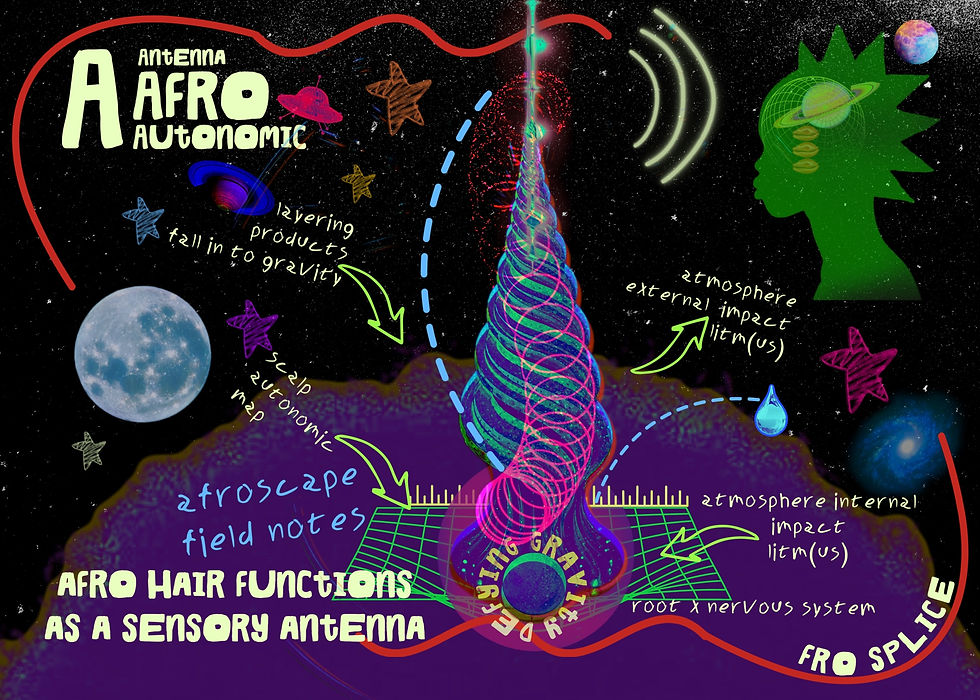
Afro hair catches the world.
Moisture.
Heat.
Dust.
Oil.
Smoke.
Scent.
Electricity.
Fabric.
Fingers.
Product.
Weather.
The mineral history of the water running through it. The internal atmosphere of the body producing it.
Its coils make chambers, crossings, channels and pockets of suspension. Water cannot move through an Afro as though it were travelling down a smooth, straight plane. Oil cannot move that way either. Gravity is present, but it is not given uncomplicated authority.

The coil changes the route.
That interruption is often described as a problem. Oil does not reach the ends quickly enough. Water does not distribute itself evenly. Shed hair does not simply fall away. Strands meet one another, wrap around one another, make agreements and make knots.
The beauty industry points to every difference in movement and calls it deficiency.
But the palm crown also interrupts simple descent. That interruption is precisely what permits water and matter to remain in contact long enough for another world to develop.
Afro hair is not failing to behave like straight hair.
It is performing a different ecology.
The crown is not an ornament placed upon the body. It is an Afro autonomic system: receiving, communicating and responding before language has decided what occurred. Hair can report dryness, hormonal change, medication, friction, tension, illness, rest, neglect, attention and shifts in climate. It can tell me that the atmosphere has changed
before I have assembled a sentence about it.

Not because every signal has one easy interpretation. Because the crown is alive in relationship with a living body, even though the visible strand itself is not living tissue. What emerges from the follicle carries the body’s record forward. What remains outside the scalp continues encountering a world.
The crown receives enough of that world to become one.
There Is No Universal Palm

Every palm crown is distinct.
Species matters.
Age matters.
Rainfall matters.
Wind matters.
Salt matters.
Soil matters.
Insects, birds, fungi, neighboring plants, disease and human interference matter. The angle and density of the fronds shape what can enter, what can remain and what must move on.
Their crowns may gather different matter. Hold different amounts of water. Shelter different lives. Carry different injuries. One may have passed through a hurricane. One may be recovering from nutrient loss. One may be feeding fruit. One may have been stripped into somebody’s preferred silhouette and left trying to keep a whole tree alive with a fraction of its functioning crown.
The blueprint belongs to the tree.
The blueprint of every Afro belongs to the person.
Density is not enough to explain it. Curl pattern is not enough and is not a ting if you're still engaging that lie of a curl typing chart.
Porosity is not a personality test.
Product categories cannot account for hormones, medication, disability, age, climate, water quality, protective styling, sensory thresholds, inherited practice, stress, nourishment, grief, pleasure or the body’s changing internal atmosphere.
Two Afros may resemble one another from across a room and require entirely different
relationships.
This is why the Four-C Fallacy cannot lead us into care. Three letters, placed within hierarchy to other letters and numbers, cannot hold an ecosphere. A chart cannot tell me what happened to this crown before I met it. It cannot tell me whether the body beneath it clenches when touched. It cannot tell me where water remains or where it escapes. It cannot tell me which strands are weathered, which are flourishing and which have simply been accused of damage because they refuse smoothness.
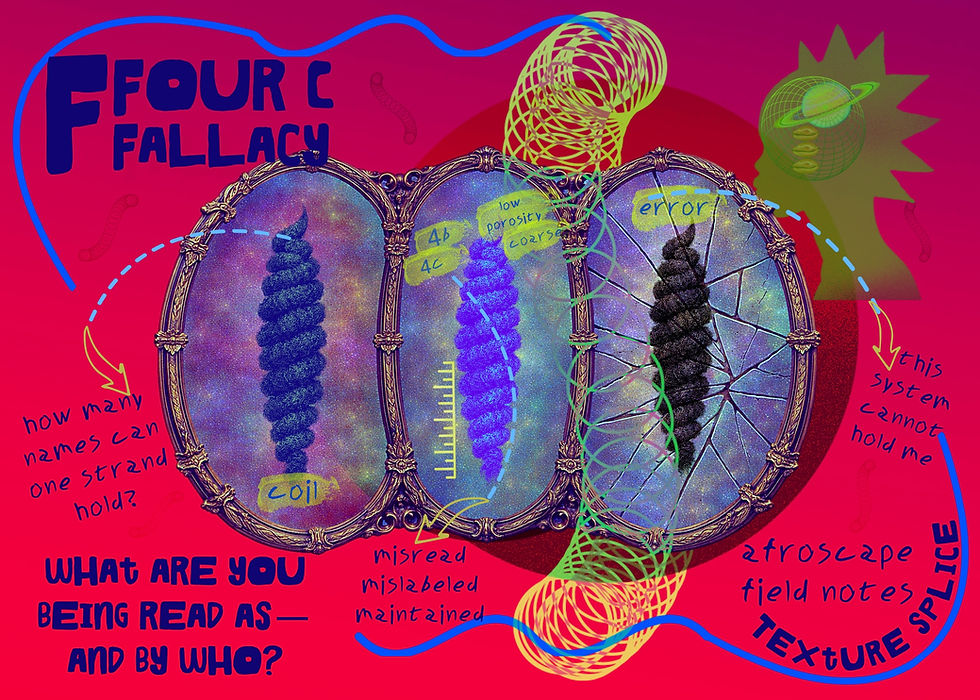
Colonial cosmetology and consumer curl culture need the crown to become legible through reduction.
Once typed, it can be assigned a routine.
Once assigned a routine, it can be sold a product.
Once sold a product, any failure can be returned to the Black person as evidence that they did not comply correctly.

Buy this.
Apply it in this order.
Detangle this often.
Trim on this date.
Pull here.
Smooth there.
Stretch the root.
Lay the edge.
Define the curl.
Make the crown reveal a pattern the eye has already been trained to reward.
An Afro translated into colonial terms without appearing to have been colonized.
But ecological care cannot begin with instructions written for an imaginary universal tree.
It begins with curiosity.
What does this crown catch?
Where does its water remain?
Where does it leave too quickly?
What has accumulated here?
What is breaking?
What is holding?
What only appears disorderly because somebody expected this crown to obey gravity?
If you are unwilling to become curious about the tree, you will not tend the tree. You will manage its appearance.
You may strip it.
Starve it.
Shear away what is still working.
Force it into a silhouette that makes sense to the colonial eye.
You may chemically alter it, scorch it, pull it toward gravity or chop it down and call the outcome clean.
The crown becomes something else under pressure.
Assimilated.
Commodified.
Disconnected from its own receiving architecture.
Then the person holding the blade calls the damage maintenance.
Four Years Is Not a Trim Schedule

Hair grows from the scalp.
Length is retained through relationship.
Those are connected tings, but they are not the same ting.
When hair grows and then breaks at approximately the same rate, the growth becomes difficult to see. When ends are repeatedly removed according to a calendar that never examined them, the hair may be growing while visible length remains nearly unchanged. The person is told their hair cannot grow when the system of care may be continually removing what the body has produced.
My October 2022 shave made the record plain.

Had I trimmed my hair every six weeks because somebody declared that healthy hair must be trimmed every six weeks, what exactly would the schedule have been responding to?
Not my ends. The calendar.
Not the weather. The rule.
Not the evidence held by my crown. The authority of repetition.
My trim may need to happen in six months.
It may happen in a year.
It may happen in two years.
Then that rhythm may change again because the ecology changed.
The answer is not to replace one universal schedule with a more spacious universal schedule. I am not declaring that everybody should trim once a year now. I am saying the interval must remain responsive to the crown.
The terrain leads.
It may lead me toward removal when ends are splitting, catching, tangling beyond what care can restore or breaking their surrounding strands. It may lead me toward a smaller intervention. It may tell me the hair is not asking to be cut at all. It may tell me that what looks rough needs water, lubrication, patience or less handling—not scissors.
The specificity belongs to the person.
And the answer may change because a body is not a fixed climate.
The Older Frond Is Still Working

Palm fronds age.
The oldest fronds generally sit lower in the crown. Their position and color change as the palm redistributes resources and produces new growth. But old does not automatically mean useless. A green or partially yellow frond may still be photosynthesizing. Palms can move mobile nutrients from older leaves toward newer growth. Removing those leaves prematurely can take functioning tissue from a tree already trying to correct a deficiency.
This is why responsible palm pruning is not simply a matter of cutting everything below a fashionable line.
The over-pruned palm—sometimes carved into what is called a hurricane cut—may look orderly to the human eye while being deprived of the crown it uses to feed and protect itself.

The older frond may still be working.
The same is true of the older strand.
The ends of my hair are the oldest hair on my head. They have lived through more washes, seasons, installations, fabrics, weather systems and internal bodily shifts than the hair nearest my scalp. Time may change them. Time may make them more vulnerable to weathering. But age alone is not proof of damage.
Older hair is material time.
An archive I can touch.
It does not need to remain attached forever to prove that I cared for it. Release can be part of tending. A frond can complete its work. A strand can reach the point where remaining attached creates more splitting, tangling or breakage than support. Cutting can preserve the larger crown.
But ecological release is not compulsory removal.
The question is not merely: How old is it?
The question is: What is it doing now?
Is it still holding?
Still protecting?
Still participating in the architecture?

Is it asking for moisture, reinforcement, reduced manipulation or release?
We have been taught to mistake age for damage because consumerism needs the crown to remain perpetually new.
New growth.
New routine.
New product.
New style.
New body.
The older frond interrupts that fantasy. It reveals that longevity is not neglect. That weathering is not automatic failure. That an ecosystem can carry visible time without surrendering its function.
The calendar cannot examine the strand.
After the Hurricane

A palm does not live beneath one stable sky.
There are ordinary rains, long dry periods, coastal salt, heat, wind and hurricanes. A storm may tear fronds, strip leaflets, flood roots, deposit salt and rearrange the crown in a few hours. The tree that emerges from that atmosphere may not require the same care it required before it.
That does not mean every marked frond should immediately be removed.
After a hurricane, assessment comes before aesthetic correction. What is broken? What has become dangerous? What is dead? What remains green and functioning? What damage can the palm compartmentalize or grow beyond? What additional stress would pruning create while the tree is trying to recover?
A crown that has survived pressure does not need to be punished for looking like it survived pressure.

My Afro also moves through weather.
The literal weather changes what it needs.
Humidity can swell the strand and alter definition.
Dry air can accelerate moisture loss.
Wind, sun, cold, indoor heating, hard water and seasonal clothing all change the conditions surrounding it.
Then there are the atmospheric events that never appear on a forecast.
Housing instability.
Illness.
Medication.
Burnout.

Grief.
A shift in hormones.
A month when the hands cannot complete the ritual they completed before.
A season of installation.
A period of being touched too often.
A period of not being touched at all.
Care after pressure cannot be reduced to returning the crown to its pre-storm appearance.
Sometimes the rhythm between washes changes. Sometimes manipulation must decrease. Sometimes an old practice stops working because the body or atmosphere it served no longer exists. Sometimes the crown needs more water. Sometimes it needs to be left the hell alone.
And sometimes it needs to be cut.
The distinction matters.
A hurricane is not a trim schedule. It is an event that requires new observation.
The storm does not erase the tree’s blueprint. It changes the conditions in which that blueprint must operate.

I am not calling the palm Black because its trunk resembles a body or because its crown can be arranged into a convenient metaphor for hair.
I am recognizing a Black ecological method.
Crown as antenna.
Hair as watershed.
Moisture as infrastructure.
Accumulation as intelligence.
Specificity before standardization.

Relationship before extraction.
The palm gathers what the atmosphere delivers and makes decisions through form. It does not flatten every arrival into sameness. Water pauses differently according to the architecture receiving it. Matter becomes habitat because it is allowed to remain in contact. Older fronds keep working until their work changes. Storms leave records. The crown continues, but continuation is not sameness.

Afro hair is not merely an ecosystem growing from the body. It is an ecological instrument through which the body receives, holds and reorganizes the world.
That instrument cannot be understood from across the room.
It cannot be cared for by category alone.
It cannot be forced into gravity without altering what it is able to receive.
An antenna does not work the same once it has been broken, grounded or pulled out of its own orientation.
A crown continually forced downward may remain hair, but its relationship to the atmosphere has been changed.
Reverse Osmo(cis) names the counterpressure required to move Afro hair away from cisness, colonial gravity and the conditions of palatable Afroness. It is not the force flattening the crown. It is the reversal of that force—the crown recovering its orientation, moisture architecture and capacity to receive. Water returns. Shape returns. Signal returns. The antenna rises back into relationship with the atmosphere.
Consumerism first teaches us to distrust the crown’s receiving architecture. Reverse Osmo(cis) interrupts that instruction. It refuses the demand that Afro hair become straighter, smoother or more socially legible before it can be recognized as tended. It restores pressure in the opposite direction: outward, upward, back toward the body’s own blueprint.
Black Palm Trees asks for another practice.
Look before naming.
Listen before cutting.
Learn how this crown moves water.
Learn what this crown has survived.
Learn which older parts are still feeding the whole.
Learn when release is requested rather than imposed.
The last four years of my hair are not proof that I finally discovered the universal correct routine. They are evidence that relationship produced knowledge no universal routine could have given me.
I shaved my head in October 2022.
By October 2026, the crown has made its own archive.

Not because I conquered it.
Because I remained curious enough to let the tree tell me what it was becoming.
The palm does not reach upward to escape the ground.
It reaches upward to bring the sky into relation.
So do I.
Black Palm Trees — The Ecology of Afro Hair

Ecological notes for sourcing
Plant-held waters and their aquatic communities: Smithsonian Libraries, Phytotelmata: Terrestrial Plants as Hosts for Aquatic Insect Communities; Kitching, “Food Webs and Container Habitats.”
Palm pruning and the continuing function of green or nutrient-deficient older fronds: University of Florida IFAS, Pruning Palms; University of Nevada, Reno Extension, Pruning Palm Trees.
Post-hurricane tree assessment: University of Florida IFAS, Restoring Trees After a Hurricane.
Cosmos Watershed
This essay enters through Still Water, where rain pauses inside the palm crown long enough to become habitat, and moves through Flowing Water, where the coil redirects water, oil and gravity. Deep Water holds the older strand as material time and bodily archive. Turbulent Water names hurricanes, colonial cosmetology, compulsory trimming and the pressure toward palatable Afroness. Tidal Water carries the crown through changing seasons, weather and care rhythms. Sacred Water returns authority to the distinct blueprint of the tree and the person: relationship before extraction, observation before removal.
Watershed | Tributaries |
Watershed | Still Water moving through Flowing, Deep, Turbulent and Tidal Water toward Sacred Water |
Relationship | Afro hair and palm crowns; the body and its atmosphere; growth and retained growth; aging and release; care and curiosity |
Hom(e)ie | The coconut palm crown—antenna, suspended watershed, archive and host for other lives |
Origin | Shaving my head in October 2022 and approaching October 2026 with four years of retained growth that a compulsory trimming schedule might have repeatedly removed |
Expansion | Palm-crown ecospheres; phytotelmata; distinct ecological blueprints; aging fronds; hurricane pressure; hair weathering; the Four-C Fallacy; Reverse Osmo(cis) |
Application | Replacing universal trimming and product schedules with close observation of the actual crown, body, atmosphere, strand condition and changing care requirements |
Lineage | Black ecological intelligence; Afro hair as tech(know)logy; Mycelial Sankofa; embodied cosmetology knowledge; the Black body as the originating blueprint |
Counter Currents | Colonial cosmetology; the Four-C Fallacy; consumer curl culture; compulsory trimming; palatable Afroness; anti-Black assumptions that Afro hair does not grow; aesthetic pruning mistaken for care |
Cosmos Coordinates
Coordinate | Placement |
Primary Portal | The Afroscape • Afro Tings |
Connected Waters | Still Water, Flowing Water, Deep Water, Turbulent Water, Tidal Water and Sacred Water |
Tings Connections | Afro Tings; I Know Tings; I Touch Tings; I See Tings; I Move Tings |
Primary Methodology | Mycelial Sankofa |
Methodological Practice | Longitudinal embodied observation: allowing four years of growth, weather, aging and changing care to produce knowledge unavailable through a universal routine |
Cosmos Concepts | Afro Autonomic; hair as antenna; moisture architecture; Reverse Osmo(cis); Four-C Fallacy; Black ecological intelligence; material time; retained growth; crown ecology |
Geographic Coordinate | The coconut palm’s tropical and coastal ecologies in conversation with a Black crown currently growing in Elyria, Ohio |
Relational Coordinate | The palm and Afro meet through shared ecological method rather than visual resemblance: both receive atmosphere, interrupt gravity and require specific observation |
Temporal Coordinate | October 2022 → approaching October 2026; four years of growth, retention, aging and accumulated relationship |
Orientation | Upward and outward: the crown rises into atmospheric relationship rather than being pulled toward colonial gravity |
Core Refrain | The crown does not obey the calendar. |
Expansion Principle | A changed atmosphere changes what care requires; it does not surrender the crown’s authority over its own blueprint |
Cosmos Constellations
Constellation | How it enters this essay | What it makes visible |
Antenna, Afro Autonomic | The palm crown and Afro extend into the atmosphere, receive matter and reorganize what they catch. | The crown is not ornament. It is reception architecture and embodied communication. |
Moisture Architecture | Fronds and coils interrupt simple descent, changing where water pauses, travels, accumulates or escapes. | Afro hair is not failing to move moisture like straight hair; it performs a different hydrology. |
Mycelial Sankofa | Four years of bodily observation join plant ecology, cosmetology knowledge, weather, memory and changing practice. | Knowledge returns through multiple living connections rather than one prescribed route backward. |
The Four-C Fallacy | Consumer curl culture reduces distinct crowns to a type that can be assigned a routine and sold a product. | Classification becomes colonial management when it replaces curiosity about the actual person and crown. |
Reverse Osmo(cis) | Counterpressure moves the crown away from cisness, colonial gravity and palatable Afroness and back toward its own orientation. | Water returns. Shape returns. Signal returns. The antenna recovers its relationship with the atmosphere. |
Material Time | The oldest ends and older fronds carry weather, survival and accumulated function. | Age is not automatic damage; release must answer present evidence rather than an external calendar. |
The Wata(ring) W(hole) | Rain pauses in the crown, becomes habitat and continues through a changed relational system. | Water creates worlds wherever architecture permits it to remain in contact. |
Atmospheric Pressure | Hurricanes, dry air, humidity, housing instability, illness, hormones and grief alter the crown’s conditions. | Care must respond to what has happened without punishing the crown for carrying evidence of survival. |


Comments