


✺ The Sweet Potato Grew All Those Leaves for What?

Updated: 1 hour ago
The plant kept growing past the part we were taught to call food.
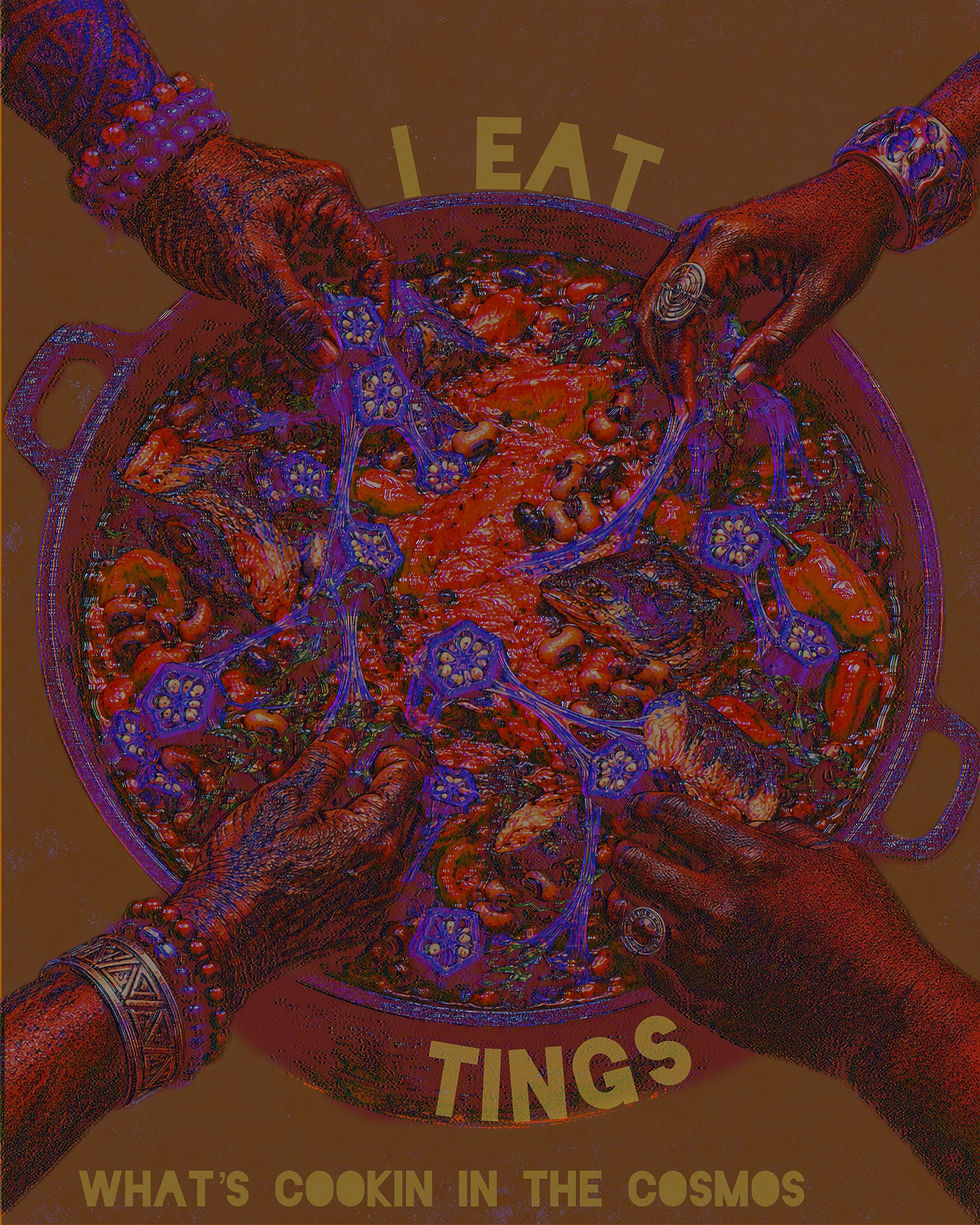
I Eat Tings
The sweet potato keeps growing past the part we were taught to eat. Its roots descend, its vines climb, its leaves gather at the window—and the grocery store’s lesson begins to come apart. Through a Senegalese hom(e)ie, Leah Chase’s gumbo z’herbes, and a pot of goat pepper soup, I follow whole plant ecology back toward the Black gut: not as performance, not as archive, but as living relationship.
✺ The Sweet Potato Grew All Those Leaves for What?
The Sweet Potato Was Never Just the Potato

Whole plant ecology, the assimilated Black gut, and bringing our foodways out of the archive
We will suspend a sweet potato over water with toothpicks and watch it perform resurrection.
Roots descend into the jar. Vines reach toward the window. Leaves keep arriving until the plant becomes too alive for the little container we assigned it. We photograph its becoming. We call it an experiment. We might even post the evidence as proof that we can grow someting.
And then what?
Because nobody ever seems to mention eating the leaves.
We are taught to marvel at the sweet potato becoming a plant without understanding that it was always part of a whole plant ecology. The leaves are not decorative evidence that the potato survived. The roots are not backstage labor supporting the edible star of the show. The sweet potato was never just the potato.
The plant did not grow all of that life merely to make its most grocery-store-recognizable part available to us.
My Hom(e)ie Said the Leaves

This began during a conversation with a Senegalese hom(e)ie who was talking about the variety of leaves eaten across different African foodways.
They were not only talking about eating a yam and its leaves. They were talking about leaves connected to other plants that also fruit—plants Western grocery culture has taught us to approach for only one recognizable part. Depending on where you are culturally, the leaf may be eaten alongside the root, tuber, fruit, seed, or other parts of the plant. What they were describing was not one unusual use of one plant. It was an entire relationship with plant variety.
Moringa Leaves
Garden Huckleberry
Scent Leaf
Baobab Leaves
Bitter Leaf
These are a small few. The list is long.
My mind moved toward the sweet potato in the jar.
Yams and sweet potatoes are not botanically the same plant. Even the names we use have been folded through displacement, commerce, mistranslation, and diaspora. And not every leaf from every plant is edible. Whole plant ecology does not mean walking outside and chewing whatever grows above the soil. It requires culturally situated knowledge: which plant, which part, prepared by whom, and how.
But the connection that opened for me was not about making every plant interchangeable. It was about recognizing how Western grocery culture amputates plants before presenting them as food.
Here is the carrot without its greens.
Here is the beet without its greens.
Here is the sweet potato without any indication that it once belonged to vines, leaves, soil, insects, heat, rain, and human hands.
Here is the fruiting agent without the ecology that made fruiting possible.
We are sold isolated outcomes and then trained to call them whole foods.
The Fruiting Agent Is Not the Whole Ecology

Mycelial Sankofa teaches me not to mistake the visible fruiting body for the entire living network.
The mushroom is not the whole mycelium. The fruit is not the whole plant. What becomes visible is not the only part carrying information.
We understand this when we are talking about mushrooms. At least, we are beginning to. We can look beneath the fruiting body and imagine the underground network communicating, exchanging, composting, warning, feeding, and returning.
But we have not necessarily brought that same relational attention to the plate.
What happens when we recognize that the leaves leading toward the fruiting agent might also be food? What happens when the body receives the tuber and the leaf, the sweet and the bitter, the starch and the green?
What new information becomes available to the gut when the plant is allowed to arrive as more than one edible outcome?
That is whole plant ecology moving toward whole gut ecology.
Not because every part of every plant must be eaten. This is not Eat All the Tings reappearing as another performance of moral purity. Black people do not need another commandment disguised as wellness.
Whole plant ecology is about restoring the relationship that tells us what can be eaten, how it must be prepared, what it accompanies, when it appears, and what the body learns through receiving it.
Western monocrop culture teaches the opposite.
Choose one edible product. Separate it from its ecology. Standardize it. Repeat it. Sell it everywhere. Eat that one ting until the soil is depleted, the palate is narrowed, and the gut is expected to survive on the same limited instructions.
Beat it into the ground.
Then beat it through the gut.
Then sell a supplement for whatever disappeared.
But the different parts of a plant are not nutritionally interchangeable. The root does not necessarily carry everything concentrated in the leaf. The fruit does not contain everything held in the seed, skin, stem, or flower. When we are taught to consume only the part selected for sale, we are not only separated from the rest of the plant. We may also be separated from nutrients and forms of nourishment carried more abundantly somewhere else within its ecology.
The supplement is then offered as an isolated replacement for what was already present before the plant was divided into product and waste.
The monocrop is not only planted in fields. It is planted in our expectations. It teaches us to recognize one part of the plant, one texture, one flavor, one type of nourishment, and one acceptable way for food to arrive.
That repetition serves the state because assimilation works best when the body forgets how many relationships it once required.
Leah Chase Kept the Tops


I have made gumbo plenty.
I know how to move a roux from deep gold toward caramel and then into those coffee notes where you have to stay with the pot. A roux does not care whether you are tired. It will wait until the exact moment your attention wanders and then burn.

But I had never made gumbo with greens. Leah Chase’s gumbo z’herbes brought me back to whole plant ecology because it was not only the amount of greens in the recipe. It was which greens were allowed to count.
Mustard greens.
Collards.
Kale.
Spinach.
Chard.
Cabbage.
Watercress.
Dandelion Greens
Carrot tops.
Beet tops.
The grocery store had taught me to see the carrot and beet as the products and their tops as the evidence to be removed. Leah Chase put the evidence in the gumbo.
Her recipe calls for an odd number of greens. Five, seven, nine, eleven—an odd number carrying luck, relation, story, and the possibility of another person arriving.
Of course the number is odd.
Black storytelling has never required the clean symmetry of Western conclusion. It circles. It repeats with new information. It returns to an earlier point and reveals that the point has moved. It leaves room at the table for spirit, interruption, improvisation, and the hom(e)ie who arrived after the pot was already on the stove.
The odd number refuses to close the ecology.
I eat the carrot, and I eat its greens.
I eat the beet, and I eat its greens.
Not because I am performing how little I waste. Not because I need to prove that I am the most decolonized person standing beside the compost bin. Performance always finds a way to reinsert itself, especially when Black people are trying to recover what assimilation interrupted.
The performance says: Look at me eating every part.
The relationship asks: Who taught you that this part was food?
Who taught them?
What preparation makes it nourishing?
What other greens does it need beside it?
What happens when its bitterness is not corrected but placed in community?
The Information Is Being Watched Through the Body Presenting It

Even the way gumbo z’herbes reached me carried the problem.
I found the dish inside a frame centering colorism, Creole hierarchy, and light-skinned hyperfemininity. The history had become secondary because the information was being watched according to the palatability of the person presenting it.
The dish was visible, but the ecology was disappearing again.
This happens constantly. Black knowledge is not allowed to circulate on the strength of the knowledge itself. It is filtered through which Black body can be consumed most comfortably. Which face can carry the history without making the audience feel implicated? Which voice can present the food without requiring anybody to examine how the food survived?
Palatability chooses the messenger and then pretends it discovered the message.
Watching older footage of Leah Chase made me cringe for a different reason. The essence of the elder Black woman who feeds the world is right there. So are the white bodies moving around her—interviewing, hovering, interpreting, receiving.
We have been here before.
The Black elder feeds the room while somebody else is positioned as the person who can explain what the feeding means.
I do not want to romanticize that position. Being the Black woman who feeds everybody is not automatically honor. It can also be extraction wearing an apron. It can be an entire world gathering around Black nourishment without ever becoming responsible to the Black body producing it.
Leah Chase was not merely standing beside a pot full of old information. The knowledge was alive because she kept cooking it. The archive could be tasted. It could enter the body. It could continue changing through every hand that learned how to hold the spoon.
Bitterness Needs Company
Ewedu, Bitter leaf, and scent leaf arrived alongside other African greens as I continued learning African cooking.
Then I went to H Mart and found myself standing before multiple kinds of mustard greens and an entire world of green possibility that the standard American grocery store had trained me not to expect.
What would happen if I experimented?
What would happen if dandelion greens did not have to carry their bitterness alone?
A bitter green by itself can overwhelm the mouth. Folded among other greens, its bitterness becomes part of a wider conversation. It still speaks. It simply does not have to be the only voice speaking.
That is ecology.
Not erasing what is difficult, but changing the conditions surrounding it.
I carried that understanding into a goat pepper soup. I used a blend of greens and took my cue from both Leah Chase and my Senegalese hom(e)ie. Not by pretending New Orleans and Senegal and Nigeria are one indistinguishable Black location, but by recognizing a relational method traveling among them:
The leaf is food.
Variety carries information.
Bitterness has purpose.
The pot can hold more than one lineage without flattening their distinctions.
Across African foodways, people eat hot soups in the dead of summer. Heat meeting heat. Pepper meeting sweat. The body being asked to move with the climate instead of pretending nourishment only travels through American seasonal logic.
Many Black Americans were not given that as a daily food grammar. We come from traditions of deep nourishment, but our guts have been made to assimilate alongside the rest of us.
The food was narrowed.
The plants were separated.
The preparation became inconvenient.
The time required to cook became evidence that the food was impractical rather than evidence that the conditions of our labor had been designed against our nourishment.
Then the state sold convenience as liberation.
I Do Not Want to Become an Archivist of Dead Tings

I use the archive often.
I need the archive because so much has been hidden, renamed, stolen, mistranslated, or allowed to disappear. But if I cannot use the archive to bring knowledge into living relationship with the present and the future, I do not wish to be an archivist.
I do not need an archive that can give me the Latin name of a leaf while letting the leaf die in the crisper drawer.
I do not want our foodways preserved like insects pinned beneath glass.
Our food needs to come out of the archive.
African foodways are also being lost to performance, Black intellectualism, and Black excellence. This is not a blanket statement about every African person or every African food tradition. It is an observation about what happens when living knowledge is made valuable primarily through presentation.
The food becomes content before it becomes practice.
The plant becomes a research interest before it becomes dinner.
The recipe becomes proof of cultural fluency before it becomes a relationship carried from one generation into the next.
We can describe disappearance so elegantly that the description becomes a career while the practice still disappears.
We have shelved ourselves before the living ecology could live.
Or rather, before it could keep being passed—hand to hand, gut to gut, pot to pot, season to season.
Mycelial Sankofa cannot be the performance of reaching backward and retrieving an impressive cultural object. It is not enough to find the recipe, cite the elder, name the plant, photograph the pot, and return everything to the shelf.
The bridge must carry nourishment.
The return must alter the body returning.
The knowledge has to reenter circulation.

The Black American gut carries assimilation.
It carries what became unavailable. What became unaffordable. What was made inconvenient. What was stigmatized until we stopped cooking it. What was processed into a product and sold back to us without the relationships that once helped our bodies recognize it.
But the gut is not only the location of loss.
It can also become a location of return.
Each time I put more than one green into the pot, I am not pretending that I have restored an entire lineage. I am changing the programming available to my body.
Each time I eat the carrot and its greens, the beet and its greens, the root and the leaf, I interrupt the grocery store’s lesson about which part deserves to be called food.
Each time I let bitter greens speak in community with other greens, I am practicing an ecology that does not require every element to become individually palatable before it can belong.
The glitch is not the body failing to assimilate correctly.
The glitch may be the body remembering that it was never supposed to live on the monocrop.
◉ At the Table

The goat pepper soup arrived at my table hot, deeply spiced, and carrying a gathering of greens rather than one green being forced to represent the entire plant world.
The bowl held what I am learning from African cooking, what Leah Chase returned to me through gumbo z’herbes, and what my Senegalese hom(e)ie opened through one conversation about eating beyond the most obvious part of the plant.
No single source became the whole story.
That was the point.
The meal became a meeting place: goat, broth, pepper, leaf, heat, bitterness, memory, experimentation, and a Black gut learning that return does not have to taste exactly like the past to remain in relationship with it.
Tongue Check
What part of the plant were you taught to discard?

Who decided that it was waste?
Which foods reached you without their leaves, roots, preparation, season, or story?
What knowledge have you recovered from the archive but not yet brought into the kitchen?
And what might your gut remember if the whole ecology were finally allowed to reach the table?
✺ The Sweet Potato Grew All Those Leaves for What?
Six Waters of Food
Water | Food portal | Movement through the essay |
Still Water | The hot bowl of goat pepper soup | Brings the body into the meal through broth, heat, greens, spice, and attention. |
Flowing Water | Roots, vines, leaves, fruit, greens, and broth | Restores movement among plant parts that grocery culture separates into product and waste. |
Deep Water | The Senegalese hom(e)ie, Leah Chase, edible leaves, and the Black gut as archive | Carries plant knowledge, preparation, food memory, and lineage beneath the visible recipe. |
Turbulent Water | Monocrop culture, assimilation, colorism, and archival performance | Reveals the systems that narrow the plant, palate, gut, and bodies permitted to carry Black food knowledge. |
Tidal Water | Repeated pots, odd numbers of greens, experimentation, and return | Allows knowledge to move through practice, revision, accumulated attention, and generation. |
Sacred Water | The whole ecology reaching the table | Returns food knowledge to embodied relationship so the archive can feed the present and continue into the future. |
Cosmos Watershed
This essay begins with a Senegalese hom(e)ie describing the variety of leaves eaten across different African foodways and expands through the sweet potato in the jar, Leah Chase’s gumbo z’herbes, H Mart greens, and a pot of goat pepper soup. Its Watershed traces how culturally situated plant knowledge becomes separated from the Black gut through monocrop agriculture, grocery-store amputation, assimilation, colorism, and archival performance—and how cooking can return that knowledge to living relationship.
Cosmos Watershed
Watershed | Tributaries |
Watershed | Still Water moving through Flowing, Deep, Turbulent, and Tidal Water toward Sacred Water |
Relationship | Whole plant ecology moving toward whole gut ecology; African and diasporic foodways remaining distinct while entering living relationship |
Hom(e)ie | The Senegalese hom(e)ie whose conversation about the variety of edible leaves opened the essay’s central inquiry |
Origin | A conversation about eating leaves connected to yams and other fruiting plants across different African food cultures |
Expansion | The sweet potato performing resurrection in a jar; carrot and beet tops; Leah Chase’s gumbo z’herbes; the variety of greens at H Mart; ewedu, scent leaf, dandelion greens, and goat pepper soup |
Application | Returning culturally situated knowledge about edible plant parts to the kitchen without turning whole plant ecology into consumption performance or moral purity |
Lineage | African leafy foodways; Senegalese relational knowledge; Leah Chase and Black New Orleans foodways; Black American cooking; diasporic adaptation and return |
Counter Currents | Western monocrop agriculture; grocery-store amputation; Black American assimilation; convenience culture; colorism; Creole hierarchy; palatability; extraction from Black elders; food knowledge trapped in archives or converted into content |
Cosmos Coordinates
Coordinate | Placement |
Cosmos | The Wata(ring) W(hole) |
Tings Index | ✺ I Eat Tings |
Primary Waters | Still, Flowing, Deep, Turbulent, Tidal, Sacred |
Atmospheric Water | None foregrounded; Indigo Water is not added as a seventh Water |
Embodiment movements | Movement, Intuition, Regulation, Integration |
Perspectival framework | Mycelial Sankofa |
Body portals | Tongue, gut, nervous system, hands |
Material portals | Leaves, roots, tubers, greens, roux, broth, pepper, bitterness |
Relational field | Senegalese, wider African, Black American, New Orleans, and diasporic foodways held in relationship without collapsing their distinctions |
Core movement | From consuming the isolated grocery-store product toward restoring relationship with the plant’s wider edible ecology |
Orientation | The fruiting agent is not the whole ecology |
Core refrain | The sweet potato was never just the potato |
Expansion principle | The bridge must carry nourishment; the knowledge has to reenter circulation |
Cosmos Constellations
Constellation | How it enters this essay | What it makes visible |
Mycelial Sankofa | The fruiting body becomes a way to understand the visible product as only one expression of a larger living network. | Return requires relationship with the whole ecology, not recovery of an isolated cultural object. |
The Six Waters | Food steadies, moves, remembers, conflicts, returns, and reconnects. | The pot is a living system rather than a container of separate ingredients. |
Whole plant ecology | Leaves, roots, tubers, fruits, seeds, skins, stems, and flowers carry different forms of nourishment. | The part selected for sale is not automatically the only edible or valuable part of the plant. |
The Black gut as archive | Assimilation enters through what became unavailable, stigmatized, inconvenient, or separated from its preparation. | The gut carries loss, but it can also become a location of return and reprogramming. |
Diasporic crossing | Senegal, Nigeria, New Orleans, Black America, and the wider African diaspora meet through distinct food relationships. | A multipoint bridge can connect lineages without flattening them into one Black location. |
The living archive | Leah Chase’s gumbo z’herbes and the goat pepper soup move knowledge from record into pot and body. | Archival recovery is incomplete until the knowledge returns to practice, relationship, and transmission. |
Bitterness in community | Dandelion and other bitter greens enter a wider gathering of leaves. | Ecology does not erase difficulty; it changes the conditions surrounding it. |
Attention as care | Watching the roux, selecting greens, tasting, adjusting, simmering, and feeding. | Preparation is part of the knowledge the meal carries. |



Comments