


✺Okra Soup — Threads Back to Black Futures | Iru, Okra & Black Food Memory

"The joy of licking every finger. Finger swipes left in the bowl. The final streaks of oil and pepper and okra gathered intentionally because nothing this alive should be wasted."
✺Okra Soup — Threads Back to Black Futures | Iru, Okra & Black Food Memory
I Eat Tings is a BespokeCurry series exploring African and diasporic foods through memory, embodiment, and the politics of taste.
I Eat Tings - Okra(o) Soup

I did not know a bowl of something could feel like a home I had never known.
And I mean that literally.
Not metaphorically.
Not aesthetically.
Not in some vague “comfort food” kind of way.
I mean my body responded to this okra soup like something ancient had finally arrived back at the door.

I think that is what has been so emotional about this entire food journey for me.
Because my body keeps understanding these foods before my mind catches up.
The porridge.
The fermentation.
The tamarind.
The iru.
The swallow textures.
The smoke.
Every dish feels like the slow building of something my body already understands beyond the present timeline I was born into.
As if my nervous system has been grieving for textures and smells it should have known all along.

And this soup?
Baby.
This soup came all the way through.
I built layers into it intentionally.
Smoked mackerel leftover from my jollof.
Pomfret baked off separately.
Shrimp.
Homemade prawn powder made from the shrimp shells themselves because I am learning now that flavor lives in the things empire tells us to discard.
Tomato reduced down deeply.

Ginger.
Pepper.
Oil floating across the top carrying heat and memory alike.
And then:
iru.
Fermented locust beans.
That clever funk.
That smell that entered my kitchen and immediately changed the atmosphere of the entire house.
Earthy.
Fermented.
Alive.
The kind of smell modern American homes are trained to reject instantly because colonialism taught us to sanitize not just our food but our very senses.
But my body did not reject it.
My body leaned forward.
//// THE HOUSE SMELLED INHABITED ////
I have been thinking a lot lately about colonial grief.

Every future begins as a bloom most people overlook. 
Pods are not isolated objects. They are the visible outcome of connected conditions. Variation is not inconsistency. It is how a living system expresses intelligence.
How the gut stops responding after generations disconnected from living foods.
How dis-ease settles into the body when everything becomes:
processed.
deodorized.
sterilized.
dead.
My parents were deeply invested in teaching me how to sanitize my palate instead of sustain myself in full.
European prestige foods became markers of sophistication while the microbial, fermented, funky, smoky depths of Black foodways remained distant from our table.
And now:
okra slime.
smoked fish.
fermented locust beans.
rice swallow.
eating with my hands.
And my nervous system responds like:
there you are.
The bowl gathers water, seed, memory, labor, and time into a single field of relation. The bowl gathers water, seed, memory, labor, and time into a single field of relation. What remains after eating is still information. Bone, structure, and memory continue to tell the sto 
The future is often built through accumulation rather than spectacle. 
Before the soup comes fire. Charring concentrates flavor, collapses distance between ingredients. 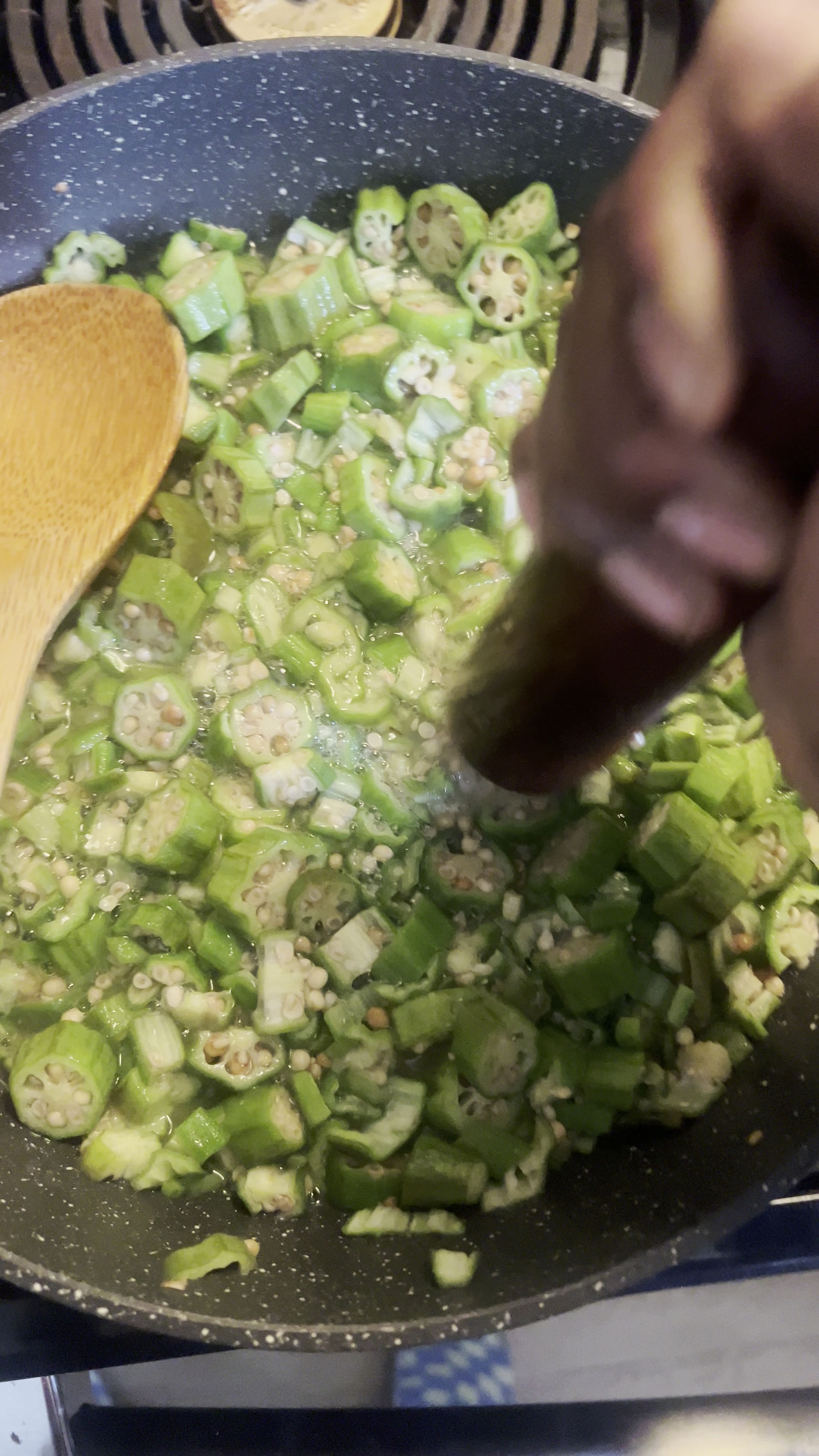
The lesson is easiest to understand when it is tasted. The pod carries its own architecture of water Inside every slice is evidence that relationship was already present before the cooking began. Sometimes the theory needs to return to the body before it can become useful. 
Nothing leaves the system. Flavor moves from shell to powder, from powder to broth. Before the pot. Before the draw. Before the soup. Every ingredient arrives carrying its own work 
Water leaves. Concentration remains. Another lesson in transformation. The cut changes the behavior. Same plant. Different architecture. Different relationship to water.
Because this soup is not simply food.
It is texture.
Atmosphere.
Viscosity.
Heat.
Mineral.
Touch.
The okra creating threads from bowl to tongue and back again.
Slimy in the most holy sense of the word.
Coating.
Softening.
Pulling me through memory I do not consciously own but somehow still recognize.
Threads weaving me back through and toward Black futures simultaneously.
//// THE JOY OF EATING WITH MY HANDS ////
And then there is the eating itself.
Washing my hands before the meal.
The small ritual of it.
Fingers testing for too hotness and diving in anyway.
Pinching the rice ball gently.
Dragging it through the soup.
Feeling the slickness of okra against skin before tongue.
No utensils separating me from the bowl.
No distance.
No performance of neatness.
Just touch.
And joy.
The joy of licking every finger.
Finger swipes left in the bowl.
The final streaks of oil and pepper and okra gathered intentionally because nothing this alive should be wasted.
Stomach full of the holiest spirit.
And I know that sounds saccharine.
But I do not care.
Because there is something spiritually rearranging about feeding the body foods it has been grieving for across generations.
I think Western food culture trains people toward separation.
Dryness.
Containment.
Efficiency.
Individual portions.
Controlled textures.
But okra soup asks you to enter the bowl fully.
To slow down.
To feel.
To touch.
To receive.
And maybe that is why I cannot stop thinking about it.
Because this soup feels less like consumption and more like return.
//// THE FUNK IS CLEVER ////
I laugh thinking about how quickly I fell in love with iru because objectively the smell is strong.
Funky.
Earthy.
Fermented.
Alive.
But once it hits the hot oil and joins the fish and tomato and okra something magical happens.
The funk becomes intelligent.
Not overwhelming.
Not loud for the sake of loudness.
Just deep.
A bass note moving underneath the entire pot.
Holding everything together quietly.
I also kept thinking about how familiar iru felt once it settled into the pot.
Not familiar in the sense that I grew up eating fermented locust beans.
I didn’t.
But familiar in the way deep dark gumbo roux feels familiar to many Black Americans.
That deep coffee-colored roux.
That near-burnt richness.
That earthy smoky funk sitting low beneath the bowl.
Iru carries a similar depth.
Not identical.
But connected.
An extension of the same flavor language that survived enslavement and crossed waters with us.
Because gumbo itself is already evidence of rupture and continuation happening simultaneously:
West African okra traditions.
French roux techniques.
Indigenous land.
Forced migration.
Smoke. Seafood.
Thickness.
Time.
And now here I am standing in my kitchen realizing that the funk of fermented locust beans reaches even further backward than the land that slavery tied us to.
The body recognizes the continuity immediately.
As if the tongue has been searching for the missing bass note all along.
And I think that is what ancestral cooking often is: deep support structures hidden beneath flavor.
Things working on the body long before language arrives to explain them.
And this soup is absolutely working on me.
Not just physically.
Spiritually.
Sensorially.
Neurologically.
I look forward to its messy goodness every single day.
And that anticipation itself feels healing too.
Because maybe the body does not simply want to survive.
Maybe the body wants to feel held.
And maybe sometimes that feeling arrives:
through smoke.
through fermentation.
through slime.
through touch.
through the bowl itself.
Tongue Check

Taste the air.
Taste the plate.
Taste what remains.
What is sweet.
What is bitter.
What is missing.
The tongue always knows.
I Eat Tings A study of the tongue, memory, and diaspora through food. Each dish is a portal.
✺Okra Soup — Threads Back to Black Futures | Iru, Okra & Black Food Memory


Comments