


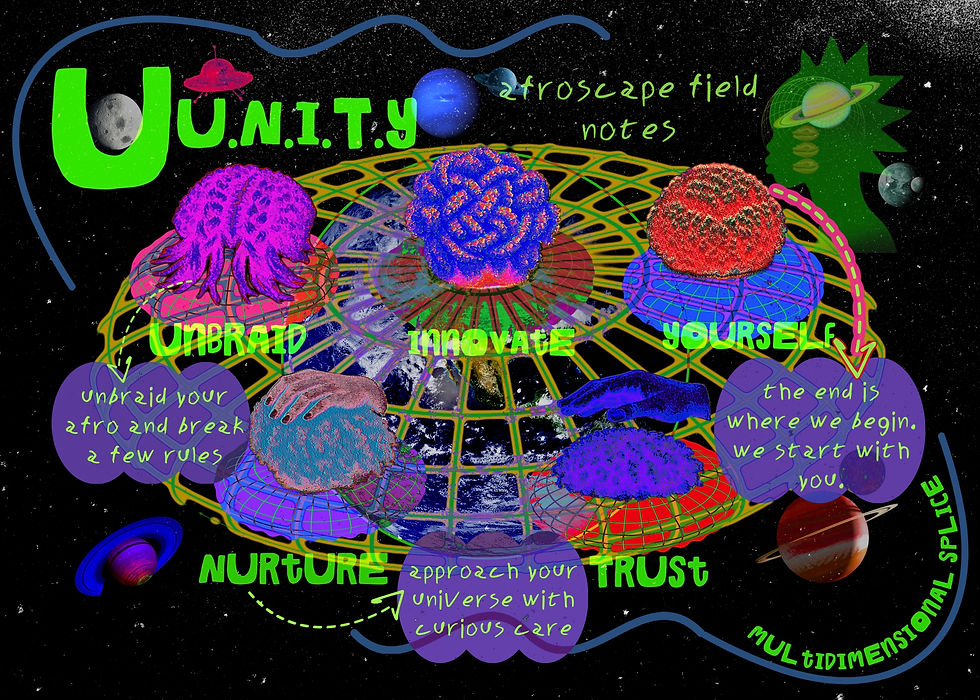
U is for U.N.I.T.Y.

Unbraid.
Nurture.
Innovate.
Trust.
Yourself.
The hand returns to the scalp.
The body remembers it was never meant to tend alone.

Afro Hair Tings
Afro care is communal power.
Before it became an industry, the hand meeting the scalp was already an exchange: attention moving through touch, knowledge passing between bodies, time being made for somebody else. Hair care gathered us close enough to notice tenderness, tension, fatigue, growth and change.
The village was not only a place. It was a way of holding one another. U.N.I.T.Y. asks what becomes possible when care connects the body back to that relationship—and when we stop selling our own culture back to one another as though extraction were the only future Black beauty could have.
◉)) I Hear Tings — Queen Latifah, “U.N.I.T.Y.”
Queen Latifah’s “U.N.I.T.Y.” belongs here because it refuses unity as a decorative promise. The song demands an account of how Black bodies—especially Black women’s bodies—are spoken to, touched, disrespected and expected to absorb harm for the sake of togetherness.

That distinction matters to Afro care. A village is not restored because everybody claims community. Unity has to become material in the encounter: respect, bodily authority, protection, reciprocity and the refusal to make degradation the admission price for belonging.
The track spells the word so the practice cannot hide inside the slogan. Here, U.N.I.T.Y. becomes a care instruction:
Unbraid.
Nurture.
Innovate.
Trust.
Yourself.
Float it for intention wherever you listen to your music tings.
U Is for U.N.I.T.Y.

Care Connects the Body Back to the Village

AfABC · U/21
Unbraid

Unbraiding is not simply taking down a style. It is loosening the rules that were braided into the body with it.
Black hair culture is repeatedly forced into binaries: done or undone, professional or unprofessional, natural or altered, masculine or feminine, cared for or neglected. Even the part can become a command to divide what the scalp holds together.
What are you parting—and what are you imparting—to the scalp beneath your hands?
To unbraid the binary is to let the crown become more complicated than the category prepared for it. It is to release the body from proving that its care is respectable, legible or profitable.
Some rules can leave with the style.
Nurture

The scalp is fertile soil. Not because it must constantly produce, but because it is living terrain that responds to what reaches it.
A hand on the scalp can carry force. It can also carry patience. It can notice where the body tightens, ask before continuing, change direction, loosen its grip or stop. Nurture enters when touch becomes responsive rather than automatic.
This is one of the quiet technologies of Afro care: shared platonic intimacy. We sit close. We hold a head with care. We learn another body’s boundaries through attention. We make room for tenderness that is neither romantic nor transactional.
The exchange can restore more than hair. It can teach the body that closeness does not have to become capture.
Innovate

Innovation is not another product arriving to explain Blackness to Black people.
It is not a new container for an old extraction. It is not hustling our own culture to one another while somebody farther from the scalp accumulates the power.
Afro hair has always generated form through adaptation: hands answering density, texture, time, weather, access, sensation and desire. Innovation begins when we trust that living relationship enough to make from it—not merely reproduce what the market has already approved.
What can Black beauty become when survival is no longer its only assignment? What forms appear when the crown is allowed to be curious?
Our beauty is not raw material waiting for somebody else to discover it. Our power lives in what we can build together without surrendering the relationship that made the knowledge possible.
Trust

Trust does not mean allowing every hand access to the crown.
Trust is built when the hand listens. When no becomes information. When discomfort is not treated as the price of beauty. When the person being tended remains the authority inside the exchange.
The village is not restored by romanticizing community. It returns through accountable relationships: people capable of touching without claiming, helping without controlling and sharing knowledge without turning one another into markets.

Trust yourself enough to notice what care feels like in your body. Trust one another enough to let that knowledge change the way the hand moves.
Yourself

The acronym ends with yourself, but it does not end in individualism.
Yourself is where consent becomes possible. Yourself is the body that can feel the difference between being held and being handled. Yourself is the knowledge that returns to the circle with enough clarity to participate without disappearing.
Care connects the body back to the village because the body arrives as a full participant—not a surface, not a service and not a resource to be mined.
The end is where we begin.
Afro care is communal power.
U is for U.N.I.T.Y.
Post Identity
Field | Entry |
Letter | U |
Letter Phrase | U Is for U.N.I.T.Y. |
Essay Title | Care Connects the Body Back to the Village |
Published Title | U Is for U.N.I.T.Y. — Care Connects the Body Back to the Village |
Series | The Afro ABCs |
Sequence | U/21 |
Primary Portal | The Afroscape • Afro Tings |
Book Connection | The Afroscape: Hair as Tech(know)logy — A Field Guide |
Central Thesis | Afro care is communal power. Hand-to-scalp care reconnects the body to accountable relationship when tenderness, consent, shared knowledge and invention replace extraction and control. |
Body Coordinate | Crown • Scalp • Hands • Nervous System • Community |
Primary Methodology | Mycelial Sankofa |
Core Refrain | Afro care is communal power. |
Return | The end is where we begin. We start with you. |
Banner Marker | AfABC · U/21 |
Cosmos Watershed
Watershed | Tributaries |
Watershed | Afro care as accountable communal relationship |
Relationship | Hand, scalp, crown, nervous system, self-knowledge and village |
Hom(e)ie | The tending hand that listens before it touches |
Origin | U Is for U.N.I.T.Y. |
Expansion | Shared platonic intimacy, unbraiding the binary, the scalp as living terrain, Black beauty beyond extraction and self-trust as a condition of collective care |
Application | Ask, listen, adjust, stop when needed and share knowledge without claiming ownership over another body. |
Lineage | The Afro ABCs • The Afroscape • Hair as Tech(know)logy • Black communal hair-care practices |
Counter Currents | Colonial cosmetology, compulsory respectability, binary hair rules, unauthorized touch, pain treated as beauty and hustling Black culture back to Black people |
Through the Six Waters
Water | Entry |
Still Water | The pause before contact—enough quiet for the body to register comfort, tension, desire or refusal. |
Flowing Water | Knowledge moving between hands, scalps, crowns and generations without becoming private property. |
Deep Water | The inherited intimacy and embodied intelligence carried through Black communal hair care. |
Turbulent Water | Extraction, disrespect, compulsory pain and markets that separate Black beauty from the relationships that made it. |
Tidal Water | Care moving between self and community through receiving, responding, correcting, resting and returning. |
Sacred Water | Consent, bodily authority and accountable tenderness making the crown a site of relationship rather than access. |
Cosmos Coordinates
Coordinate | Entry |
Primary Portal | The Afroscape • Afro Tings |
Connected Waters | Still • Flowing • Deep • Turbulent • Tidal • Sacred |
Tings Connections | I Touch Tings • I Know Tings • I Hear Tings • Afro Tings |
Primary Methodology | Mycelial Sankofa |
Methodological Practice | Reading hair care through touch, consent, bodily response, cultural transmission and the relationships that hold knowledge |
Cosmos Concepts | Shared platonic intimacy • Afro Autonomic • unbraiding the binary • scalp as living terrain • Black beauty beyond extraction • village power |
Relational Coordinate | Self and village held together without allowing community to overrule bodily authority |
Temporal Coordinate | Before the beauty industry • within the present exchange • toward Black beauty futures beyond extraction |
Orientation | Inward • Relational • Reciprocal |
Core Refrain | Afro care is communal power. |
Expansion Principle | The village returns through accountable relationship, not compulsory access. |
Body Coordinate | Crown • Scalp • Hands • Nervous System • Community |
Banner Marker | AfABC · U/21 |
Cosmos Constellations
Constellation | Connection |
The Afro ABCs | U/21 continues the reverse movement from Z toward A. |
The Afroscape | Positions Afro hair as living terrain shaped through body, atmosphere, touch, time and relationship. |
Mycelial Sankofa | Returns Black hair knowledge through a living network rather than one authorized source. |
Shared Platonic Intimacy | Names closeness that does not require romance, transaction or ownership. |
Afro Autonomic | Connects the scalp and crown to regulation, sensation, tension, safety and response. |
Unbraiding the Binary | Releases the crown from done/undone, professional/unprofessional, natural/altered and masculine/feminine. |
Black Beauty Beyond Extraction | Refuses to make Black culture raw material for resale or discovery. |
Queen Latifah — “U.N.I.T.Y.” | Makes respect, bodily authority and protection conditions of unity. |
Atmospheric Field and Embodiment
Field | Entry |
Atmospheric Field | Touch • Pressure • Tension • Warmth • Time • Product • Sound • Proximity • Permission |
Embodiment | The body registers whether it is being held or handled. Care becomes legible through breath, tension, consent, adjustment and the freedom to stop. |
Binary Disruption | Done/undone, cared for/neglected, professional/unprofessional, natural/altered and individual/community cannot contain the crown’s full life. |
Material Practice | Ask before touching, notice bodily response, loosen force, change direction, stop when needed and keep knowledge in relationship. |
U establishes Afro care as a relational technology. The crown is not an isolated surface, and the hand is not a neutral tool. Scalp, hair, nervous system, memory, culture and community meet inside every act of tending.
The village becomes a practice rather than a nostalgic location. It is made through consent, reciprocity, correction, curiosity and shared invention. The body returns to the village as a full participant—not a surface, service or resource to be mined.
U practices Mycelial Sankofa by returning Black hair knowledge through the relationships that carried it: hand to scalp, body to body, correction to practice and self-knowledge back to community.
Unbraiding makes discernment possible. We retrieve the tenderness, skill and collective intelligence that still nourish; notice what control and extraction distorted; compost the rules that cannot carry us forward; and innovate from the living relationship that remains.


Comments