


Social Rank of Fatness

The Track 🎵 BigXthaPlug, “The Largest” - I Hear Tings
Social Rank of Fatness
There was a point when I realized I was absolutely not going to make it in fat community.

I was at the very beginning of trying to come back into relationship with my body (2022). And I mean the beginning.
I had stopped drinking.
That was about it.
I wasn’t doing some massive wellness transformation. I wasn’t running five miles every morning. I wasn’t weighing chicken breasts and broccoli and posting gym selfies.
I was on the fucking floor.
Stretching.
Trying to figure out what had happened to me.
Trying to understand what my body had been carrying.
Trying to let my mind and my body expand enough that maybe they could start finding each other again.
I was talking to Tess Holliday. Tess had nominated me for a Good Morning America award the year before, during COVID. I didn’t know them before that, and at first, being seen by someone with that kind of visibility in fat community felt affirming. I thought it was genuine.
I don’t remember the exact conversation anymore, but I remember telling Tess that I was stretching or doing yoga.
And they got upset.
They understood what I was saying about movement in my own body as commentary on theirs.
I Was Fat Before Fat Community

I did not discover being fat through fat community.
I had already lived an entire life in a fat body.
And my fat body had moved.
I modeled.
I performed.
I traveled.
I worked.
I fucked.
I danced.
I stretched.
I made shit.
I wore shit.
I showed up.
My fat body itself was not what incapacitated me.
Other tings did that.
Trauma did.
Masking did.
Being unidentified inside my own neurodivergence did.
Living inside environments that required things from my nervous system that my nervous system could not sustainably provide did.
But fatness itself?
I had already figured out how to live there.
And strangely, it wasn’t until I entered more deeply into the discourse of fat community that the body started acquiring all these fucking borders.
Small fat.
Mid-fat.
Large fat.
Superfat.
Infinifat.
Suddenly everybody needed a classification.
I understand the argument underneath some of that language.
Bodies at different sizes encounter different material barriers. Clothing access changes. Seating changes. Medical discrimination changes. Transportation changes. Architecture changes. The way strangers interact with you changes.
We need ways to talk about material difference.
But that isn’t always what I experienced those words doing.
I watched description become caste.
I watched a politics supposedly organized around bodies excluded for being too large construct another system for deciding whose body gave them the most authority.
You can’t sit over here.
You aren’t fat enough.
Your experience isn’t the same.
Defer to the larger body.
Center the larger body.
Bro.
We escaped one fucking cafeteria table and built another one.
Belonging

I think belonging is part of what makes this complicated.
Fat people have been told forever that we don’t belong.
You don’t belong in this clothing.
As my momma pulled and tugged on clothing.
Shamed for a nipple poking through a shirt.
Too much thigh jiggle under a skirt that I had no control of.
Consent removed.
Yank and pulled at like property.
You don’t belong in this seat.
You don’t belong in this photograph.
You don’t belong in desirability.
You don’t belong in fashion.
You don’t belong onstage.
You don’t belong in health.
You don’t belong in movement.
You don’t belong until your body changes.
Then fat community arrives and says:
You belong here specifically because of this body.
That can be powerful.
It can also become dangerous when belonging becomes more important than relationship.
Because now I have another question:
What are you willing not to see in order to remain who the community rewards you for being?
They Saw Me

I thought being seen meant something.
Now it is one of those things I wish had never happened.
I wish Tess Holiday had never “found” me.
I wish I had never followed them.
I wish they had never latched onto whatever they latched onto in me.
Not because I regret being visible.
Because I misunderstood what visibility meant.
I thought they were doing what I would have been doing.
That distinction has cost me a lot in my life.
When I reach toward somebody, I mean it.
When I see some random person on Instagram struggling and I ask if they need something, I am actually trying to help.
When I support somebody’s work, I believe I am participating in an ecosystem.
When somebody tells me they want to work with me, I assume some fucking work might eventually happen.
I was reading other people’s gestures through my own relational ethics.
Then I got closer.
And proximity gave me more information.
The work never came.
The relationships weren’t what I thought they were.
When I saw fat people visibly struggling online and tried to get people support, I began encountering something I had not understood from outside the frame.
Some of what I thought was community began feeling like social-media acting.
Performance.
Positioning.
Strategy.
I was being genuine inside something that increasingly did not feel genuine to me.
And that is a dangerous place to be.
Because you don’t know you’re in a transaction when you think you’re in a relationship.
Step Three Feet Outside the Frame
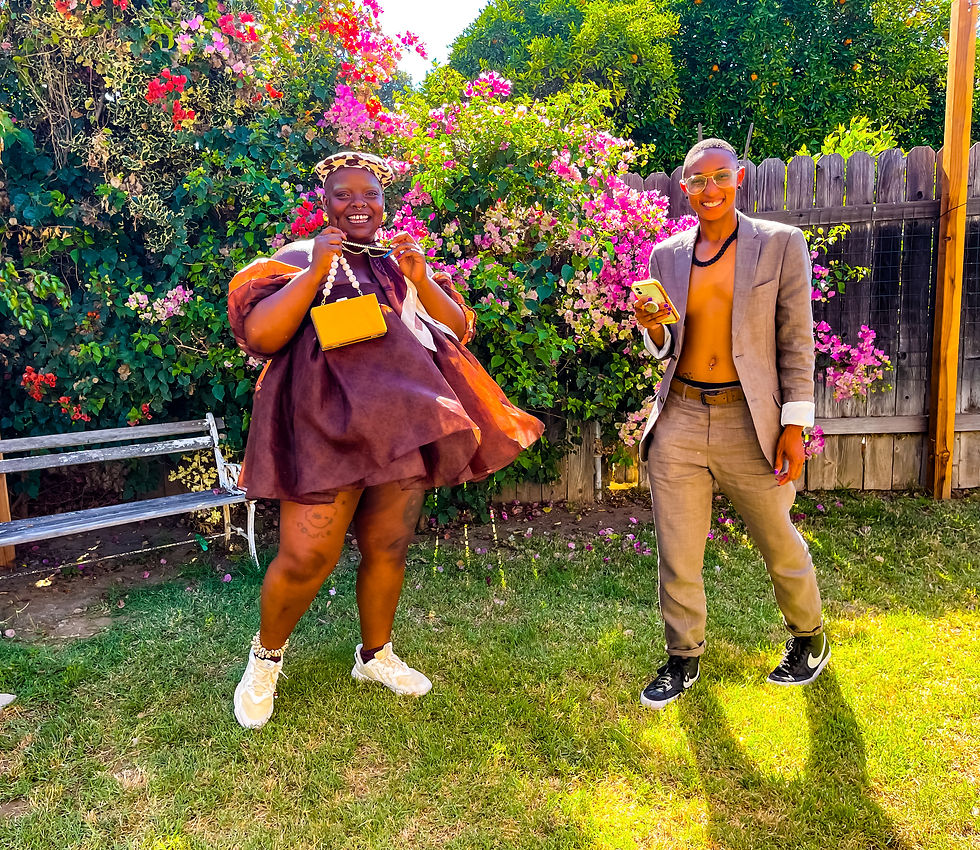
I eventually spent physical time around some of the biggest personalities in fat fashion.
I sat in one well know fat influencers barren living room.
I met people whose online presence had been enormous to me before I encountered them in physical space. And proximity began teaching me something that social media couldn’t.
The point wasn’t a fat influencer’s house.
The point was the frame.
Social media had taught me to experience fragments as wholes. A photograph. A room. A caption. A declaration of confidence. A language of community. A politics of inclusion.
Then I stepped three feet outside the frame and got more information.
Not from one party.
Not from one person.
Through pattern.
The enormous online performance of unapologetic fatness did not always correspond with the freedom, openness or community I expected to encounter in person.
And I had expectations because I had participated.
I supported the work. I purchased from the lines. A pair of boots from said influencer appears in my ELOQUII Black Creators Project shoot.

That photograph means something different to me now.
Not because I need to erase the boots from my archive. The photograph is evidence of what I understood relationship to mean at the time.
I bought the thing.
I wore the thing.
I put the thing inside my own art.
I thought support participated in relationship.
Proximity taught me that consumer support, representational proximity and shared fatness did not necessarily produce reciprocity.
That was difficult information for me to receive.
But it was information.
Relationship leaves evidence. And so does the absence of relationship.
The boots stayed in the photograph.
What changed was what I knew when I looked at them.
The Slot Was Filled

I entered those spaces as a dark-skinned fat Black body and repeatedly experienced myself as surplus.
There was already some who filled that slot.
And standing in that room, I had a thought that became harder to shake the longer I spent in these spaces:
The slot was filled.
I was beginning to recognize the architecture of the room.
Fat.
But which fat?
Black.
But which Black?
Dark-skinned.
But do we already have one?
Famous enough?
Useful enough?
Connected enough?
Photogenic in the correct way?
Can you make something for us?
Can you bring something into the room?
Can your Blackness become useful collateral for whatever somebody else is building?
Will you do the work for free?
I remember being asked to do creative direction on the spot. It was Tess’s bday I obliged. There was a bougainvillea in the back yard.
A garage element.
Boom.
The host was displeased at my flex in their backyard.
I increasingly felt like I had been approached as free Black collateral.
Something useful.
Something that could be collected.
Something that could potentially produce.
But not somebody who needed to be known.
That is not community.
That is casting.
And suddenly all the language around inclusion started sounding different.
Because inclusion can still leave the architecture completely intact.
You can diversify the fucking cast without changing who owns the theater.
I Was Fat Before They Saw Me

This is what I had to remember.
I had already been living.
I had already been making.
I had already been wearing clothes.
I had already been creating images.
I had already been traveling.
I had already been moving through my body.
Being recognized by fat celebrity culture did not create any of that.
But for a moment, being seen by people with enormous platforms made it feel like perhaps I had been admitted somewhere.
Then I got close enough to understand:
I didn’t want the fucking membership.
And shortly afterward, my life became considerably less glamorous.
I ended up on the floor.
Stretching.
Funny how that works.
I had been publicly seen.
Then I had to learn how to see myself.
The Body Cannot Give Inconvenient Information

There is a phrase that circulates constantly in fat spaces.
You cannot tell how active somebody is by looking at their body.
That’s true.
You can’t.
You cannot look at a fat stranger and know whether they exercise.
You can’t know their cardiovascular health.
You can’t know their disability.
You can’t know what they eat.
You can’t know their medications.
You can’t know their genetics.
You can’t know their fucking knees.
But a true statement can still become a shield.
Because eventually I started watching people use statements like this not merely to resist stereotyping but to avoid asking themselves a much more uncomfortable question:
Am I actually moving my body?
Not:
Can fat people move?
Of course we fucking can.
Not:
Do I deserve dignity if I don’t exercise?
Of course you fucking do.
The question is:
What is actually happening in my body?
And somehow even asking that can become politically suspicious.
Any inquiry into the condition of a fat body becomes fatphobia.
But then what happens when the body actually has something to say?
What happens when something hurts?
What happens when your stamina changes?
What happens when your mobility changes?
What happens when your bloodwork changes?
What happens when your relationship with food changes?
What happens when nothing is wrong and the doctor is just being a fatphobic asshole?
All of that is information.
Fat liberation cannot require dishonesty about the body.
Otherwise we have created another system where the body is allowed to speak only when it confirms the politics.
Relationship Leaves Evidence

I don’t think movement has to make somebody thin.
That’s not what I’m saying.
Bodies respond differently.
Bodies change differently.
Strength can increase without dramatic weight loss.
Balance changes.
Endurance changes.
Flexibility changes.
Cardiovascular capacity changes.
Technique changes.
Pain changes.
The desire to move can change.
And sometimes the outside of the body changes too.
But I think relationship leaves evidence.
Not necessarily smaller-body evidence.
Evidence.
If I have been in relationship with something, eventually that relationship changes something.
Maybe it changes me.
Maybe it changes the environment around me.
Maybe it changes what I know.
Maybe it changes what I can do.
Maybe it changes what I want.
Maybe it teaches me how to return.
But there should be some evidence that contact occurred.
Otherwise what the fuck are we calling relationship?
I Have Lost Weight Before
This is not my first bodily transformation.
That’s important.

I did Atkins in college.
Colonial Wild Fire.
Burn the shit down.
Change the body.
I lost a lot of weight.
Then around the end of graduate school, it happened again differently.
I was under enormous stress.
My OCD was driving.
I was going to the gym constantly.
And my body changed.
Again.
Neither experience taught me how to inhabit myself.
That’s what I understand now.

A changed body is not necessarily evidence of an embodied relationship with the body.
You can lose weight while completely disconnected from yourself.
You can exercise every fucking day because compulsion is driving the car.
You can control food without understanding nourishment.
You can achieve the culturally legible result while the ecology underneath it remains untouched.
And if the ecology remains untouched, what happens when the intervention ends?
I know what happened to me.
The weight came back.
Because I had changed the body without building somewhere for the changed body to live.
Cultivation

When I started again in 2022, I knew it had to be slow.
I didn’t necessarily have all this language yet.
I just knew I couldn’t do that shit again.
I couldn’t burn myself down and call the smoke transformation.
So I started on the floor.
Stretching.
Then I returned.
And returned.
And sometimes stopped.
Life happened.
Trauma happened.
Money happened.
My nervous system happened.
There were periods where practices disappeared because I needed to survive whatever was directly in front of me.
Then I came back.
That return matters.
Because what I’ve been building isn’t a perfect routine.
It’s cultivation.
Cultivation requires patience.
You cannot scream at the soil because the seed hasn’t become a fucking tomato by Thursday.
You have to develop the conditions.
Pay attention.
Respond.
Learn what this particular organism does in this particular environment.
And eventually the practice becomes embedded enough that when something falls out of place, you know some of the routes back.
Movement is becoming that.

There are weeks I might get one kettlebell workout.
That doesn’t mean the relationship disappeared.
I know the kettlebell.
My body knows it.

I know what happens when I return.
I’ve been doing shoulder stand and plow consistently for years, including when there was substantially more fat on my body than there is now.
The practice did not require thinness.
The practice required relationship.
Hom(e)ie, What Are the Abs Doing?
My stomach still fucks with me.
I don’t want to pretend embodiment means I float through the house every morning in complete spiritual alignment with every inch of my fat body.
Absolutely the fuck not.
There are days I look in the mirror and do not like my stomach.
My stomach expanded through everything my body went through.
Sometimes I catch myself sucking it in.
And this is where embodiment becomes hilarious.
Because I have also had to learn how to properly contract and engage my abdominal muscles.

We praise the Sacroliac.
Your core supports your framework.
It changes how you walk.
It supports movement.
I spent weeks just realigning walking.
Hip movement.
Core engagement.
So now there are moments where I have to distinguish:
Am I engaging my fucking core?
Or am I trying to make my stomach disappear?
Same muscles.
Completely different assignment.
Hom(e)ie, are we stabilizing the spine or trying to look good for colonial boo boo?
Because binary femininity taught me another version of abdominal engagement.
Suck it in.
Smaller.
Tighter.
Make the silhouette more desirable.
Make the man look.
Make the woman look.
The way I use to pop my right hip in images
Oooh Fashion pose.
More like hips unbalanced and unsupported and was a release of pressure that happened to look cute on camera.
That movement is organized around somebody else’s gaze.
Core engagement is organized around my fucking skeleton.
That is what relationship teaches you to distinguish.
Not simply:
Did the muscle contract?
But:
Who was the contraction for?
The Pantry

The same cultivation eventually changed food.
Siir and I had talked for years about sustainability and decolonizing our palate.
But talking wasn’t the same as doing it.
And importantly, the politics did not come first.
My body did.
As I became more sustainable inside my own body, I started asking different questions.
How do I sustain this?
Not:
How do I make this body smaller?
How do I make sure I have quality of life inside this body?
How do I support what is actually happening here?
That sent me outward.
Because the body isn’t a closed system.
I started looking at ancestry.
Precolonial foodways.
Generational patterns in my family.
What ingredients traveled.
What colonialism disrupted.
What migration changed.
What foods actually make my body respond differently.
And then our cooking started changing.
Then the grocery trips changed.
Then ingredients changed.
Then preparation changed.
Then our palate changed.
Then the pantry changed.
This spring and summer, I started looking around and realizing:
Oh shit.
The pantry is actually becoming what we were talking about years ago.
Not because we bought a fucking starter kit for decolonizing your pantry.
Though i’m def gonna do a starter kit post.
Because relationship built evidence.
We cooked.
We tasted.
We learned.
We fermented.
We fucked things up.
We made things again.
We found stores.
We followed ingredients.
We paid attention to what our bodies did afterward.
The ancestors became information, not reenactment.
And slowly the world around our bodies changed.
That’s another kind of bodily transformation.
Relationship leaves evidence, but the evidence isn’t always visible on the body. Sometimes the evidence is the world the relationship taught you to build around the body.
Open the pantry.
There’s the evidence.
Fat Politics Cannot Be Another Diet
This is where I get frustrated with some fat politics.
Not because fatphobia isn’t real.
It is Hella real.
Not because everybody needs to lose weight.
They don’t.
Not because fat people owe anybody health.
They don’t.
Not because every health condition in a fat person comes from fatness.
It fucking doesn’t.
I am asking something else.
Can your politics survive information from your body?
Because if the answer is no, we have built another diet.
Not a food diet.
An information diet.
Only consume information that protects the identity.
Only speak bodily truths that maintain belonging.
Only acknowledge change that doesn’t destabilize the community.
Only move in ways that cannot be interpreted as aspiring toward something politically suspicious.
And I cannot live like that.
I already spent too much of my life being given somebody else’s map for my body.
I am not taking another one because this one has inclusive graphics.
The GLP-1 of It All
And yes, I notice the contradiction of watching a culture built around fat acceptance arrive in the age of GLP-1 drugs.
My Serena Williams Nikes have hit the archive because girl what in the what?
I’m not interested in litigating individual people’s prescriptions.
I don’t know their bodies.
I don’t know their medical needs.
And I am not their fucking doctor.
My question is simpler.
Is the juice worth the squeeze?
For me?
I look at the intervention, the unknowns, the side effects being discussed, what I would potentially be asking my body to tolerate, and I don’t want that route.
That’s me.
But I also have a larger question.
If you don’t know how to be with yourself before an intervention changes your body, what happens when the intervention itself gives your body new information you don’t know how to receive?
Smaller doesn’t automatically mean embodied.
I know.
I’ve been smaller.
Twice.
I wasn’t more embodied.
I was just smaller.
That’s not the same fucking ting.
Protecting Fat People or Protecting Fatness?
Maybe that’s the question underneath some of this.
Were we protecting fat people?
Or did we start protecting fatness?
Because those aren’t necessarily the same project.
Protecting fat people means a fat person deserves medical care without humiliation.
Clothes.
Seats.
Access.
Sex.
Pleasure.
Work.
Movement.
Food.
Safety.
Complexity.
Humanity.
It means their body is not evidence of moral failure.
It means they do not owe anybody thinness.
But protecting fatness can become something else if bodily change begins threatening membership.
What happens when someone starts moving differently?
Eating differently?
Thinking differently?
What happens when their body changes?
What happens when they discover something they were doing wasn’t working?
What happens when they decide something about their body needs attention?
What happens when they don’t?
Can they still belong?
That is the question I wish fat community had asked me when I was on the floor.
Not:
Why are you telling me you’re stretching?
But:
What are you finding down there?
Social Rank of Fatness

I think this is ultimately why the hierarchy bothered me so much.
Small fat.
Mid-fat.
Large fat.
Superfat.
Infinifat.
The problem isn’t acknowledging that bodies encounter different material conditions.
Of course they do.
The problem is what happens when those material differences become social rank.
Because then the body becomes credential.
And once the body becomes credential, changing the body potentially changes your authority.
That’s dangerous.
Now somebody can become invested in remaining legible to the community.
Remaining the icon.
Remaining the representation.
Remaining the person whose body gives them access to the microphone.
And again:
What are you willing not to see in order to remain who the community rewards you for being?
Your health?
Your relationships?
Your children?
The fact that being fetishized isn’t the same as being loved?
The fact that somebody desiring your fatness doesn’t mean they’re safe?
The fact that followers aren’t community?
The fact that your politics may be excellent while your actual life is falling the fuck apart?
The fact that maybe something needs to change?
I watched enough in Los Angeles and in fat-fashion spaces to know that visibility can become its own drug.
Being famous and fat can become something a person has to maintain.
But the body doesn’t exist to maintain the brand.
At least mine doesn’t anymore.
Can You Be Changed by the Ting?
This is the question I’m increasingly asking about everything.

Can the person teaching the ting be changed by the ting?
Can somebody teaching astrology actually be changed by studying the whole chart?
Can somebody teaching embodiment be changed by their own body?
Can somebody talking about community be changed by what the people around them actually need?
Can somebody talking about fat liberation receive information from their fat body that complicates what they already believe?
Can I?
Because I don’t get an exemption.
I cannot build an intellectual and artistic practice around embodiment while living outside my own.
I can’t tell people to touch the ting while refusing to touch myself.
And touching yourself does not mean liking everything you find.
That’s another lie.
Sometimes I touch my body and discover capacity.
Sometimes pleasure.
Sometimes grief.
Sometimes strength.
Sometimes my stomach pisses me the fuck off.
Okay.
Sit that ass down.
Stay.
Don’t immediately turn the discomfort into an intervention.
Don’t turn it into a slogan either.
Touch it.
What is actually happening?
What does the body say?
What does the history say?
What does the environment say?
What am I doing?
What am I not doing?
What needs tending?
What am I assuming?
What have I been avoiding because the answer might complicate the person I think I am?
Then return.
Sit That Ass Down

That’s what four years have taught me.
Contact is not enough.
You have to stay.
Cultivation means returning long enough for the ting to change you.
And long enough for you to learn how to change the conditions around the ting.
That’s what happened with movement.
That’s what happened with food.
That’s what happened with the pantry.
That’s what is happening with my stomach.
That’s what is happening with my body.
I am not finished.
Thank fucking God.
Finished is another fantasy.
I am cultivating something.
And cultivation leaves evidence.
Not necessarily the evidence Instagram knows how to reward.
Not necessarily a dramatic before-and-after.
Not necessarily thinness.
Sometimes the evidence is a kettlebell.
Sometimes it’s knowing how to return after three weeks of chaos.
Sometimes it’s an ingredient that wasn’t in your kitchen four years ago.
Sometimes it’s your hands knowing what to do before you have words for it.
Sometimes it’s catching yourself sucking in your stomach and asking:
Hom(e)ie, what are the abs doing?
Sometimes it’s realizing that the ting you once had to force yourself to do is becoming something you actually want.
Sometimes it’s opening the pantry.
Sometimes it’s simply being able to receive information from your body without immediately declaring that information either failure or liberation.
Right now it’s recognizing the seasonal flow of movement for me, and fall will be a new shift transitions from summers research and development with the Bespokecurry cosmos.
Because I don’t need another community to tell me what my body means.
I don’t need another ranking system.
I don’t need another identity that becomes so precious I have to protect it from reality.
I need relationship.
And relationship builds evidence.
So yes.
Touch the fucking ting.
But don’t touch it once and run back to the internet with a vocabulary word.
Touch it again.
Let it contradict you.
Let it embarrass your politics.
Let it ruin the theory if the theory was wrong.
Let it change the environment around you.
Come back when you stop.
Come back when life interrupts you.
Come back when you don’t like what you see.
Come back when you do.
Keep coming back until the practice starts becoming something you don’t have to perform.
And then sit that ass down long enough for the ting to talk back.
Social Rank of Fatness
Cosmos Watershed
Social Rank of Fatness begins on the floor. After years of living, moving, modeling, creating and traveling in a fat body, I entered fat community and encountered another architecture for sorting bodies: small fat, mid-fat, large fat, superfat, infinifat. Language meant to describe material differences could also become caste, credential and belonging.
Through fat-fashion spaces, social-media visibility, movement, previous weight-loss cycles, my stomach, kettlebells, food and the slow transformation of our pantry, I ask what happens when protecting an identity becomes more important than receiving information from the body itself. This is not an argument for thinness. It is an argument for contact, cultivation and a politics capable of surviving what the body actually says.
Watershed
Watershed | Tributaries |
Watershed | Deep Water |
Relationship | fat body / movement / belonging / community / cultivation / self |
Hom(e)ie | The fat body |
Origin | Beginning to stretch after stopping drinking and realizing that describing movement inside fat community could be interpreted as judgment of another fat person’s body |
Expansion | Fat-fashion culture, social rank, visibility, celebrity, colorism, tokenism, bodily information, previous weight-loss cycles, movement, GLP-1s, food, ancestral ingredients, sustainability, cultivation |
Application | Distinguishing liberation of fat people from protection of fatness as identity; developing bodily practices capable of receiving inconvenient information without immediately converting that information into shame, intervention or ideology |
Lineage | Fat childhood and adulthood → modeling and fashion → fat-community visibility → 2021 recognition/proximity → 2022 embodied return → movement and cultivation → ancestral food inquiry → spring/summer 2026 pantry |
Counter Currents | Fatphobia · diet culture · body hierarchy · social-media performance · celebrity culture · tokenistic inclusion · colorism · compulsory belonging · bodily denial · weight loss as automatic evidence of health · fatness as automatic evidence of liberation · Colonial Wild Fire |
Cosmos Coordinates
Coordinate | Entry |
Primary Portal | I Know Tings |
Connected Waters | ≋ Deep Water · ≋ Tidal Water |
Tings Connections | I Move Tings · I Adorn Tings · I Eat Tings · ◉≋ Afro Theory / Afroscape |
Primary Methodology | Contact Practice |
Methodological Practice | Returning to the body through movement, food, sensory information, archive, interruption and repetition long enough for relationship to produce material evidence |
Cosmos Concepts | Relationship Builds Evidence · Cultivation · Colonial Wild Fire · Social Rank · Contact · Reality vs. Construction · The Body as Information |
Geographic Coordinate | body ↔ floor ↔ fat-fashion spaces ↔ grocery store ↔ kitchen ↔ pantry |
Relational Coordinate | body ↔ gaze ↔ movement ↔ community ↔ visibility ↔ food ↔ ancestor ↔ environment |
Temporal Coordinate | earlier weight-loss cycles ↔ 2021 fat-community visibility ↔ 2022 return to the body ↔ 2022–2026 cultivation ↔ embodied present |
Orientation | autobiographical · fat · Black · neurodivergent · embodied · relational · archival · unsanitized |
Core Refrain | Relationship builds evidence. |
Expansion Principle | Contact is not enough. Cultivation requires returning long enough for the thing to change you and for you to change the conditions around the thing. |
Cosmos Constellations
Constellation | Connection |
I Know Tings | Primary constellation. The body becomes a participant in knowledge-making rather than an object whose meaning must be supplied by medicine, politics, social media or community. |
I Move Tings | Movement becomes relationship rather than punishment. Stretching, yoga, kettlebells, walking, shoulder stand, plow and core engagement produce information through repeated bodily contact. |
I Adorn Tings | Modeling, fat fashion, the ELOQUII Black Creators Project, Nadia Aboulhosn’s boots and proximity to fat-fashion culture expose the difference between representation, visibility, inclusion and relationship. |
I Eat Tings | Food becomes part of the cultivation practice after bodily sustainability produces questions about nourishment, ancestry, ingredients and quality of life. The changing pantry becomes material evidence of relationship. |
◉≋ Afro Theory / Afroscape | Black embodiment, colorism, tokenistic representation, ancestral food knowledge, colonial bodily discipline and the recovery of relational practices locate fatness within a larger Black ecological and historical frame. |
Contact Practice | Touch the thing before theorizing the thing. Bodily contact is allowed to complicate ideology, identity and prior knowledge. |
Cultivation | Relationship develops through patience, repetition, interruption, adjustment and return rather than rapid transformation. The goal is not identical performance but an ecology capable of sustaining the practice. |
Relationship Builds Evidence | Relationship becomes materially legible through capacity, knowledge, changed environments, practiced return, bodily response and the structures built around the body. Evidence does not have to mean thinness or visible bodily transformation. |
Social Rank of Fatness | Size descriptors intended to communicate material differences can become social caste when body size begins distributing belonging, authority, authenticity and access within fat community. |
Visibility / Casting | Recognition and inclusion are not synonymous with relationship. Proximity to fat-fashion culture reveals how race, colorism, usefulness, celebrity and body size can operate as a casting grid even within supposedly expansive spaces. |
Colonial Wild Fire | Previous rapid weight-loss periods—including Atkins and compulsive exercise—changed the body without creating an ecology capable of sustaining embodied relationship. Transformation without cultivation becomes another burn-and-rebuild cycle. |
The Pantry | The pantry functions as environmental evidence: bodily sustainability led toward ancestral and precolonial food inquiry, which gradually changed shopping, cooking, ingredients, palate and the material ecosystem surrounding the body. |


Comments