


⟁≋)) An Unkindness of Ghosts — The Body That Could Not Acclimate Quietly

Reading Rainbow Tings

Reading Rainbow Tings is a space for the books, ideas, and Afrofuturist worlds that move me—curated through my own reading practice and obsessions. It’s about exploring texts that expand the mind, ignite imagination, and connect us to histories, futures, and embodied ways of knowing. Reading here is active, reflective, and deeply personal, inviting engagement that shapes how we see, think, and inhabit the world.

A Reading Note
This is not a book review.
Reading Rainbow Tings follows what reading does to the body: what moves, irritates, opens, floods, recirculates, refuses and remains after the book closes. I am less interested in determining whether a book is good than in noticing what kind of ecosystem it creates inside and around me.
An Unkindness of Ghosts left rust in the water.
I had finished the book and moved on before I wrote this essay. I thought I had skipped it. Turns out I was still developing the sensory equipment necessary to receive what it had already left behind.

◉)) I Hear Tings — An Aural World
Moor Mother — Analog Fluids of Sonic Black Holes
Analog Fluids of Sonic Black Holes enters Matilda through multiple openings. Analog is the ship’s aging machinery and the inherited social systems people keep forcing to function. Fluids are blood, waste, water, condensation, medicine, agriculture—the circulation keeping this floating slave ship alive. Sonic black holes are space, swallowed histories, ancestral signals, and all that disappears while continuing to exert pressure.
This is not an easy or casual listen. It grates. It scrapes. It is abrasive enough to make the body feel like skin being dragged across metal. But that difficulty is part of what it gives. The album does not decorate An Unkindness of Ghosts. It builds an aural Matilda: fragmented, mechanical, haunted, pressurized, and still reaching backward for a continuity that cannot arrive intact.
⟁≋)) An Unkindness of Ghosts — The Body That Could Not Acclimate Quietly
Mami Wata Sent Me to The Deep

My introduction to Rivers Solomon did not begin with their first book.
It began underwater.
With Drexciya.
With The Deep.
And The Deep was huge for me. Huge in the development of my understanding of water as tech(know)logy. Huge in the building of this Cosmos, which began at the Wata(ring) W(hole), with Mami Wata already moving through it.
Mami Wata sent me to The Deep.

Mami Wata enters the Studio. A mami wata lineage arranged for wearing. 
Water takes shape in metal. A Mami Wata current carried close. Mami Wata spray, inside is hypochlorous acid. Trickster energy. 
The Deep returns through adornment.
Which feels almost too on the nose now.
Drexciya had already given me an underwater civilization born from the pregnant Africans thrown overboard during the Middle Passage, their children adapting beneath an Atlantic that was supposed to have swallowed the evidence. Rivers Solomon took that current somewhere else. Memory became something carried through bodies. Water became archive. Survival became adaptation. The Atlantic did not only hold the dead. It became an environment through which something else could become possible.
That did something to my brain.
Because I was already trying to understand water as more than metaphor. Water as infrastructure. Water as memory. Water as movement. Water as technology. Water as a place bodies change because the environment requires something different of them.
The knowing is in there.
So imagine me getting to An Unkindness of Ghosts later and discovering this was Rivers Solomon’s first fucking book.
Excuse me?
Because now we are not underwater.
We are in space.
And my creative direction brain has spun this one a million different ways since I finished it.
I keep trying to see Matilda.
Not clean sci-fi spaceship Matilda either.
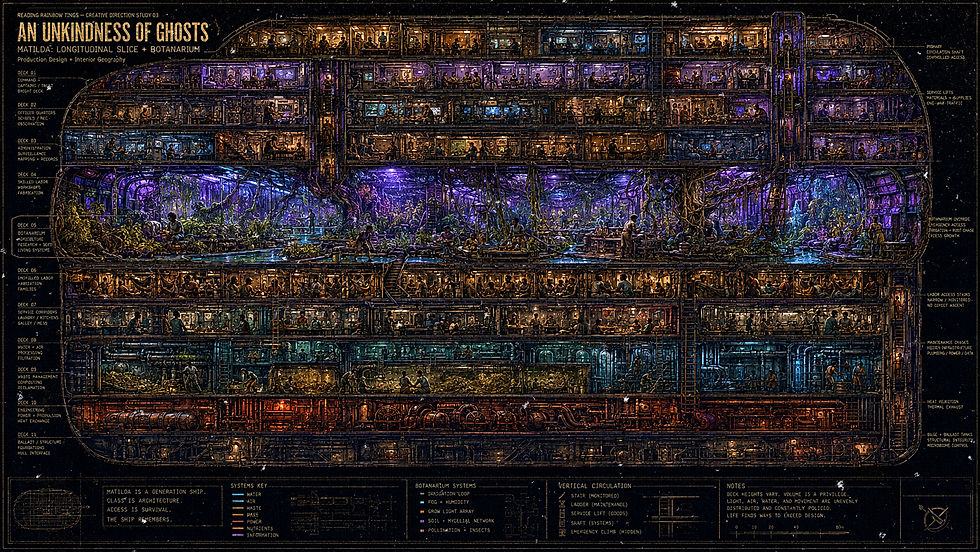
I see something with the class machinery of Snowpiercer, the lived-in enormity of The Expanse, something of the biological otherworldliness I imagine around Octavia Butler’s Oankali, and then something stranger than all three because none of those references can quite get me where Solomon took me.

A spaceship turned slave ship.
Or maybe a slave ship that never stopped being a slave ship just because somebody pointed it toward the stars.
That distinction matters.
Because An Unkindness of Ghosts does something to time that my own work keeps returning to: it smashes past and future together until they have no choice but to become present tense.
Colonialism does not sit safely behind us because the ship is technologically advanced.
Slavery does not become past tense because there are stars outside the window.
Plant knowledge does not become primitive because it survives aboard a machine.
Gender does not automatically become more expansive because we have entered speculative space.
God does not disappear because somebody built an artificial sun.
The old architecture gets aboard too.
And then my imagination starts wandering through the ship.
I want to see the lower decks.
I want to feel the temperature change as I move through them.
I want to know what the walls sweat.
I want to hear the pipes.
I want to know what rust smells like after generations in a closed atmosphere.
I keep wondering what the Botanarium looks like.
Of course I do.

What plants survived Earth?
Who decided what was worth carrying?
What became medicine after generations away from soil?
What knowledge traveled with the plants?
What knowledge disappeared even though the plant survived?
What changed because somebody had to learn the plant again inside an entirely different ecosystem?
That image stayed with me long enough that pieces of the Botanarium started finding their way into the visual world of my own Black Herbalism work. Because once my imagination finds an ecosystem, apparently it is going to walk around in there touching shit.
And maybe that is part of why this book has remained so visually alive for me.
Solomon gives me a ship moving toward Earth while carrying people who have never known Earth, holding fragments of knowledge from people who knew fragments of knowledge from people before them, all inside an ecosystem engineered to keep the whole thing alive while reproducing the very colonial arrangements supposedly left somewhere behind.

Past.
Future.
Present.

All circulating through the same pipes.

Which is probably why my first environmental note after reading the book was:
rusted industrial water recycling itself through generations.
And then, somehow, I skipped the essay.
Not the book.
The essay.
I kept moving.
And maybe I needed to, because apparently Mami Wata sent me into The Deep first, but Matilda was going to make me figure out what happens when there is nowhere for the water—or the history—to leave.
And then Rivers Solomon showed up again.
Not because I was following them.
I wasn’t.
Their Instagram just floated something into mine about Once I Was Made of Earth, a story they were writing and releasing while it was still becoming.
And of course I stopped.
Because now I had already met Solomon through The Deep, through water and memory and bodies carrying what history tried to drown, and here came Earth.
Once I Was Made of Earth.
Come on now.
But what pulled me in wasn’t only the title. It was the telling of a story while the story was still being made real. I was encountering the work in motion rather than receiving the finished object after everybody had decided what it was.
That matters to me.
I am building a Cosmos in public. I am writing myself further into its frame while the frame is still changing shape. Tings I write become diagrams. Diagrams become objects. Objects send me backward into old essays. A book changes how I understand water and years later that water changes how I understand another book.

So I was already looped into this question of what happens when telling becomes material.
When imagination does not simply describe a world but starts making conditions through which a world can exist.
My creative direction brain likes that kind of ish because it immediately starts running ahead of the page.
What would this look like?
What would have to exist for this to be possible?
What changes once somebody tells the story aloud?
What does the story make available that wasn’t available before it was told?
And then I went backward.
Back to Solomon’s first novel.
Back to An Unkindness of Ghosts.
Only to find a ship full of people moving toward Earth.
That fucked with me a little.
Because apparently I had entered Rivers Solomon through water, encountered them again through Earth, and then Mycelial Sankofa’d my way backward into a first novel asking what happens when generations of people attempt to return to an Earth they cannot remember.
⟁≋)) An Unkindness of Ghosts — The Body That Could Not Acclimate Quietly

I initially forgot to write this essay.
I finished Rivers Solomon’s An Unkindness of Ghosts and then kept moving. Straight into Suyi Davies Okungbowa’s Son of the Storm, then Warrior of the Wind, letting those books pull me toward storms and wind and atmosphere until I realized I had left an entire fucking spaceship floating behind me.
Maybe I needed to.
Because when I first finished An Unkindness of Ghosts, I knew what I had encountered. I could feel it. I had language for hierarchy, colonial architecture, neurodivergence, bodily sovereignty, misreception. I knew immediately that Matilda was doing something environmental that I wanted to map.
I wrote down:
rusted industrial water recycling itself through generations.
That made me double look.
I knew there was something there.
But I was still thinking too closely about the water.
Not because the Wata(ring) W(hole) has ever only been water. It hasn’t. A watering hole is an entire ecosystem. Water may be the deepest current moving through it, the gathering place around which life reorganizes itself, but there is no water without atmosphere. Without earth. Without heat. Without bodies. Without decay. Without whatever comes to drink and whatever is waiting nearby to eat the ting that came to drink.
Everyting is in relationship.
I needed a few more books before I could see what Matilda actually was.
Matilda is a closed colonial ecosphere whose water, air, heat, light, bodies, labor, waste and memory have been forced into recirculation.
There it is.
And once I could see that, An Unkindness of Ghosts became a very different book.
Because nothing aboard Matilda can simply leave.

Not the water.
Not the waste.
Not the bodies.
Not the violence.
Not the history.
Not even God.
Everything has to keep moving through the ship.
And anything that didn’t make it aboard?
Well.
That is a different kind of ghost.
You Cannot Sankofa What Wasn’t Carried

Mycelial Sankofa has never required an intact road backward.
That’s part of why it needed to become mycelial in the first place.
Sankofa gives us this beautiful technology of retrieval: go back and get it. Return for what has been left behind. Refuse the colonial insistence that forward is the only legitimate direction.
But I keep encountering another question.
What happens when you go back and there is nothing there?

Not because there was never anything to retrieve.
Because the ecosystem blocked its transmission.
Matilda makes that question material.
Generations of people have lived aboard a ship moving through space toward a place most of them cannot remember. Earth is origin without being memory. Whatever knowledge came aboard Matilda had to survive the crossing, then survive generation after generation of containment, hierarchy, religious control, labor, violence and recirculation.
You cannot retrieve what nobody carried.
You cannot ask an elder who no longer exists.
You cannot walk back to the land.
You cannot put your hands into ancestral soil when there is a fucking hull between you and the universe.
So the past has to find other ways to remain alive.
Lune leaves information.
Not orientation.
Information.
Aster has to decode it.
That distinction stayed with me because I know what it is to have information without orientation.
My mother is physically alive.
I can ask questions.
I have asked questions.
I have explained.
Educated.
Returned.
Compared.
Tried to make dates line up with behavior, behavior line up with memory, memory line up with what I now understand about my body.
And the story still does not fucking line up.
Sometimes the answer is essentially:
Nobody told us.
And somewhere inside me, every time, is:
Do you not have eyes?

I was diagnosed autistic late late late as fuck.
I understand that the language available now was not necessarily the language available to the people around me when I was a child. I am not expecting somebody to have pulled a contemporary diagnostic manual out of the air and named me correctly.
I am asking whether anybody got curious.
There was a body there.
There was behavior there.
There was sensation there.
There was struggle there.
There was information everywhere.
What happens when an ecosystem has been taught that safety means not becoming curious about the information?
That question has become much more important to me than whether somebody knew the correct name.
Because Black survival has created archives of its own, and some of those archives are built around what we learned not to investigate.
Stay safe.
Keep going.
Don’t ask too much.
Don’t tell everybody your business.
Pray on it.
Side Rant: Your Prayers Are Unkind Ghosts

If words are spells, then I’m about tired of people organizing their prayers around me without my consent.
You—and all the power of your mouth—do not automatically become helpful just because you have centered yourself on “praying for me.” Your prayer may not be clearing a path. It may be creating an energetic block. You may think you have special access to some invisible person in the sky whom I have already decided to move around.
Prayer requires more respect, intention, and care than people give it. It also requires consent.
Because y’all’s unfettered prayers are like unkind ghosts: summoned without permission, released into somebody else’s atmosphere, and allowed to linger because the person who spoke them assumed good intentions would absolve their impact.
If I do not know you, I am not putting your name in my mouth. I have had too many strangers’ names in my mouth—who were somewhere causing harm and trauma while entire collectives organized language around their protection.
Ask first. Otherwise, keep your unkind ghosts—and my name—out of your mouth.
(side rant over)
Make it work.
Get the child through school.
Get the child to adulthood.
Get the family through whatever is happening and perhaps one day somebody will have enough distance to ask what the hell happened.
Except distance doesn’t automatically create curiosity.
Sometimes safety becomes the legacy.
Nada else.
No curiosity about whether the strategy still works.
No curiosity about what the strategy cost.
No curiosity about what happens to a body that has to keep performing safety inside conditions that never actually became safe.
A closed system doesn’t only recirculate what it contains.
It can only recirculate what survived containment.
And Mycelial Sankofa has to account for that.
Sometimes going back to get it means finding the thing that was preserved.
Sometimes it means finding fragments and learning how they speak to one another.
And sometimes it means going back and investigating why there is nothing where something should be.
The missing piece is information too.
The contradiction is information.
The silence is information.
The living relative who still cannot tell you what happened is information.
Mycelium does not need the tree to remain standing in order to tell you something happened there.
A Body Made by the Ship

This is where Matilda starts fucking with the fantasy of return.
The ship is headed toward Earth.
Home.
Origin.
The place before.
Except:
What does it mean to return to a place you cannot remember with a body made by the place that carried you away from it?
I screamed when I finally found that question because there is my late diagnosis sitting inside a generation ship.
Diagnosis was supposed to explain something.
And it did.
It explained an enormous amount.
But explanation did not return me to some untouched version of myself waiting patiently before masking began.
There is no little pre-colonial Kiing standing on Earth waiting for present-day me to get off the ship.
My body was made here.
Not entirely, obviously. I carry things much older than the systems that attempted to contain me. That’s the whole reason retrieval remains possible.
But this nervous system learned inside these conditions.
This body learned inside these conditions.
My understanding of intimacy learned here.
My understanding of work learned here.
My understanding of success and danger and authority and gender and family and God learned here.
My survival technologies were developed aboard the ship.
You do not arrive at Earth and subtract Matilda from the body.
And that is one of the places where I think people misunderstand unmasking.
There can be an expectation that recognizing neurodivergence will feel like immediate relief. Finally, permission to be yourself.
Sure.
And then your body starts telling you shit.
The light is too bright.
That sound actually hurts.
That texture has always bothered you.
You don’t want somebody standing that close.
You don’t want to be touched that way.
You were not fine after that social interaction.
You were not enjoying the thing everybody told you that you were enjoying.
You were surviving it.
Some sensations seem to become more intense after unmasking when what may actually be changing is your access to the information.
The sensation is not necessarily new.
Your ability to receive it is.
And now you have to live with knowing.
That is part of what Aster brought back into view for me.
Not simply neurodivergent representation.
Sensation.
A body responding to an engineered environment.
Matilda controls temperature.
Light. Space. Movement. Labor. Access. Privacy. Food. The rhythms through which a body is permitted to survive.
And then bodies respond differently to those conditions.
Colonial systems are very good at taking that response and making the body the problem.
Too sensitive.
Too rigid.
Too difficult.
Too literal.
Too emotional.
Too much.
Not enough.
What happens if instead of diagnosing the body as the disruption, we receive the body as environmental information?
The body that cannot acclimate quietly may be the body telling the truth about the climate.
That is where Aster meets the Wata(ring) W(hole) for me.
The body is not sitting inside the ecosystem as some independent object.
The body is participating in it.
Receiving it.
Changing because of it.
Transmitting information about it.
The question was never simply what is happening inside this body.
The question is also:
What is this environment doing that this body can feel?
Baby

And then these people named the artificial sun Baby.
Baby.
I cannot leave that alone.
Because Matilda does not merely control bodies through laws and hierarchy. The ship controls the conditions under which life itself is possible.
Light is infrastructure.
Heat is infrastructure.
Agriculture is infrastructure.
Time is infrastructure.
And the technology producing artificial light is called Baby inside a society saturated with religious authority.
I am not interested in flattening that into Baby means Baby Jesus and moving along. That’s too easy.
I am interested in the resonance.
What happens when the technology controlling your light is given sacred language?
Because then environment and God can begin doing political work in tandem.
The authority controlling material survival can also tell you what survival means.
It can tell you why suffering exists.
It can tell you what obedience means.
It can tell you what is promised.
And when the material environment and the sacred explanation reinforce one another long enough, hierarchy can start feeling less like something somebody built and more like the natural order of the universe.
I know something about being handed Jesus and curiosity at the same time.
That is a hell of a combination to give a child whose brain will eventually refuse to stop asking how the ting works.
Because curiosity keeps going.
Prayer says trust.
Curiosity says but what happened?
Prayer says God will make a way.
Curiosity says through what mechanism?
Prayer says put it in God’s hands.
Curiosity eventually notices your hands are still sitting right fucking there.
And I reached a place where the architecture could no longer hold.
Not because I needed everybody else to stop believing.
Because for me, it does not exist.
It cannot.
My mind operates the way it operates, and eventually the explanation has to withstand the inquiry.
Especially when prayer becomes substitution for material response.
You prayed instead of doing.
You prayed while the information was standing in front of you.
You prayed while bodies continued responding to conditions nobody changed.
At some point I had to ask what the prayer was materially producing.
And sometimes the answer was nothing.
The prayer was hollow because the action never arrived.
Naming the light sacred does not make the room warm.
What Did the Body Actually Say?

Sexual sensation belongs here too.
It has to.
Because sexuality may be one of the places where our culture most aggressively takes bodily information and tells us what it means before we have interpreted it ourselves.
We are over-coerced around sexual sensation.
Arousal gets assigned desire.
Desire gets assigned consent.
Touch gets assigned intimacy.
Intimacy gets assigned relationship.
Relationship gets assigned a recognizable architecture.
The body responds and somebody is already waiting with the definition.
But:
Sensation is information before it is meaning.
That has become increasingly important to me as I unmask.
What did my body actually say?
Not what was I told it meant.
Not what did somebody else need it to mean.
Not what category becomes available if I organize the sensation correctly.
And that question cannot begin with me.
Because I keep thinking about our enslaved ancestors and this colonially empty assumption that everybody aboard those ships, everybody standing on those auction blocks, everybody living in quarters and plantations and maroon communities and all the spaces Black bodies made in between was somehow moving through gender, sexuality, kinship, intimacy and sensation according to the binaries we inherited descriptions of them through.
How the fuck would we know?
We know what somebody recorded.
We know what somebody permitted themselves to see.
We know what survived.
We know what was named legible enough to become archive.
And we know that the people doing much of the recording were invested in making Black bodies classifiable.
Male.
Female.
Breeder.
Laborer.
Mother.
Father.
Property.
Useful.
Disobedient.
Dangerous.
Dead.
Coloniality needed bodies to stay still long enough to determine what could be extracted from them.
That does not mean the bodies themselves were still.
It does not mean sensation obeyed the categories.
It does not mean intimacy did.
It does not mean gender did.
It does not mean kinship did.
It does not mean everybody experiencing something had language for what they were experiencing, particularly when the language that survived was so often the language of the people containing them.
This is where Mycelial Sankofa gets difficult again.
Because going back looking for evidence of Black multiplicity can become another colonial trap if I require my ancestors to have left behind the exact language I need in order to believe they existed outside of the categories somebody else recorded them through.
Sometimes there is no clean document to retrieve.
Sometimes what survived is relationship.
Or a lack of.
Practice.
Mimicry.
Gesture.
Adornment.
Touch.
Refusal.
A way bodies gathered when nobody was supposed to be looking.
A sensation somebody never got to name.
And sometimes the absence of language does not tell me there was an absence of experience.
It tells me something about the conditions under which experience was permitted to become history.
That matters to me because I know what it is to experience sensation before having language that belongs to me.
I remember being a child and watching media teach me what bodies were supposedly doing.
What attraction looked like.
What romance looked like.
What sex meant.
What a boy did.
What a girl did.
What somebody was supposed to want when somebody else touched them.
And there was mimicry in that.
There had to be.
When you don’t understand the social architecture but everybody around you appears to understand it, you study.
You get two degrees in theater.
You reproduce.
You try the gesture.
You try the response.
You see whether performing the ting produces the information everybody seems to already possess.
And when you are an unidentified neurodivergent child, mimicry can become particularly fucking confusing because performing recognition can be mistaken—even by yourself—for actually recognizing what is happening.
Nobody gave me language for that.
And I wasn’t allowed the kind of curiosity that could have made it speak.
So sensation could become tangled with instruction.
What I felt.
What I was supposed to feel.
What television told me that feeling meant.
What adults refused to explain.
What Christianity told me I should not feel.
What gender told me somebody with my body would feel.
What somebody desiring access to my body needed me to say I felt.
All of it could arrive at once.
That is not bodily clarity.
That is an ecosystem talking over the body.

And this is part of why unmasking can feel like receiving sensation for the first time even when the sensation itself is old.
I am not simply discovering new sensations.
I am trying to determine which interpretations were mine.
What did the body actually say before everybody else finished the sentence?
Aster and Giselle make that question deliciously uncomfortable.
Sisters.
Lovers.
Even writing those words next to each other makes the cultural sorting machinery start screaming.
Because what are they then?
What kind of relationship is this?
Where does kinship stop and sexuality begin?
Which designation gets priority?
But I wonder how much the urgency of those questions belongs to the same colonial architecture I am trying to examine.
Matilda is carrying remnants of Earth through space.
Not simply people.
Categories.
Religions.
Hierarchies.
Ideas about bodies.
Ways of making relationships legible.
Ways of deciding which relationships require explanation.
And yet generations aboard the ship have also made something else from what was carried.
That matters.
Because Aster and Giselle do not need to become evidence for some clean argument about what relationship should look like. Their relationship can remain difficult. Tender. Sexual. Familial. Harmful in places. Necessary in others. Fluid without becoming uncomplicated.
I become more interested in:
What is moving between them?
Care.
Trauma.
Recognition.
Need.
Pleasure.
History.
Dependency.
Intimacy.
Violence.
Tenderness.
Familiarity.
Bodies learning one another inside a closed environment where almost everything else is already being assigned from above.
And maybe that is another way of thinking about ancestors whose full relational lives I cannot retrieve.
I do not have to force them into contemporary language to rescue them from colonial language.
I can leave room.
Room for sensation without surviving designation.
Room for intimacy without a census category.
Room for gender that moved differently depending upon where and with whom the body was.
Room for relationships whose names did not survive the ship.
Room for Black bodies to have always been more complicated than the archive had any interest in recording.
Because coloniality loves designation.

If it can name the body, it can place the body.
If it can place the body, it can determine what the body is allowed to do.
And sexual culture participates in this constantly by treating sensation as though sensation has already declared allegiance.
Sometimes the body has only said:
I felt that.
Let the body finish the fucking sentence.
And if I cannot recover what an ancestor called that sensation, that does not give me permission to call it for them.
Maybe Mycelial Sankofa sometimes means refusing to fill the archival silence with another certainty.
Maybe tending the absence is part of retrieval too.
Rust in the Water

This is why I keep returning to that first note.
Rusted industrial water recycling itself through generations.
Water aboard Matilda cannot simply flow away.
It returns carrying residue.
So does history.
The people aboard Matilda inherit a world they did not build but must continually metabolize. The infrastructure outlives its architects. The hierarchy becomes ordinary because nobody alive remembers its construction. Survival requires participation in systems that survival itself did not choose.
Rust is useful here because rust tells you that time has been happening to the infrastructure.
The structure can remain standing while changing chemically.
Water can continue moving through a pipe that is contaminating what it carries.
And everybody downstream can become accustomed to the taste.
That is where the Six Waters give me Turbulent Water, but not turbulence as spectacle. This water is mechanically circulated. Pressurized. Redirected. Heated and cooled according to somebody else’s architecture.
And still it moves.
Still something leaks.
Still information crosses boundaries.
Still Aster decodes Lune.

[Mind Mechanics
Still, Aster decoded Lune.
Aster decodes the moon.
My name is Amber.
My mother is a Cancer.
Decoding the moon.
The burying of emotion in Black bodies already perceived as too weird.]
Still somebody becomes curious.
That’s where I find rupture in this book.
Not in some fantasy that destroying the system automatically returns everybody to purity.
There is no purity to return to.
Earth itself is not an untouched origin waiting to make everybody whole.
The bodies arriving there will be Matilda bodies.
Bodies carrying generations of recirculated memory.
Bodies carrying rust.
Bodies carrying adaptations that made survival possible.
Bodies carrying information about an environment they may no longer inhabit but can never claim did not make them.
Mycelial Sankofa does not ask those bodies to scrape themselves clean.
It asks:
What survived?
What mutated?
What disappeared?
What grew in the dark anyway?
What information has been moving underneath the official story?
What happens when the organism everybody called difficult was actually responding correctly to poisoned soil?
What happens when safety preserved the body but prevented curiosity?
What happens when curiosity returns?
Maybe that is what keeps pulling me back toward An Unkindness of Ghosts after I had already moved on to other books.
I thought I had skipped the essay.
I hadn’t.
I was still developing the sensory equipment to receive it.
I needed storms.
I needed wind.
I needed to understand atmosphere more clearly.
I needed to understand that water was never moving alone.
I needed my own body to become louder.
And I needed to understand something about retrieval that I don’t think I could have written when I first closed the book:
Going back does not guarantee that what you need will be there.

Sometimes somebody destroyed it.
Sometimes somebody forgot it.
Sometimes survival required somebody to stop asking about it.
Sometimes the person who should know is sitting directly across from you and still cannot give you an answer that makes the ecosystem make sense.
So you follow what remains.
A sensation.
A contradiction.
A notebook.
A leak.
A body behaving strangely inside an environment everyone insists is normal.
You follow it not because you know it will take you home.
You follow because it is moving.
And if the water tastes like rust, perhaps the first question isn’t what is wrong with the water.
Perhaps you find the pipe.
Perhaps you ask who built it.
Perhaps you ask how long everyone has been drinking from it.
And perhaps the body that could never quite swallow quietly was never the problem in the first place.
⟁≋)) An Unkindness of Ghosts — The Body That Could Not Acclimate Quietly
Cosmos Watershed
An Unkindness of Ghosts enters the Wata(ring) W(hole) as an engineered closed ecosphere. Matilda recirculates more than water: air, heat, artificial light, labor, waste, bodies, memory, religion, hierarchy and ancestral fragments move through the same enclosed architecture. The novel opens a watershed around what happens when survival requires circulation through infrastructure that is itself contaminated—and what neurodivergent sensation can reveal about environments everyone else has been trained to call normal.
Industrial Recirculation Watershed
Watershed | Tributaries |
Watershed | Industrial Recirculation |
Relationship | Water, atmosphere, bodies, memory and labor moving through engineered containment while carrying accumulated residue |
Companion | Rust / Pipe / Leak / Artificial Light |
Origin | Matilda as generation ship and closed colonial ecosphere |
Expansion | Hydrological circulation expands into atmosphere, memory, caste, theology, fragmented retrieval and bodily sensation. Power becomes climate when hierarchy controls light, temperature, agriculture, movement and access. |
Application | Reading bodies as environmental sensors rather than isolated problems; following what happens when ancestral information survives as fragments; asking what the body can perceive about an environment everyone else has been trained to normalize |
Lineage | Mycelial Sankofa / Wata(ring) W(hole) / Black speculative ecology / Trans Learn Tings / ancestral retrieval |
Counter Currents | Archival absence, enforced safety, religious authority, classification, masking, contamination, blocked transmission, failed curiosity, coercion, binary designation and misreception |
The Six Waters
This book isn’t simply Turbulent Water. Turbulent Water is dominant, but the closed ecosphere forces all six waters into strange industrial relationships.
Water | Movement Through An Unkindness of Ghosts |
Still Water | History that appears absent because transmission has been interrupted; archival silence; information waiting without orientation |
Flowing Water | Knowledge moving between bodies despite institutional containment; care, medicine, memory and encoded information |
Deep Water | Lune, Earth, ancestral absence and everything carried beneath what Matilda officially remembers |
Turbulent Water | Dominant water: forced circulation through hierarchy, environmental control, sensory overwhelm and survival |
Tidal Water | Return toward Earth; generations moving between an inaccessible origin and the habitat that actually formed their bodies |
Sacred Water | Retrieval without purity; Mycelial Sankofa; tending fragments without pretending the ancestral archive remained intact |
Cosmos Coordinates
Matilda is the primary planetary body here because the ship itself is the environmental body organizing every other relationship. Aster, Lune, Baby and Earth move through its coordinates rather than requiring separate coordinate systems.
Coordinate | Entry |
Planetary Body | Matilda |
Planet of Origin | Earth / remembered Earth |
Primary Water | Turbulent Water |
Secondary Water | Deep Water |
Movement | Recirculation / decoding / return |
Portal | The generation ship / neurodivergent body |
Primary Technology | Engineered ecosphere / observation / medicine / encoded archive / artificial light |
Cosmological Function | Turns colonial hierarchy into environmental condition while forcing bodies, memory and ancestral fragments to continue circulating through the habitat |
Core Inquiry | What does it mean to return to a place you cannot remember with a body made by the place that carried you away from it? |
Threshold | Containment becoming normal / sensation becoming knowledge / absence becoming evidence / return without purity |
Black Ecological Orientation | Black bodies surviving inside engineered scarcity while continuing to transmit information the dominant environment cannot or will not receive |
Calabash Relationship | Matilda becomes a closed vessel carrying finite resources, contaminated inheritance, living bodies and fragments of an ancestral world that cannot simply be refilled |
Wata(ring) W(hole) Relationship | Water, air, heat, light, bodies, labor, waste, religion and memory reveal themselves as one forced circulatory ecosystem. Aster receives its conditions through the body; Lune persists through encoded memory; Baby turns light into environmental and sacred infrastructure; Earth remains an origin that cannot be recovered whole. |
Return Practice | Follow the fragments without manufacturing certainty. Let the body finish the sentence. Locate what the infrastructure keeps reproducing. Return changed. |
Cosmos Constellations
Constellation | Star / Body | Relationship in the Essay | Current |
Mycelial Sankofa | Lune → Aster → Earth | Retrieval through fragments, code, absence and incomplete inheritance | Go back, but do not pretend everything survived |
Misreception | Aster / the neurodivergent body | Bodily and social information interpreted through systems incapable of receiving it | The body speaks; the environment mistranslates |
Colonial Wildfire | Matilda | Colonial infrastructure reproduces itself until domination becomes habitat | Architecture becomes climate |
Trans Learn Tings | Aster + Giselle | Sensation, gender, sexuality, kinship and relationship exceed inherited designation | Sensation before meaning |
Afroscape | Matilda as ecosystem | Bodies cannot be separated from the conditions producing their adaptations | Environment is embodied |
Riotous Deathscapes | Caste / labor / survival | Infrastructure determines whose exposure, suffering and death become ordinary | Scarcity is engineered |
The Six Waters | Industrial recirculation | Water carries residue through a closed system rather than cleansing it automatically | Flow does not guarantee freedom |
Sacred Infrastructure | Baby | Artificial light, theology and environmental dependence occupy the same atmosphere | Ask what sacred language materially produces |
Ancestral Multiplicity | Enslaved ancestors / archival absence | Colonial records cannot be assumed to contain the full gendered, sexual, sensory or relational lives of Black bodies | Absence of designation is not absence of experience |
Mimicry + Sensation | Child body / media / unmasking | Social and sexual scripts can teach the performance of recognition before the body has been allowed to interpret its own sensation | What did the body actually say? |
Atmospheric Field
Matilda makes visible something the Wata(ring) W(hole) has always held: water is never alone.
The ship’s rusted water cannot be understood separately from artificial light, temperature, air, agriculture, labor, bodies, geography, memory or power. Hierarchy has become environmental. When power determines whether a deck freezes, power becomes temperature. When power determines where a body can move, power becomes geography. When power controls artificial sunlight, power becomes climate.
Climate: Industrial recycled climate Dominant Weather: Enclosed pressure system Water: Rusted industrial recirculation Heat: Unequally distributed and politically controlled Light: Artificial / sacred / infrastructural Air: Recirculated survival atmosphere Terrain: Engineered caste geography Residue: Generational violence, religious authority, memory and adaptation Rupture: Leaks, curiosity, decoding, sensation and relational excess Embodiment: Survival through contaminated circulation
Atmospheric Inquiry: What conditions make this body necessary, and why does the system call its response abnormal?
The atmosphere was always part of the ecosystem. This reading simply makes more of that relationship visible.
Embodiment
Movement, Intuition, Regulation and Integration remain coordinates of the reading, but they do not need another table competing with the primary Cosmos architecture.
Movement lives in bodies navigating decks, caste boundaries, forbidden access, closed circulation and eventual return.
Intuition lives in sensation and curiosity recognizing inconsistencies before institutional explanations can resolve them.
Regulation lives in neurodivergent bodies adapting to engineered sensory and social conditions, and in masking becoming a technology for surviving environments that refuse to change.
Integration lives in decoding inheritance without expecting recovered information to restore an untouched self.
The body that cannot acclimate quietly may be the body telling the truth about the climate.
Mycelial Sankofa
Retrieval does not guarantee recovery.
Mycelial Sankofa in An Unkindness of Ghosts asks what remains possible when ancestral transmission has been interrupted by displacement, survival, silence and engineered containment.
Sometimes we retrieve an object.
Sometimes a story.
Sometimes a sensation.
Sometimes a contradiction.
Sometimes we retrieve the location where information should have been and discover nothing there.
That becomes especially complicated when I think about enslaved ancestors whose gendered, sexual, sensory and relational lives reach us through archives constructed inside colonial systems that needed Black bodies to be classifiable.
The absence of a surviving designation is not evidence that the experience did not exist.
Mycelial Sankofa cannot require my ancestors to have left contemporary language behind before I allow them complexity.
Nor can the absence simply be filled with whatever story makes me feel whole.
Sometimes tending the absence is the Sankofa.
Sometimes the contradiction is what survived.
Sometimes the living body itself becomes the fragment that proves something happened.
And sometimes going back means discovering that the archive existed all along while the system responsible for retrieval failed to return it.


Comments