


Creative Direction Is Apparently a Job I’m Applying For

And if you’re still wondering where my résumé is…
You’re reading it.
Creative Direction Is Apparently a Job I’m Applying For

Every finished piece begins with seeing what could become possible. The source image was inspiration. The artistic direction was mine.
There is something wonderfully funny about spending your entire career creatively directing only to discover that, apparently, you’re not a creative director.
I directed theater.
I directed photoshoots.
I directed a music video during the pandemic.
Creative direction has always been about building worlds with whatever was available. Much of this production was built from my own personal prop collection & me calling homies peak pand 
Creative direction means shaping movement, space, and the story the camera carries.Creative directio 
Rhythm wasn’t decoration. It was part of the world we were building. Every frame begins long before the camera starts recording.
I built immersive educational experiences.
I designed workshops.
I modeled my own work because I couldn’t afford someone else to embody it.
I turned every apartment I lived in into a set because I couldn’t afford a studio.
I spent years supporting artists whose work I genuinely believed in, often taking on

multiple roles to help bring their visions into the world. I did that work because collaboration mattered to me. I believed we were building relationships that could grow in both directions.
Sometimes they did.
Many times they didn’t.
When it came time for the relationship to shift—when I needed collaborators for my own work, or when I stepped more fully into creative direction—people disappeared, couldn’t execute, or suddenly became far more interested in evaluating my practice than participating in it.

One of the clearest examples came during the Eloquii's Black Creators Project.
After months in residency with a program that spoke about opportunities extending beyond influencing, I asked about creative direction opportunities.
I was told they needed to see my résumé.
I laughed.
Not then.
Now.
I approached this residency as a creative direction project, building a complete visual language. Creative direction lives in the details. Every decision supported the larger story. Every look was designed as part of a larger visual system rather than a collection of individuals. 
I executed a level of creative direction that transformed the residency into a fully realized visual One project closed. The visual language kept evolving. The work didn’t disappear. It became a universe no one else could have commissioned.
Because the résumé had been sitting in the room the entire time.
The same pattern appeared elsewhere.
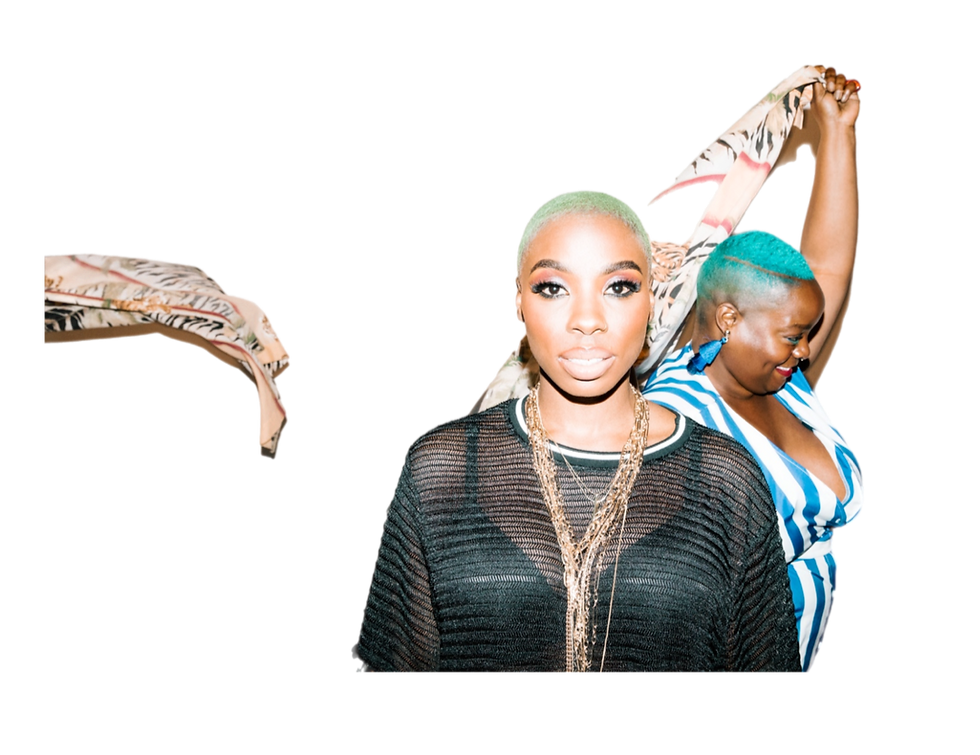
I spent months working across multiple creative roles to support Jessy Wilson’s first album release. The work is on my résumé. The credit I received never reflected the scope of what I contributed, and that collaboration ultimately became one of the more harmful experiences of my creative career.
From installation to final frame. Creative direction extends beyond what the camera captures. Props become storytelling when they’re part of the language. 
Sometimes the work lives just outside the frame.
The work existed.
The recognition simply didn’t travel with it.
These days, the conversation has shifted again.
Apparently using AI as a design assistant means I now need to defend authorship over work that has looked unmistakably like mine for decades.

That’s the strange part.
The software didn’t invent my visual language.
It didn’t invent the Cosmos.
It didn’t invent the characters.
It didn’t invent my obsession with embodiment, movement, ecology, theater, hair, symbolism, or world-building.
And before anyone decides that the next thing “came out of nowhere,” let me save us both the trouble.
I’m preparing to move into large-scale Afroscape installations using textiles—roving, yarn, mop thread, fiber, and other materials—to explore Afro hair as landscape, architecture, ecology, and memory.

Again, not a plot twist.
I’ve been making things my entire life.

I’ve built crowns.
I’ve designed and built bead and cowrie.
I’ve constructed sets.
I’ve styled hair.
I’ve designed adornment.
I’ve always been fascinated by how materials hold stories and how stories become environments.

The installation work isn’t a departure.
It’s simply the next expression of the same foundational theory I’ve spent years developing around Afro hair—now expanding into the larger world I’ve always known it belonged to.
It didn’t invent my creative direction.
It simply arrived after years of asking,
“Does anyone want to build this with me?”
Eventually, I stopped waiting.
If I couldn’t enter the world I wanted to work in, I would build one.
That’s what the Cosmos is.
Not a portfolio.
Not a rebrand.
Black Fairytales — Rapunzel. An early experiment in retelling familiar stories through Black worlds Black Fairytales — Rapunzel. The braid was never simply hair—it became the environment the story... Black Fairytales — Thumbelina / Arrietty. A study of smallness, botanical worlds, and Black wonder Fred Crump Jr.’s A Rose for Zemira showed me that Black fairy tales could exist as complete worlds.
Caption 1 Black Fairytales — Rapunzel. A reimagining of Rapunzel through Black hair as lineage, architecture, and living memory.s to imagine fairy tales through Black imagination instead of inherited European narratives.
Caption 2 Black Fairytales — Rapunzel. The braid was never simply hair—it became the environment the story moved through.
Caption 3 Black Fairytales — Thumbelina / Arrietty. A study of smallness, botanical worlds, and Black wonder imagined through the scale of nature.
Caption 4 Fred Crump Jr.’s A Rose for Zemira showed me that Black fairy tales could exist as complete worlds. Years later, Black Fairytales became my own conversation with that lineage.
Not proof that I finally became a creative director.
It’s simply what my creative direction looks like when it no longer has to fit inside someone else’s job description.
And if you’re still wondering where my résumé is…
You’re reading it.
The website is my résumé.
Beautiful, but not the final form. The work still had more becoming to do. The first photoshoot brought the idea out of my head, even though the project had not found its fina B for Built Up Braided Bundles. The care was always layered. A for Afro Autonomic. Hair as signal, sensation, and nervous system relationship. C for Colonized Coil Care. The problem was never the hair. I for Invitation Itch. Even irritation was trying to tell me something. The braid became a map of accumulation, moisture, and care. The flashcards became field notes. The hair theory kept widening. Colonized care taught us to fight the hair. The work asks what happens when we stop.
The first Afro ABCs prototypes. I knew the ideas before I knew the visual language that could hold them.
Creative Direction Is Apparently a Job I’m Applying For


Comments