


✺ Domoda: Reprogramming the Tongue | Senegambian Peanut Stew

✺ Domoda: Reprogramming the Tongue | Senegambian Peanut Stew
Open Post
I Eat Tings
A study of the tongue, memory, and diaspora through food.
Each dish is a portal.
I Eat Tings is a BespokeCurry series exploring African and diasporic foods through memory, embodiment, and the politics of taste.
I Eat Tings:
✺ Domoda: Reprogramming the Tongue | Senegambian Peanut Stew

The Tongue, The Threshold, The Return
Reprogramming the Tongue
jack sprat could eat no fat
his wife could eat no lean
and so between them both you see
they licked the platter clean
I laugh at this colonial ass rhyme for two reasons.
One, because my spouse and I upon first glance embody this energy.
Two, because within American culture fat and skinny are simply two sides of the same colonial coin.
The rhyme pretends difference is harmony.But the truth is most of our differences were never chosen.
They were trained.
We talk often about mental health — how trauma shapes childhood into adulthood —but we do not zoom in enough on the tongue.
And the tongue is one of the first places trauma enters
and exits
the body.
And one of the first places it can leave.
When I speak about the tongue, I am speaking about more than taste.

The tongue is food.
The tongue is language.
The tongue is breath.
The tongue is spell work.
The tongue is where air and nourishment meet the body.
A threshold.
A liminal space that is always shifting.
The mouth is a watering whole.
The Tongue is a filter.
And what passes through it
shapes us.
And taste is not only literal.
Taste is atmospheric.
The tongue is constantly reading the room.

You can taste indifference in the air.
You can taste absence in a conversation.
You can taste when something has been prepared without care.
The body knows the difference between nourishment and neglect long before the mind catches up.
Which means if you are living inside atmospheres that taste like lack,then the plate becomes sacred territory.
Because sometimes the only place care exists
is in the food you make for yourself.
And sometimes that is where the return begins.
What we eat and what we refuse to eat are reflections of the atmospheres we have survived.
Food was one of the first tings I got curious about
when I got serious about my diagnosis.
I used to say:

“I eat anything.”
“There’s nothing I don’t like.”
But that wasn’t openness.
That was survival.
The dinner table was one of the first places I experienced abuse.
You cleared your plate. All of it.
Or else.
There was no refusal.
No negotiation.
No pause to ask the tongue what it needed.
So the tongue learned quickly:
Eat everything.
Feel nothing.
Finish fast.
Which means eating was one of the first sites of colonial grooming in my life.
My palate was not built on preference.
It was built on compliance.
Assimilation dressed up as taste.
So when I began to reevaluate my relationship to food,
everything became available for inquiry:
The pace at which I eat.
The way I chew.
The way I breathe.
I realized I didn’t eat like someone who enjoyed food.
I ate like someone trying to get through it.
One of the first tings I did when I got sober
was reconnect with food as an embodied practice.
When I began my journey toward regulation, food was one of the first places I returned to.
Everything was up for reevaluation.
The pace at which I eat.
The way I sit with food.
The relationship between breath and chewing.
For three months straight I ate with my hands only.
No utensils.
Just skin and food meeting directly.
It slowed everything down.
Breathwork became part of the meal.
And I realized something uncomfortable:
The way I had been eating for most of my life did not reflect someone who loved food.
It reflected someone who wanted the act to end as quickly as possible.
For twenty to twenty-five years of my life I was vegan or vegetarian.
I’ve spoken about this before in How I Eat My OCD.
And when I started evaluating that chapter honestly, I saw the layers more clearly.
Some of it was ethical curiosity.

But much of it was connected to assimilation and acceptance.
It was also practical survival.
Less money spent on food meant more money for the bar.
Or more flexibility to participate in a world I could not actually afford to inhabit.
Empire tells you what adulthood is supposed to look like.
But it rarely pays you enough to sustain it.
Food became a negotiation.
Food was also shaped by Black hypermasculinity.
Black hyper-masculinity — especially the kind shaped by colonial plantation sports — has a very particular relationship to food.
Men in my life — and in the culture — eating as performance.
Consumption as dominance.
Excess as identity.
Spending absurd amounts of money on food
not for nourishment
but for display.
Food as dominance.
Food as spectacle.
(that protein ting is also connected to this, but that's for another post)
So my body swelling as a child —
high cortisol, weight fluctuation —

was not random.
It was chemical.
Emotional.
Environmental.
And yes —
also about eating foods my body did not like
and did not agree with.
But when you give children things like benadryl as sleep aids…
how would the body ever get a clear signal?
Let me not drift too far.
I was also placed in charge of feeding myself early.
Then my sibling.
I used to tell people I started making grits at three.
A slight exaggeration.
But not really.
So food became one of the only places
where I could practice a kind of sovereignty.
Even inside limitation.
My spouse’s story sits on the other side.
Food insecurity.
Processed foods.
Missed meals.
Sugar-heavy survival snacks.
Not indulgence —
absence.
So now we have two tongues.

Two bodies.
Two histories.
And both of them were trained by the same system.
Our tongues formed habits rooted in anti-Blackness
and state compliance.
And our bodies responded accordingly —
swelling
constricting
adapting
learning the rhythm of lack
and calling it normal.
Cycles of overfilling and undernourishment.
Because this is what ytness does to the Black body.
It distorts appetite.
So the journey back to my Indigenous Afrikan tongue
has been slow.
Intentional.
Because taste is not just preference.
It is programming.
And programming does not undo itself overnight.

They started with bleached cotton
and ended with bleached flour.
And the connection between the two —
and the chains they placed on the body —
is not hard to see.
Even now —
food insecurity is real.
Learning how to eat differently requires:
slowing down
cooking in smaller batches
wasting less
learning new ingredients
unlearning urgency
and most importantly —
allowing the tongue to understand what it is experiencing.
Introducing African ingredients that take patience to source and understand.

Because when your ancestors crossed that weary sea,
something was lost in translation.
Not just recipes —
but relationship.
I know Black American soul food like the back of my hand.
And I know all the tired arguments around it.
They do not move me.

Even our comfort foods carry colonial fingerprints.
My savory grits and my partner’s sweet grits.
Both assimilation.
The grits likely bleached white.
Sugar or salt.
Anxiety without release.
Love distorted through survival.
Colonial tongues.

So I began asking a deeper question:
How can I speak liberation forward
if the atmosphere of my mouth is still colonized?
Bleach Black
If my tongue is coated in those tings
how do I name freedom?
Even the grocery store reveals the programming.
Endless varieties of the same few things.
I can’t even get a different kind of banana.
So I started elsewhere.
THE GLITCH UPDATES HERE
The tongue registered something unfamiliar —
not just in flavor
but in feeling.
Depth.
Layering.
Time.
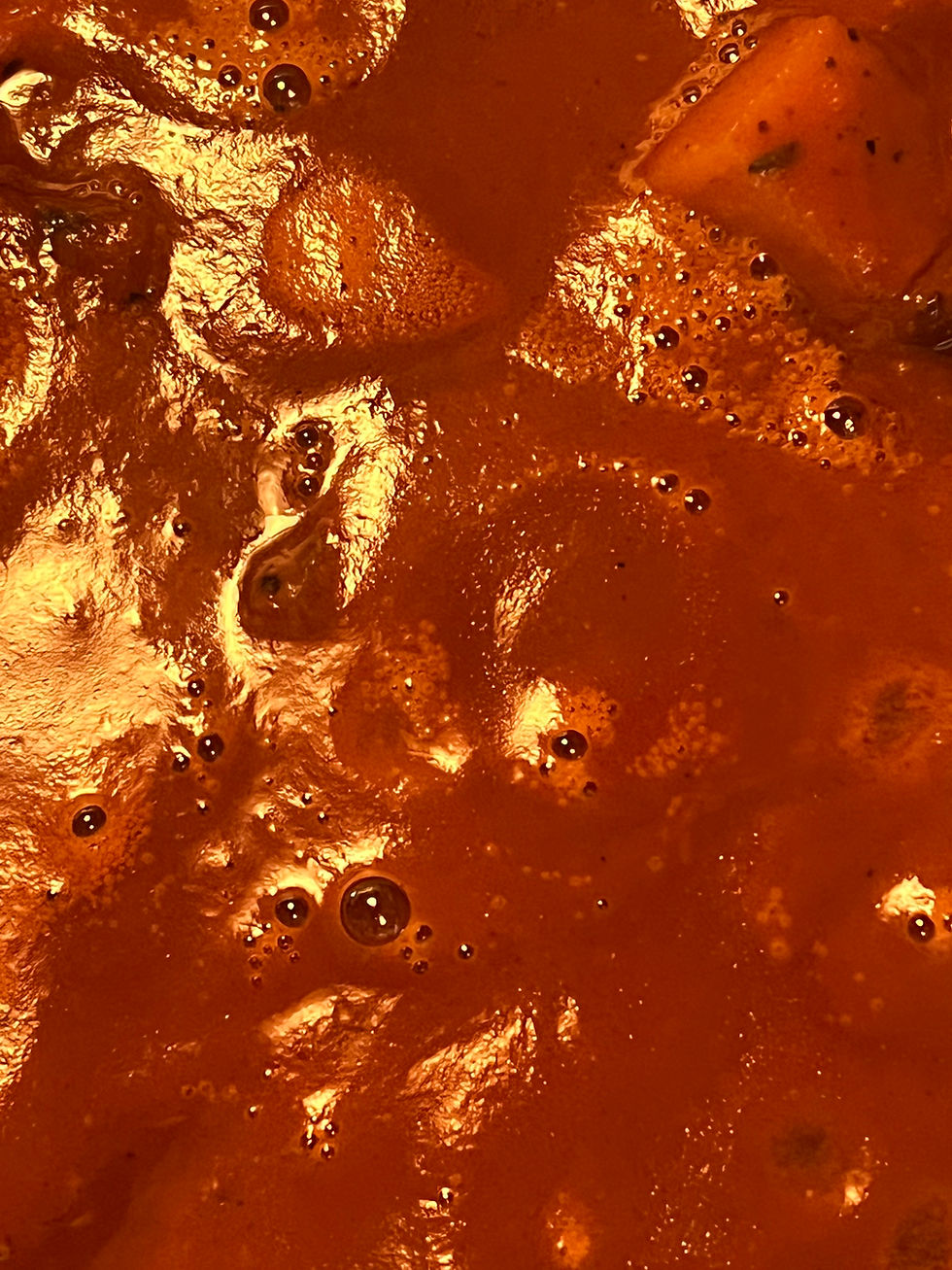
Recently I made domoda.
A Senegambian peanut stew.
And y’all…
My tongue is being reprogrammed.
The difference between the American peanut and the African peanut imagination is night and day.
colonial wild fire
indigenous wildfire
I never disliked peanut butter.
But my imagination around peanuts has always been limited.
Peanut butter cookies? Hard pass.
Reese’s? No thank you.
But a PB&J? I’ll tear that up.
Dried peanuts? Respect.
Boiled peanuts? Not really my ministry.
But domoda changed something.
Preparing that dish felt sacred.
And I could taste the difference immediately.
Not just the peanut.
Not just the tomato.
Care has a flavor.
And the tongue always knows.
Placing it on the altar of my mouth was new territory.
The dish forces slowness.
It forces presence.
It asks the tongue to experience peanuts as something full and complex rather than just a sugary sweet treat.
And I found myself having a conversation with baby me.
“This is peanut butter too, baby.”
Your ancestors ate something like this.
These are flavors that built you.
These are the tastes that flavored your melanin.
Cooking this dish also revealed something deeper about African foodways.
Layering.
Maximalism.
Attention.
African cooking is a slow build.
A gradual burn.
You arrive at the dish through patience.
Every step requires your presence.
And that presence transforms the final meal.

Tomato and peanut butter together are powerful.
I first learned that through the Sudanese dish Dakwa.
Expanding my palate through African dishes has also allowed me to innovate through my own cooking.
Blending modernity with indigenous Blackness.
Letting the tongue experiment.
Letting memory return through flavor beyond the appropriation and performance of our dishes.
And slowly — slowly — I am discovering what my actual taste palette is.
Not the one built through trauma.Not the one built through survival.
The real one.
The one that emerges when the body is allowed to listen to itself.
That discovery changes everything.
Energy.
Community.
Exchange.
Soul food becomes something different when it is rooted in regulation instead of survival.
My body has adjusted naturally over time.
Cravings shift when they are met with (see)ded depth.
This is how we restore balance.
How we interrupt cycles of under-eating and over-eating.
How we quiet the voracious emptiness empire placed inside our mouths.

Grounded nourishment.
Food that waters the body.
Food that reminds us we were always meant to be w(hole).

And maybe the tongue was always water too.
carrying salt
memory
breath
the quiet return of taste
when the body finally remembers
it was never meant
to live on bleach
The tongue is learning again.


Tongue Check
Taste the air.
Taste the plate.
Taste what remains.
What is sweet.
What is bitter.
What is missing.
The tongue always knows.
I Eat Tings
A study of the tongue, memory, and diaspora through food.
Each dish is a portal.
✺ Domoda: Reprogramming the Tongue | Senegambian Peanut Stew
That dish opened something in my tongue.
Plantain would soon continue the lesson.
✺ Plantain: The Glitch in the Banana Program | I Eat Tings


Amazing writing. I found that making my own food was one of the first ways I could express myself without feeling pressure to appease someone else. Even though I only know how to make a few things, I know each are things that bring me joy. It sounds like the Domoda Peanut Stew gave you joy too!