


Nashville and the Theology of Silence: On Being Useful Until You Become Inconvenient

Watching people entertain lies from a stranger because somewhere deep down they were already prepared to believe I was disposable.

Nashville and the Theology of Silence: On Being Useful Until You Become Inconvenient


The Beginning of Disposabilityy

I moved to Nashville in 1997.
I was going into the 7th grade. 12. Almost 13.
We had lived in Florence, Alabama for a year prior and my first experience of the South was horrific. Half of my life had been spent growing up in Denver, Colorado and then suddenly I was stolen into a place where all people could focus on was my skin tone, my round overly-developed body, and my strange accent. I didn’t know it then, but this was the beginning of a long journey of disposability.
That 6th grade year should have shifted something within my family. It should have caused intervention. It should have caused outside help. I went from being a straight-A student to barely being able to make C’s at Mars Hill Bible School, a deeply racist and violent educational environment where whiteness, religion, and performance moved as one body.
But instead of asking what had happened to me, my parents swept it under the rug and decided we would just “start fresh.”

The problem was the rug was already packed full.
Packed full of religious violence, silence, fear, projection, grief, and expectations I was never supposed to carry alone. And I carried it anyway because that is what Black children in survival-based families often learn to do. Especially neurodivergent ones. Especially the ones whose differences are useful until they become inconvenient.
—
Burnout Before Diagnosis
By 2018, almost twenty years later, it finally felt like things in Nashville were beginning to shift for me creatively.
But before I can even talk about Nashville, I have to talk about collapse.
I completed grad school in 2010 after experiencing three years of deep harm at University of California, Irvine, that I now understand through the lens of autistic burnout and OCD. At the time I had no diagnosis, no accommodations, no language for what was happening to my nervous system. I just knew my body and mind were beginning to fail me.

I asked my department head for a break because I could literally feel my mind teetering on a ledge.
He said no.
I went directly into another rehearsal process after stage managing my first full show alone. I was beyond exhaustion. My nervous system was fried. I bumped into another ASM and she lied and claimed I hit her in the back. My parents should have gotten me a lawyer. I should have left the program entirely.
But colonial fear is a hell of a thing.
My parents had high school educations. Their child being in these institutional spaces meant something symbolically. Survival had become attached to institutional proximity and endurance no matter the cost. So instead of protecting me, the expectation was: push through it.
don’t embarrass us.
keep going.
And I did.
I graduated with an MFA and immediately started working for a nonprofit in DC making $38,000 a year while doing the labor of someone who should have been making double that. When I asked for a raise I was told I did not have children and therefore had no reason to need more money.
Before creative director became an Instagram title, some of us were already carrying entire... There is a specific exhaustion that comes from being both the infrastructure and the artist at the.. People talk about “manifesting” now. I was producing full festivals while severely underpaid...
Caption 1 - Before creative director became an Instagram title, some of us were already carrying entire ecosystems on our backs.
Planning. Styling. Producing. Directing. Performing. Smiling through collapse.
Caption 2 - There is a specific exhaustion that comes from being both the infrastructure and the artist at the same time. Nashville saw the output. Very few people ever stopped to ask what was happening underneath it.
Caption 3 - People talk about “manifesting” now. I was producing full festivals while severely underpaid and undiagnosed. SunFest taught me I could build worlds. It also taught me what institutions are willing to extract from Black labor without care.
That sentence still sits in my body strangely.
Again: I should have gotten a lawyer.
But with what money? With what support? With what understanding of myself?
I was young, burnt out, isolated, and deeply conditioned to survive harm instead of identify it.
Two years into that position I ended up needing emergency surgery on my intestines because of a stress blockage.
A stress blockage.
At 27 years old.
That should have been another moment where everyone stopped and realized something larger was happening. But nobody did. No conversations around autistic burnout. No conversations around prolonged stress and nervous system collapse. My boss was asking me to return to work within a week of surgery because productivity in America matters more than bodies do.
And honestly, that has been one of the clearest themes of my life: people preferred my usefulness over my wellness.
—
Survival Inside Institutional Spaces
There’s a pattern you’ll notice here and I’m not going to over-litigate every incident because I no longer feel the need to perform perfect victimhood in order to deserve dignity.
Most jobs I have engaged have ended in some form of rupture: being fired, leaving abruptly, burning out, being pushed out, or me finally reaching a point where my nervous system revolted and I no longer cared about the consequences.
Now with an AuDHD + OCD diagnosis fully in view, I understand why.
When you are PDA-profile autistic and deeply unsupported, eventually survival overrides performance. Especially when you have spent years overextending yourself inside systems that underpay you, overwork you, exploit your labor, and then punish you once you can no longer mask comfortably.
At a certain point I would flip the script completely.
And instead of asking: “What is happening to this person?”
people decided:
“They're difficult.”
“ They're intense.”
“They're unstable.”
“They have an attitude problem.”
Rarely:
burnt out.
Rarely:
unsupported.
Rarely:
deeply dysregulated inside systems actively harming them.
—
Nashville and the Performance of Community
This happened again at TPAC where as a stage manager I was publicly humiliated in front of an entire staff and no one intervened.
People often mistake survival adaptations for charisma. That grin is exhaustion, overstimulation... Even burnt out I still showed up styled. Still creating silhouette. Still building character. Theater taught me how to survive impossible environments while smiling through them.
Caption Image 1 - People often mistake survival adaptations for charisma. That grin is exhaustion, overstimulation, masking, performance theory, and “keep going anyway” all happening simultaneously.
Caption Image 2 - Even burnt out I still showed up styled. Still creating silhouette. Still building character. Still making beauty out of nervous system collapse because theater trained me to believe the show must always go on.
Caption Image 3 - Theater taught me how to survive impossible environments while smiling through them. People applauded the production. Nobody asked what it cost my body to remain inside it.
It happened again after cosmetology school while working at Aveda Institute as a junior educator. The school was severely understaffed in ways that violated state requirements. One day there were only three educators covering over 500 students.
Three.
I had requested off months in advance for platform work. I ended up taking a stylist kit because I could not access mine in time and was terrified of being late to a professional commitment. When I returned I was accused of theft and fired.
Again: no one asked what conditions created the situation.
Only punishment.
Only disposal.
Only labor extraction until the moment I became inconvenient.
Hair became one of the only spaces where my theater brain, my design brain, and my obsession with... One of many hair projects. One of many rooms where I proved my capability publicly while privately.. I built worlds out of hair because I understood early that Black hair was never just cosmetic...
Caption 1 - Hair became one of the only spaces where my theater brain, my design brain, and my obsession with transformation could exist together. Even then, Nashville preferred spectacle over understanding the labor underneath it.
Caption 2 - One of many hair projects. One of many rooms where I proved my capability publicly while privately collapsing. Nashville loved the output. The city was far less interested in what it meant to sustain the person creating it.
Caption 3 - I built worlds out of hair because I understood early that Black hair was never just cosmetic. It was architecture. Performance. Armor. Survival. Ritual. And still people tried to flatten the work into trend.
And this continued across multiple salon spaces in Nashville even as I moved into booth rent and slowly began recognizing that I actually needed to work for myself because traditional structures could not hold me properly.
At the time I did not fully understand why.
Now I do.
—
But even while collapsing internally, I continued building.
That is the part people seem to conveniently forget.
If I figure something out, I get people paid.
That has always been my nature.
I connected people.
Built ecosystems.
Designed experiences.
Shared opportunities.
Pulled people into rooms.
Created visuals.
Styled shoots.
Directed concepts.
Introduced people to one another.
Shared audiences.
Shared language.
Shared resources.
And almost nobody ever attempted to stabilize me in return.
People were more than happy to consume my labor, my creativity, my weirdness, my aesthetics, my access, my emotional depth, my body, my ability to execute.
But very few people ever stopped and asked:
“Are you okay?”
And Nashville in particular is a city that loves extraction while pretending it is community.
Especially once the city fully entered its gentrified creative era.
I remember when East Nashville was still considered dangerous.
I remember when Antioch and Hickory Hollow were the old spots.
I remember when 2nd Avenue belonged more to locals than tourists.
I watched the city turn increasingly colonial in real time while still trying to cosplay itself as progressive and artistic.
And within that shift came an entirely new class of creative performance.
People buying positionality.
People performing artistry instead of embodying practice.
People performing healing.
Performing liberation.
Performing “community.”
Performing Blackness.
But with very little depth underneath it.
Meanwhile I was actually living my praxis through my body.
The dream was always my own production company. But unlike a lot of people now, I never wanted to skip embodiment and jump directly to title. I started telling stories using my own body because that was what I had access to.
My home became set design.
Archive.
Installation.
Theory.
Experiment.
I was doing visual direction, performance work, fashion storytelling, movement, and interdisciplinary worldbuilding before “creative director” became everybody’s Instagram bio.
And because I was not easily digestible, people wanted proximity to me without responsibility toward me.
They wanted:
the connect,
the cannabis,
the aesthetics,
the energy,
the access,
the weirdness in controlled doses
or under the influence.
But not the fullness of me.
Never the fullness.
—
Melanin Pool Poppin and the Labor of Care
Melanin Pool Poppin came out of that period and people still do not understand that what made it magical was not branding.
It was care.
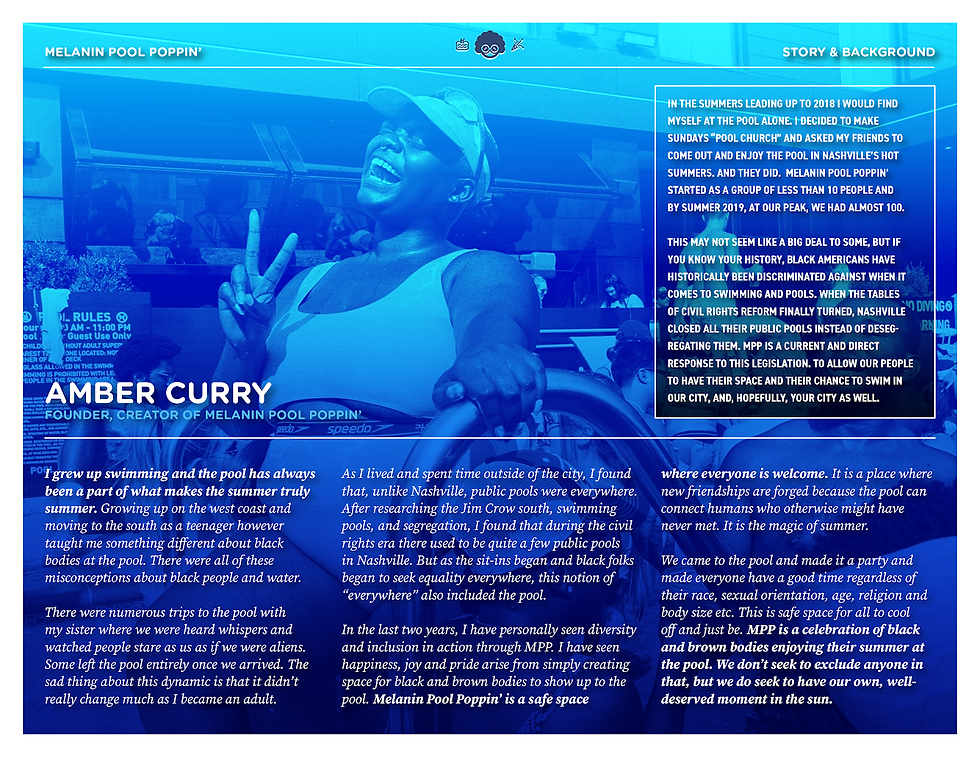
It was ecosystem.
Improvisation.
Trust.
Embodied labor.
I lost money creating those spaces.
I overextended myself creating those spaces.
The event was literally: tell a Black friend and pull up.
That was the energy.
And yes, mistakes happened. I was heavily masking through alcohol during that period because I was trying to survive socially while deeply dysregulated internally. I own that fully.
But people also do not understand the amount of labor I was carrying while simultaneously trying to hold community together.
And it seemed like everybody felt entitled to me.
People wanted my body in their art.
Wanted my ideas.
Wanted my energy.
Wanted my connections.
Wanted access to my creativity.
But would not fully recognize the art I myself was building within Nashville.
People filling in the gaps of my life instead of simply asking me directly.
Clients beginning to lay claim to me in ways that made me not even want to do hair anymore because suddenly I was expected to carry everyone else’s scalp, identity, self-esteem, and projection while they refused to do deeper work around their own relationship to self.
People wanted transformation while refusing embodiment.
And honestly that is a lot of Nashville.
—
Around 2018 I really thought things were finally opening up for me professionally. I had started working with a Black musician and genuinely believed I was moving toward a larger production role creatively.
I did hair.
Artistic direction.
Creative support.
Travel.
Visual development.
And yes, my travel was often covered. I’m not denying that. But overall I was still deeply underpaid relative to the amount of labor and intellectual property I was contributing.
On one major project, yt creatives received the majority of the visible credit for work I had heavily shaped.
Again:
people loved what I could produce.
Not necessarily me.
And this pattern repeated itself constantly.
The Black Gold Kwanzaa event.
The Vote video project with the Unitarian church during the pandemic.
Event after event where people knew I could execute impossible timelines so they underpaid me, overextended me, and expected me to still show up smiling at the end of the night after building entire environments from scratch.
And then once the event started?
You become “the help.”
Even inside spaces supposedly centered around Black liberation and communal politics.
That kind of dissonance changes you.
—
Black Beauty School and Afro Hair Praxis
Black Beauty School took off during the pandemic largely because white salon spaces suddenly discovered performative anti-racism through Black Lives Matter.
Meanwhile I had already spent years trying to deeply understand Afro hair science because I recognized there was a violent disconnect happening in salon culture.
I went to cosmetology school because I wanted to understand the system from the inside.
I brought Black barber education, Afro hair theory, and textured hair science into spaces that... The irony still sits heavy in my chest. The platform work that helped cost me my Aveda position...
Caption 1 - I brought Black barber education, Afro hair theory, and textured hair science into spaces that barely believed our bodies deserved curriculum in the first place. And people still act confused when I critique salon culture.
Caption 2- The irony still sits heavy in my chest. The platform work that helped cost me my Aveda position was also proof that I actually knew what I was talking about. I was teaching while still being treated as disposable by institutions benefiting from my labor.
And what I discovered was that most salon education had almost nothing to do with care.
It was product.
Brand loyalty.
Colonial aesthetics.
Maximum profit extraction.
Pushing Afro bodies into salon cycles built for white maintenance structures.
And when I began speaking critically and disruptively about that online, people paid attention.
But what I did not realize was how many people around me were quietly waiting for me to fail.
—
The cyberstalking situation still honestly blows my mind.
Not because of the stranger.
But because of how many people I actually knew decided to engage with anonymous accounts instead of simply contacting me directly.
People I had worked with.
Supported.
Shown up for.
Shared space with.
And they all chose gossip over care.
That is the part that altered me permanently.
Watching people entertain lies from a stranger because somewhere deep down they were already prepared to believe I was disposable.
And to be clear:
I did not steal money with Black Beauty School.
Every salon that hosted me legally paid my fee.
But by that point people were more interested in narrative than truth.
And honestly?
That realization nearly destroyed me.
—
Narrative Theft and Social Disposal
Even projects like the Eloquii Black Creators Program carried the same contradiction.
I created some of the strongest commercial work of my life there:
finding photographers,
styling myself,
building concepts,
creating visual stories through a queer fat Black body in ways those brands rarely ever allow.
People often read confidence in Black fat bodies as ease. What they were actually witnessing was... I was always trying to tell fuller stories.Not just clothing. Intimacy. Softness. Texture... Fashion became another stage language for me. Another way to build worlds while my actual life... People saw boldness. What they did not see was how much of my body was operating in survival mode... I knew exactly how to command an image.Years of theater taught me composition, gesture, silhouette.. Even then I was building environments, not just outfits.Trying to create emotional worlds through... I wanted fat Black fashion imagery to feel cinematic and embodied instead of disposable content... The irony of this period is that some of the most visually expansive work of my life was happening..
I poured some of my strongest visual storytelling into this project. Creative direction. Styling. Performance. Character work. Embodiment. Narrative. Trying to create fat Black imagery that felt cinematic, strange, sensual, and alive instead of flattened into “body positivity” branding. And still, underneath all the sequins and color theory and editorial polish, I was exhausted.
Caption 1 - People often read confidence in Black fat bodies as ease. What they were actually witnessing was performance training and survival adaptation layered carefully on top of burnout.
Caption 2 - I was always trying to tell fuller stories.Not just clothing. Intimacy. Softness. Texture. Black interiority. Bodies existing without apology inside beautifully designed worlds.
Caption 3 - Fashion became another stage language for me. Another way to build worlds while my actual life was quietly unraveling behind the scenes.
Caption 4 - People saw boldness. What they did not see was how much of my body was operating in survival mode while still being expected to produce beauty on command.
Caption 5 - I knew exactly how to command an image.Years of theater taught me composition, gesture, silhouette, tension, spectacle. But nobody teaches you what happens when your body can no longer sustain constant performance.
Caption 6 - Even then I was building environments, not just outfits.Trying to create emotional worlds through image-making while still not fully understanding why traditional systems kept breaking my body apart.
Caption 7 - I wanted fat Black fashion imagery to feel cinematic and embodied instead of disposable content. Not trend. Not algorithm bait. Worldbuilding.
Caption 8 - The irony of this period is that some of the most visually expansive work of my life was happening at the exact same time my nervous system was collapsing underneath me.
And still I was deeply underpaid and ultimately unsupported while other cohort members were able to more sustainably transition into influencer and commercial ecosystems.
Again:
I was useful.
Valuable.
Visually compelling.
But not fully supported as a human being.
That has been the pattern.
—
Neurodivergence Misread as Moral Failure
And I think what hurts the most is realizing how many people interpreted my burnout, dysregulation, defensiveness, and overwhelm as moral failure instead of unsupported neurodivergence.
My body was communicating distress constantly.
Through collapse.
Through rage.
Through overstimulation.
Through illness.
Through withdrawal.
Through disruption.
Through exhaustion.
And instead of asking:
“What support does this person need?”
People chose punishment.
Projection.
Distance.
Conversation.
Disposal.
—
Reclaiming Authorship After Collapse
I am in full view now of my praxis, my capabilities, my art, and the cosmology I have actually been building all these years.
And the irony is that many of the same people who flattened me, extracted from me, projected onto me, or quietly participated in my social disposal are now participating in watered-down versions of ideas I was already trying to articulate while fighting for my survival.
But survival changes your relationship to authorship.
And I no longer need permission to tell the truth about what happened to me.
Especially because my body already has.
Nashville and the Theology of Silence: On Being Useful Until You Become Inconvenient


Comments