


⟁| on “she/they,” lineage, and the fear of becoming beyond Black womanhood

“She/they” is often socially acceptable because “she” still remains visible.
Still remains reassuring.
Still signals proximity to recognizable womanhood.
Still communicates:
“I have expanded, but not beyond comprehension.”
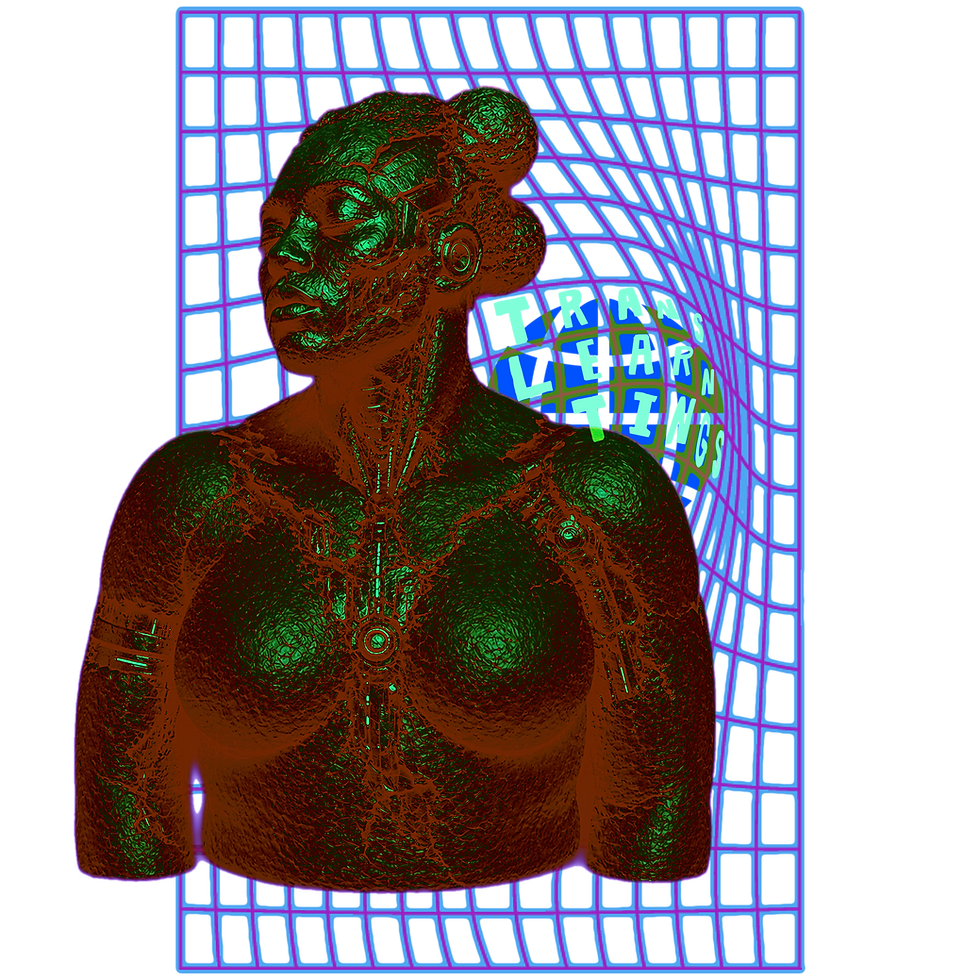
Trans Learn Tings is a growing archive exploring gender, embodiment, transition, autonomy, and becoming beyond the limits of colonial identity systems. These essays are not concerned with proving transness or defending existence. They are concerned with what becomes possible when we stop performing prescribed identities and begin listening to the body, the spirit, and the futures trying to emerge through us. Through personal narrative, cosmological inquiry, disability justice, Black studies, and trans liberation, Trans Learn Tings asks how we learn ourselves into being.
⟁| on “she/they,” lineage, and the fear of becoming beyond Black womanhood

This is exactly why I say they/them exclusively—because harm still happens when you refuse to go along.
Especially within Black womanhood, where difference too easily gets read as disruption instead of reality.
And we need to be honest:
Black womanhood is carrying a lot.
Brilliance.
Survival.
Care.
Innovation.
Endurance.
But one of the loudest things it is carrying is a deep attachment to the binary.
To be Black is already to exist outside the norm.
Outside the structures that tried to define us.
Outside the systems that insisted humanity had to look one way in order to count.
Blackness itself is already a rupture.
Which is why it is always revealing to watch people celebrate rupture aesthetically while refusing it materially.
People love the language of liberation until someone actually embodies it.
And I have experienced this intimately.
I have sat in private conversations with people—especially Black women—who wanted to speak openly about queerness, fluidity, disconnection from womanhood, exhaustion with performance, and the suffocation of the binary.
Behind closed doors, there is honesty.
Curiosity.
Even grief.
But the moment the audience appears, the performance returns.
Suddenly the binary gets defended.
Pronouns get questioned.
Distance gets created.
And the same people who spoke to me softly in private begin reattaching themselves publicly to the very structures they admitted were harming them.
That contradiction matters.
Because it reveals how much of gender performance is tied to social survival and communal approval.
It reveals how many people are not actually choosing embodiment freely—they are negotiating visibility.
Negotiating acceptance.
Negotiating proximity to safety.
And I understand why.
Black people have historically been punished for becoming unintelligible to dominant systems.
But what becomes dangerous is when that fear gets redirected laterally onto other queer and trans people who refuse to perform coherence for the comfort of the room.
Especially those of us who stop leaving “she” behind as reassurance.
Because then the issue is no longer identity.
The issue becomes obedience.
The issue becomes:
“How far are you allowed to transform before the community no longer recognizes you as worthy of care?”

Because once someone refuses the binary entirely, the conversation changes.
And let me be clear:
some people genuinely are fluid there.
Cool.
If it does not apply, move on.
But there is a very specific performance I keep witnessing where “she/they” functions less as embodiment and more as social cushioning.
Difference with a seatbelt.
Queerness that still protects the comfort of everyone else in the room.
Because the moment “she” disappears entirely, people are forced to confront something deeper:
their attachment not just to women, but to the performance of womanhood itself.
And specifically within Black communities, that attachment runs deep because Black womanhood was never allowed to simply exist.
It had to perform usefulness.
Strength.
Sacrifice.
Legibility.
Care.
Survival.
It had to become a defense mechanism.
So now when someone says:
“I do not locate myself there anymore,”
or,
“I refuse that framework entirely,”
people respond as though lineage itself is under attack.
But evolving beyond inherited harm is not betrayal.
And that is the conversation many people refuse to have.

Because a lot of us are still deeply invested in the tropes handed down to us.
The strong Black woman.
The endlessly enduring Black woman.
The suffering Black woman.
The self-sacrificing Black woman.
The hyper-feminine nurturer.
The container for everyone else’s survival.
And many people defend those tropes because they are afraid of what remains if they let them go.
Because if Blackness itself has always existed outside of the colonial norm, then what does it mean that so many of us still cling to colonial gender structures as proof of legitimacy?
What does it mean that we can imagine Afrofutures, abolition, liberation, rupture, spiritual transcendence, and the collapse of empire — but still panic when someone says:
“I am not she.”
That contradiction is important.
Because it reveals that many people are comfortable with radical aesthetics but not radical embodiment.
Comfortable with liberation as metaphor.
Uncomfortable with liberation as lived reality.
And some of us were never alive inside those roles to begin with.
Some of us survived by performing proximity to them.
By rehearsing them.
By masking through them.
By shrinking ourselves into something recognizable enough to avoid punishment.
And still, the punishment came.
That is why I cannot “opt back in” for the sake of communal comfort.
That is why they/them is not aesthetic for me.
It is not trend.
It is not rebellion for rebellion’s sake.
It is refusal.
Refusal to keep reenacting identities that required my disappearance.
Refusal to keep calling survival freedom.
And this is where people become uncomfortable:
because many communities do not actually want transformation.
They want expansion that leaves the original structure intact.
A little queerness.
A little softness.
A little fluidity.
But not enough to destabilize the social architecture.
Not enough to force grief.
Not enough to force reexamination.
Not enough to force accountability around the ways gender itself became inherited trauma.
Especially from the very people we are taught must remain beyond critique.
And that part is dangerous.
Because honoring lineage should not require reproducing the conditions that wounded you.
I honor the women I come from fully.
I understand what they survived fully.
I understand why they became who they became.
But healing also requires honesty.
Some of what they carried was survival strategy.
Some of what they carried was silence.
Some of what they carried was performance.
Some of what they carried was gendered suffering mistaken for identity.
And I refuse to inherit all of it unquestioned simply because it is familiar.
My refusal is not rejection.
It is continuation, just in truth.
Because I do not believe liberation is found through better performance of the same inherited scripts.
I believe liberation begins the moment we stop confusing survival with selfhood.
They and them
us and we
my ancestors got me
⟁| on “she/they,” lineage, and the fear of becoming beyond Black womanhood


Comments