


◉⌁ I See Tings- Freedom Under Surveillance

PART 2
◉⌁ I See Tings- Freedom Under Surveillance
A few days ago was Juneteenth.

This is not a continuation of my thoughts about culture.
This is a continuation of my thoughts about power.
Because the more I reflect on the day, the more I keep returning to a single image.
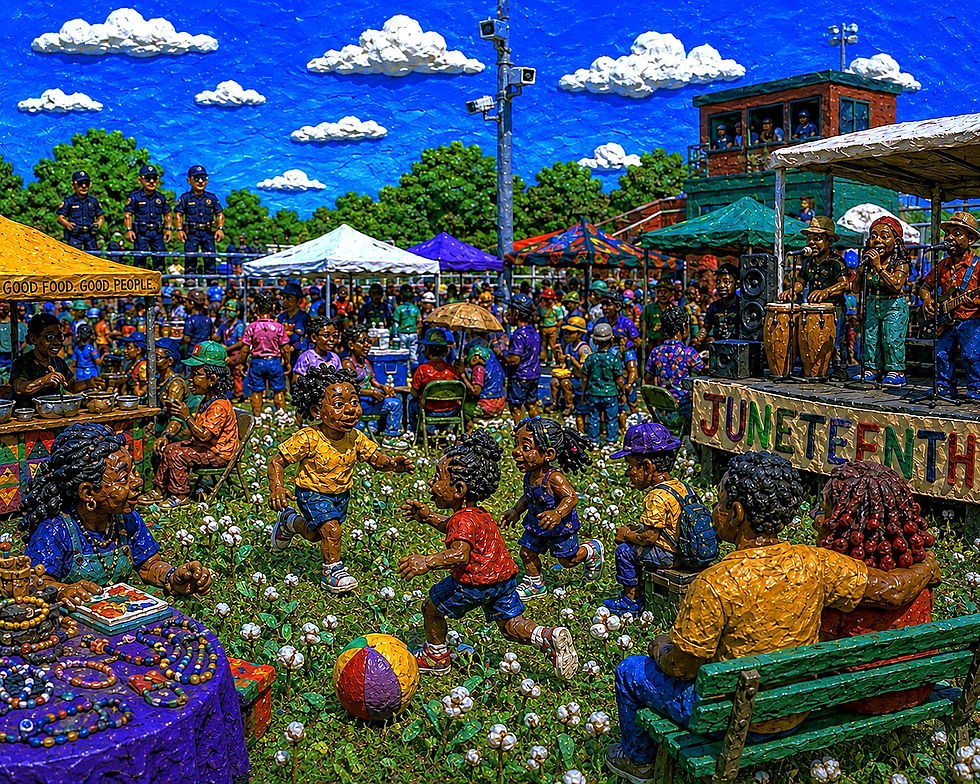
Black children playing games in the middle of a football field.
A renovated cotton field.
Police standing nearby.
Photographers taking pictures.
Parents watching.
Music playing.
Juneteenth banners moving in the wind.
And all of it occupying the same space.
Freedom.
Surveillance.
Joy.
Control.
Memory.
Possibility.
The image won’t leave me.
Because it feels like the entire country compressed into a single afternoon.
Accessibility Beyond Compliance
One of the reasons I have complicated feelings about the event is because the event itself rocked the boxes.
Our accommodation and accessibility needs were met.
I need to say that clearly.
The organizers made efforts.
People worked hard.
Things happened because somebody put labor into making them happen.
But accessibility is bigger than accommodation.
Accessibility is relationship.
And that is where things become complicated.
People are more concerned about bureaucracy and not getting in trouble than actually fulfilling accessibility and seeking to understand why it needs to exist.
Accessibility becomes a checklist.
A liability concern.
A compliance issue.
A thing you do so nobody complains.
A thing you do so nobody sues.
A thing you do so you can say you did it.
But accessibility is not paperwork.
Accessibility is culture.
Accessibility is relationship.
Accessibility is understanding that different bodies move through the world differently.
The proof isn’t whether accommodations were technically provided.
The proof is how people behave.
Accessibility moves past uncomfortability.
If you’re actually being accessible for everyone there, then you’re not gonna act weird around the disabled people.
And that’s still what happened.
We had already communicated our needs.
We were actively setting up.
The event wasn’t opening for hours.
We were literally trying to determine our layout.
And somebody still felt the need to walk over and bark instructions.
To fuss.
To police.
To exert authority.
Not because there was an emergency.
Not because anything was wrong.
Because authority had to remind itself it existed.
And maybe that’s what I kept noticing all day.
People performing authority.
People performing control.
People performing management.
Very little relationship.
The Disabled Kid
Then there was the disabled kid helping clean up.
I don’t know their story.
I don’t know their diagnosis.
I don’t know their support needs.
And I don’t need to.
Because what stayed with me wasn’t who they were.
It was what the interaction represented.
Because they definitely sent the disabled kid to the disabled people.
And that’s actually not how accessibility works.
That’s fucking disrespectful to the kid and to us.
Accessibility is not disabled people managing disabled people.
Accessibility is not assigning disability to disability and calling it support.
Accessibility is shared responsibility.
Everybody should understand it.
Everybody should practice it.
Everybody should participate in creating it.
The moment felt familiar because it reflected a larger pattern.
We create categories.
Then we expect those categories to care for themselves.
We isolate people.
Then call the isolation support.
And somehow we’re surprised when nobody feels connected.
Overseers
I spent much of the day thinking about overseers.
Not historical overseers.
Modern ones.
The kind that wear badges.
The kind that carry cameras.
The kind that carry clipboards.
The kind that decide who belongs.
The kind that tell you where to stand.
The kind that document your existence.
The kind that create systems that require your participation while never fully trusting you inside them.
The event was organized.
It was managed.
It was structured.
But I kept finding myself wondering why so many Black events still feel dependent upon people who fundamentally do not understand the communities they are attempting to serve.
And before somebody rushes to flatten that statement, that’s not about competency.
It’s about relationship.
You can organize an event.
You can manage logistics.
You can create schedules.
You can secure permits.
And still not understand the people in front of you.
Those are different skills.
The Archive

And surveillance doesn’t only wear a badge.
Sometimes it carries a camera.
The photographs looked beautiful too.
White photographers walking around Black events taking pictures of Black people for historical evidence.
Because that’s what you’re doing.
Taking pictures of Black people so somebody can later point to the photograph and say:
Look.
See.
We supported Black people.
We celebrated Juneteenth.
We showed up.
The photograph becomes a receipt.
A federal holiday requires documentation.
A grant requires documentation.
An institution requires documentation.
A county requires documentation.
And suddenly there is a camera in my face asking me to smile.
As though joy can be commanded.
As though participation is consent.
As though being present means I want to become part of somebody else’s archive.
One photographer came by our booth.
And I almost flipped a bird.
Not because I was angry at him specifically.
Because I was angry at the assumption.
No.
I don’t want to be memorialized in any of this bullshit.
I don’t need my face used as evidence that liberation happened.
I don’t need my body helping a city, a county, a sponsor, or an institution prove that they supported Black people when they actually did not.
The photograph looked beautiful.
The relationship was missing.
An Awards Show for the Best Blacks

Juneteenth is an awards show for the best Blacks in the system.
The sentence arrived in my head and refused to leave.
Because all day I found myself wondering:
Who gets funded?
Who gets recognized?
Who gets invited on stage?
Who gets legitimacy?
Who gets visibility?
Who gets celebrated?
And who remains outside the frame?
Then I listened to the conversations.
The gossip.
The ranking.
The comparisons.
Whose Juneteenth was better.
Whose event had more people.
Whose stage was bigger.
Whose sponsors were better.
Whose organization did it best.
As though liberation can be measured through attendance numbers.
As though freedom is a competition.
As though colonialism didn’t already teach us how to build hierarchies and call them success.
We can’t even come together.
The amount of ugliness and gossiping I heard around people talking about other people’s Juneteenths.
Trying to figure out what they need to do next year.
Trying to figure out how to win.
Trying to figure out how to rank themselves.
Instead of asking how we build something together.
Instead of asking how we stop reproducing colonial lines.
Being Black is becoming a clique when we’re already a queer people and the parameters for being Black are absurd.
The Minefield
The terrain beneath presentation. What survival conceals.
Yesterday I gave away jewelry.
Like I always do when I see people in need of intention and care.
I watched another Black kid steal from my table with encouragement of a parent.
I had a whole conversation.
Was engaging.
Was willing to care.
Would’ve given it to them for free.
But instead you steal.
And somehow that moment sits beside everything else.
The generosity.
The scarcity.
The curiosity.
The surveillance.
The joy.
The exhaustion.
The possibility.
The disappointment.
All occupying the same field.
Just like Juneteenth itself.
And maybe that’s why one image kept returning.
Wig laid.
Hair displayed.
But the scalp underneath is a minefield.
Because it wasn’t just about hair.
It was about the holiday.
It was about the event.
It was about the country.
The holiday looked beautiful.
The vendors looked beautiful.
The outfits looked beautiful.
The photographs looked beautiful.
The performances looked beautiful.
The social media posts looked beautiful.
But underneath?
Disabled people still struggling for dignity.
Queer kids still unsupported.
Police still surveilling.
Vendors still underfunded.
Community still fragmented.
Curiosity still under-resourced.
Relationship still waiting to be built.
The wig is laid.
The scalp is telling another story.
And until we learn the difference between gathering and relationship, we will continue mistaking celebration for liberation.
Cosmos Watershed
Companion Current
This essay examines a recurring contradiction: communities, artists, and cultural workers are often told their work has value while simultaneously being asked to give it away. Visibility is offered in place of investment. Attention is offered in place of support. The result is a culture that celebrates creativity while struggling to sustain the people who create it.
Companion Current
✺ Freedom Under Surveillance
This essay explores what happens when movement, gathering, and everyday life unfold under watchfulness. Whether through policing, institutional oversight, algorithms, or social scrutiny, surveillance reshapes behavior long before intervention occurs. The body learns to anticipate being observed and adjusts accordingly.
Expansion Current
If surveillance enters through institutions, it also enters through ordinary life. This essay traces how safety calculations become embedded in routine activities, transforming simple errands into logistical and emotional negotiations.
Lineage Current
Observation is not inherently harmful. This essay distinguishes care from surveillance by examining the invisible labor of building environments where people can participate safely and fully. It asks what happens when systems are designed to support rather than control.
Counter Current
Where surveillance seeks information, community leaves traces of relationship. This essay explores how care becomes visible through small acts, shared infrastructure, and the material evidence of people showing up for one another.
Sacred Current
Both essays ultimately return to the same question: what does genuine support look like? If culture is valuable, who sustains it? If freedom is necessary, what structures protect it? This essay examines the long work of building ecosystems capable of holding people beyond visibility, attention, or observation.
◉⌁ I See Tings - Freedom Under Surveillance


Comments