


◍◈ I Adorn Tings - The Garment Tells the Truth

I've spent over 15 years modeling.
But I never entered modeling because I wanted to become a mannequin.
I entered because I have always been interested in storytelling.
◍◈ I Adorn Tings - The Garment Tells the Truth

Part 1
I have been reviewing my work in fashion.

Not fashion as aspiration.
Not fashion as trend.
Not fashion as content.
Fashion as infrastructure.
Joy is part of the fit test too. Every outfit begins as a relationship between body and movement. Movement reveals what photographs cannot. Pattern is only one layer of construction. A garment should support the life happening inside it. Like a rhinestone cowboy. I do not only model garments. I teach in them while busting respectability. Infrastructure begins before the event does. Garments should work where knowledge is shared. A wardrobe is built one relationship at a time. Silhouette changes as the body moves. Sometimes the smallest details carry the longest relationship. Still pissed ILYSM went OOB. Clothing becomes different once it enters a life. Sometimes the body finds the garment before the photograph does.
Which is not how most people talk about clothes.
Most conversations about clothing eventually become conversations about identity.
Who are you?
What are you wearing?
What aesthetic do you belong to?
The Top is...
The Shoe is...
The Bag is...
Who owns you?
I understand all of those questions.
I like fashion.
I always have.
I like silhouettes.
I like adornment.
I like beautiful things.
I like clothing that tells stories.
What I am increasingly uninterested in is clothing that only works in photographs.
Because eventually the body tells the truth.
The garment tells the truth.
And the truth is often different from the marketing.
I've spent over 15 years modeling.
But I never entered modeling because I wanted to become a mannequin.
I entered because I have always been interested in storytelling.
Modeling was another stage.
Another place where a story could move through a body.
I wasn't interested in simply displaying clothes.
I was interested in what the clothes were saying.
How they changed a posture.
How they invited movement.
How they transformed the relationship between a body and the space around it.
The photograph was never the whole story.
It was one frame.
One moment.
One possibility.
The story began long before the camera appeared.
It continued long after the lights were packed away.
That is the work I was always interested in.
And if I'm honest, the stories I was able to tell were beautiful.
But they were never complete.
The industry often asks the model to communicate aspiration.
To embody desire.
To make the garment appear effortless.
I wanted something else.
I wanted to tell stories about relationship.
About movement.
About Blackness.
About fatness.
About queerness.
About accessibility.
About what a garment asks of a body—and what a body asks of a garment.
Those are different stories.
They're also much harder to tell inside an industry that often mistakes appearance for truth.
The Fat Fashion Promise

For years fat fashion was sold to us as liberation.
Finally access.
Finally visibility.
Finally representation.
And I understood why that mattered.
There were years when finding clothes at all felt impossible.
I remember when my options were super limited when the choices were D.E.B., Ashley Stewart, Lane Bryant, Department Stores and a handful of pitiful others.
Years when style and fatness were treated as mutually exclusive.
Years when we were expected to settle.
So when brands began appearing many of us were grateful.
Color carries. The garment studied. Zelie for She. Lace remembers. 
The garment breathes. 
Becoming celestial. I did that. Not Eloquii. 
Portrait in motion. Zelie for She. Joy survived.
Maybe too grateful.
Because gratitude can become a shield against critique.
The conversation became:
At least they make our size.
But eventually another question arrived.
Do they make good clothes?
Not clothes that photograph well.
Not clothes that trend.
Not clothes that get reposted.
Good clothes.
The kind that survive a life.
The kind that survive a body.
The kind that survive reality.
The Limits of Extended Sizing
There are also brands like Universal Standard that have built their reputation around extended sizing and technical fit. While that work has undoubtedly expanded access for many fat people, I've never found myself reflected in the worlds they create.
My critique isn't simply about the garments.
It's about the imagination behind them.
Again and again, I see a very particular kind of fat body being centered: minimal, restrained, polished, and emotionally quiet. Even when bodies of color appear, they often exist within that same narrow aesthetic. The story being told is one of respectable fatness—calm, neutral, and nonthreatening.
That has never been my body.
Extended sizing is important. But extending sizes is not the same as extending imagination. A garment can fit my measurements while still refusing the fullness of who I am.
Eloquii and the Problem of Visibility

I have complicated feelings about Eloquii.
Partly because I remember sitting in conversations, when I was in residency with the Black Creators Project, with people involved in the design process.
Partly because I remember the excitement around finally seeing a company acknowledge larger bodies.
And partly because I still own Eloquii garments with the tags attached.
Not because I forgot about them.
Because they never became part of my life.
The fabrics weren’t breathable.
The garments weren’t particularly comfortable.
The pieces often felt over-trended.
Built around a moment rather than longevity.
Built around a campaign rather than a wardrobe.
And what is fascinating now is that I have lost a significant amount of weight.
Many of the Eloquii pieces I own are size 20s and 22s.
I am currently much smaller than that.
Yet some of those garments are only now beginning to fit in a way that feels comfortable.
That should raise questions.
Because a size is supposed to communicate information.
Pattern speaks. Monochrome, uninterrupted. Styled for visibility. Details carry weight. Shape before trend. Light follows texture. Performance became product. Even the feet performed. And those heels uncomfortable AF. Movement between frames. 
Movement between frames. 
Labor in motion. 
The body kept working. 
Performance for profit.
And if a size 20 only becomes comfortable on a body significantly smaller than a size 20, then what exactly are we measuring?
What exactly are we building?
What exactly are we telling fat people about their bodies?
The entire line often felt like skinny people designing for larger bodies.
Which, from what I observed, was not far from the truth.
And eventually the garment told the truth.
Zelie for She and the Limits of Representation

But I don't think the problem begins and ends with thin people designing for fat people.
That explanation is too easy.
Because then we arrive at Zelie for She.
A fat designer.
A fat-owned brand.
A company that should have understood exactly what I was looking for.
And yet my experience was often more complicated than I expected.
Before I go any further, I want to be clear: I own multiple pieces from Zelie for She. Many of them I genuinely love. They remain part of my wardrobe, and I can't imagine selling them or giving them away. As my body changes, I'll continue altering them, repairing them, and keeping them in rotation for as long as the garments allow.
That is precisely why I feel capable of critiquing them.
My relationship with the brand has never been built around a single purchase or a single disappointing garment. It has been built over years of buying, wearing, living in, and returning to the work. And across that relationship, I have come to realize that very few of the pieces I own exist above critique.
This is the part people don't like talking about.
Because we have been trained to believe that representation itself is the victory.
But representation is not craftsmanship.
Representation is not construction.
Representation is not embodiment.
I specifically remember purchasing an organza set.
The top.
The pants.
The whole thing.
And my immediate reaction was confusion.
Not because it was ugly.
Because it felt unfinished.
Like Fashion Design 101.
Like somebody had discovered an exciting fabric and stopped there.
The garment looked fashionable.
The garment did not feel resolved.
The fabric irritated my body.
The construction felt underdeveloped.
The experience of wearing it never matched the image being sold.
That wasn't true of every garment.
But it happened often enough that I stopped ignoring the pattern.
Again and again I found myself looking at pieces and thinking:
This is a great photograph.
This is not a great garment.
And those are not the same thing.
I think that's what I keep returning to throughout this series.
Representation may get someone through the front door.
But representation alone cannot draft a pattern.
It cannot decide where a seam belongs.
It cannot choose an interfacing.
It cannot account for friction against fat skin.
It cannot predict how a garment will move after six hours of wear.
Those things require a different practice altogether.
They require the slow craft of actually listening to bodies.
And bodies, eventually, always tell the truth.
The Body Is the Final Reviewer
Fashion reviews rarely talk about bodies.
Not real bodies.
They talk about trends.
Campaigns.
Collections.
Aesthetics.
The body gets edited out.
My body has become my final reviewer.
Can I teach in this?
Can I travel in this?
Can I vend in this?
Can I stand in this for eight hours?
Can I regulate my nervous system in this?
Can I move?
Can I breathe?
Can I live?
The answers matter more than the campaign.
More than the branding.
More than the mood board.
Because eventually the body tells the truth.
When the Body Becomes the Marketing
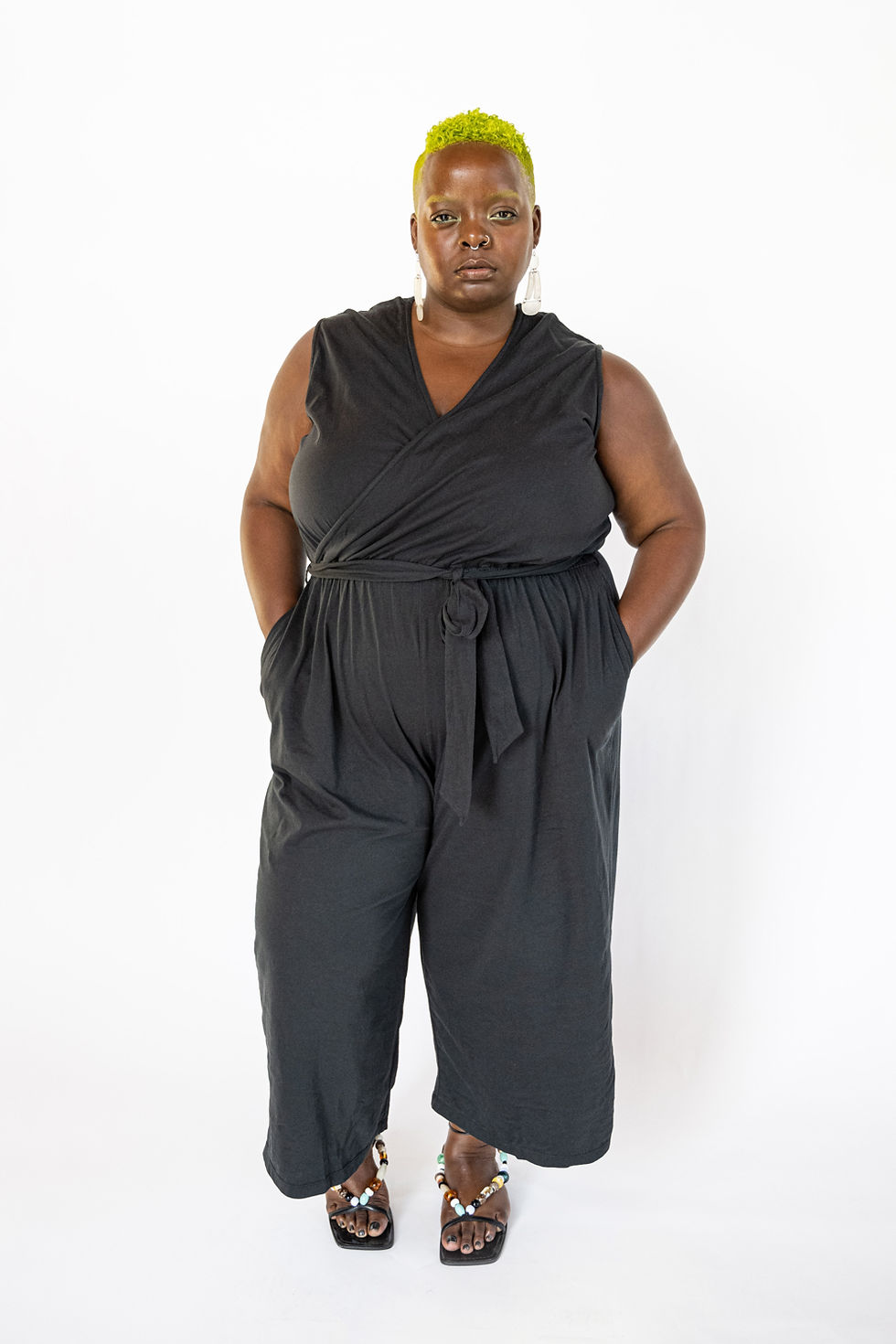
There is another experience I keep returning to as I write this essay.
This time, I wasn't buying the garment.
I was helping sell it.
A few years ago, during the Black Beauty School West Coast Tour, we intentionally drove through Denver to Nederland because Tonlé invited me to collaborate. That opportunity wasn't something that happened to me. It was something I helped create through the work I had already been building.
On the surface, it felt aligned.
A slow fashion company.
Natural fibers.
A commitment to sustainability.

A fat Black body wearing clothes that claimed another relationship to fashion.
In many ways, the people I worked with extended as much care as they knew how.
I don't doubt that.
And yet care and harm can exist together.
Because what became increasingly clear was that the infrastructure surrounding the clothing had never actually prepared itself for my body.
Not simply my size.
My Blackness.
My visibility.
My presence.
I became useful for the images.
I became useful for the story.
But when the audience responded with discomfort, the limits of that care became visible.
The clothing said my body belonged.

The ecosystem surrounding the clothing was far less certain.
That distinction matters.
Because we often celebrate representation without asking whether the systems surrounding that representation have actually transformed.
A photoshoot is easy.
A campaign is easy.
An Instagram post is easy.
Building an ecology capable of supporting the people you invite into your work is something else entirely.
Looking back now, I don't think Tonlé was unique.
I think it revealed a pattern that I would encounter again and again, whether the company was a small independent label or a national retailer like Eloquii.
The scale changed.
The language changed.
The aesthetics changed.
But the outcome often felt remarkably similar.
The fat body was welcomed as an image.
The fat body was far less understood as a lived experience.
And when that body was also Black, the distance between representation and relationship became even more apparent.
The garment kept telling the truth.
Not only through its seams.
But through the world that surrounded it.
Because a garment is never just a garment.
It carries the values of the people who designed it, photographed it, marketed it, sold it, and imagined who deserved to wear it.

Every image was negotiated through movement, light, and relationship. 
The campaign began long before the camera was ready. Movement begins. Joy is part of the practice. Structure and softness. Holding myself. Every angle tells. Ease has shape. Pattern remembers. Learning through movement. Gesture becomes language. Finding another silhouette. The landscape joined the conversation. Every garment entered the conversation before the camera did. Looking back without returning. Trust can’t be rushed. Sharing the same field. Literal Field Notes. Sharing the same field. Companionship takes many forms. Holding the threshold together. Walking into the next landscape. The making of the image. A pause between photographs. Between fences and fields. Joy found us, too. 
Waiting is part of the work. 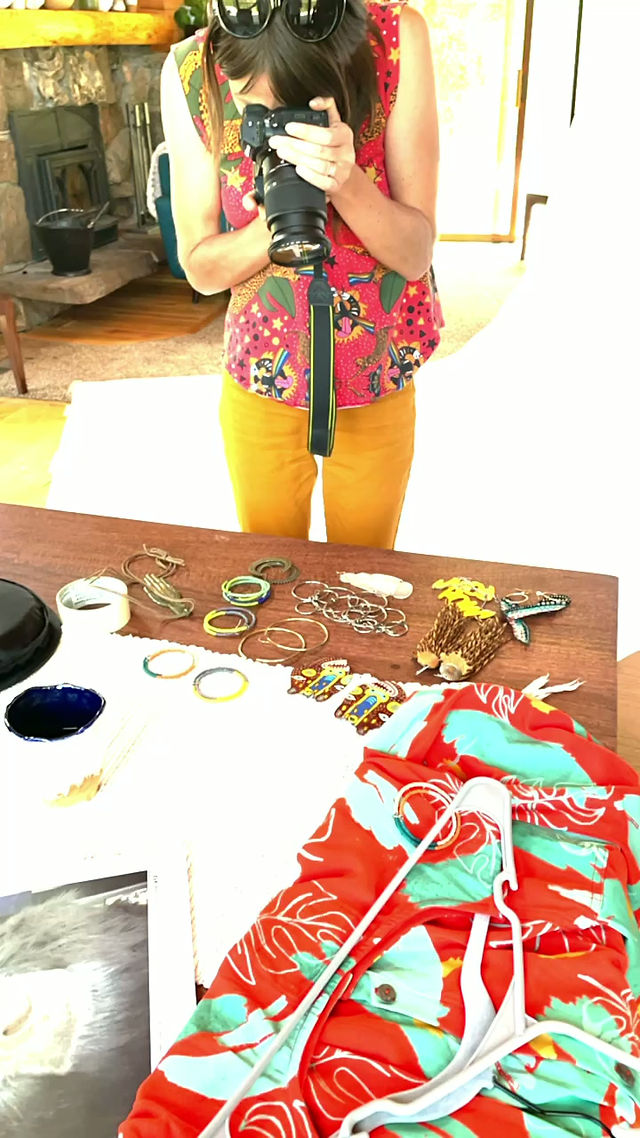
Every look is built piece by piece. 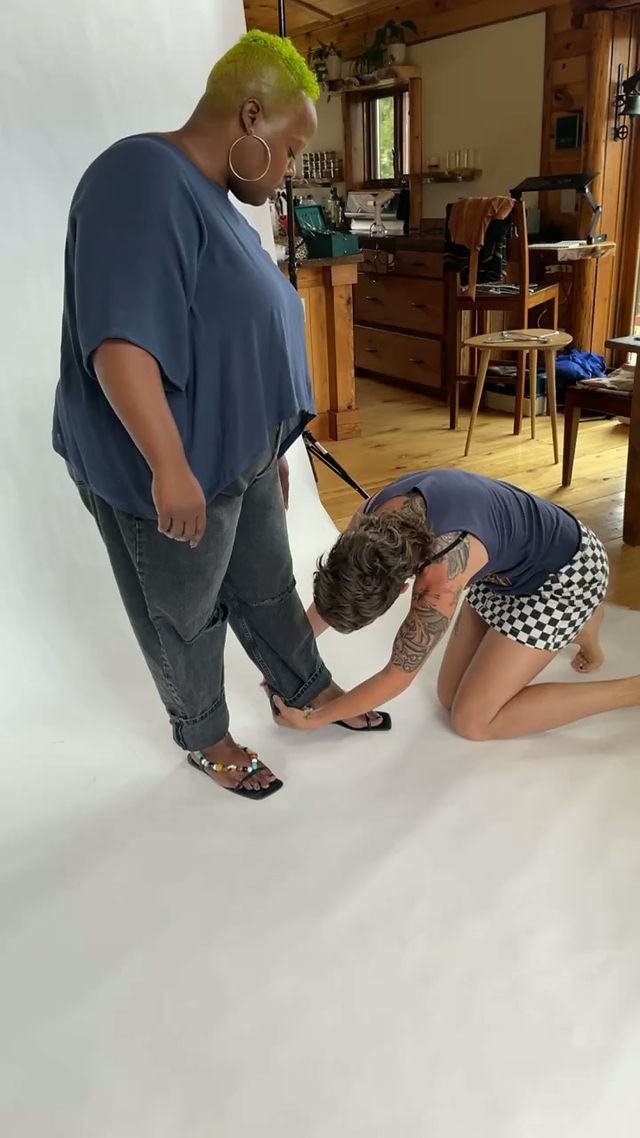
The details matter. Every set begins by hand. Finding the frame. Building the studio.
Slow Fashion Is Not an Excuse
I ordered a dress from The Flower Iris in May.
It cost around two hundred dollars.
Months passed.
Eventually an email arrived.

An apology.
An explanation.
Health issues.
Production delays.
Uncertainty.
Refund options.
And I want to be very clear.
My frustration has never been that someone became sick.
My frustration has never been that someone is disabled.
My frustration has never been that making clothing takes time.
Slow fashion should be slow.
Handmade work takes time.
Life happens.
What I cannot accept is the growing tendency to confuse transparency with accountability.
Those are different things.
Explaining dysfunction is not the same thing as resolving dysfunction.
Naming a problem is not the same thing as building infrastructure.
The email acknowledged uncertainty.
It never offered a timeline.
It never established a plan.
It asked customers to continue carrying the uncertainty.
After that email, communication lapsed again.
Eventually I disputed the charge with my bank.
Not because I wanted to.
Because the relationship had effectively ended.
There was no garment.
No timeline.
No meaningful follow-up.
Only more uncertainty.
That is the distinction I keep returning to.
The language of care is not the same thing as the practice of care.
The performance of transparency is not the same thing as stewardship.
And I think social media has made that distinction increasingly difficult to see.
It is possible to build an online identity around thoughtfulness, intention, and slow fashion while still failing to build the operational systems that sustain those values.
Those systems matter.
Because eventually the garment tells the truth.
Sometimes through its construction.
Sometimes through whether it ever arrives.

Slow Fashion Requires Stewardship

I want to be careful here because I am not writing this as somebody standing outside the problem.
I run Bespokecurry.
I make the jewelry.
I package the jewelry.
I photograph the jewelry.
I write the descriptions.
I answer the emails.
I maintain the website.
I manage inventory.
I ship orders.
I build displays.
I create workshops.
I do the work.
For years my shipping statement has reflected reality.
People were not receiving handmade jewelry three to five days after placing an order.
They never were.
My stated shipping window was often two to four weeks.
Not because I wanted people to wait.
Because I wanted enough room to honor my commitments.
And the funny thing is that most orders shipped much faster than that.
Usually the next weekend.
Sometimes sooner.
But I built the policy around reality instead of wishful thinking.
And yes, there were moments when I missed my own expectations.
Especially while navigating diagnosis, burnout, and learning what regulation actually meant in my life.
But when that happened, I communicated.
I sent specific emails.
I gave updates.
I explained what was happening.
I often included extra jewelry because delays affect people, not order numbers.
The point is not that I was perfect.
The point is that stewardship remained part of the process.
A shipping statement is transparency.
A relationship is accountability.
An apology is transparency.
A plan is accountability.
Stewardship is accountability.
And I think that distinction matters.
Building a Wardrobe Instead of a Collection

At this point I am not trying to build a collection of clothes.
I am trying to build a wardrobe.
An ecosystem.
When I have the coins I want to support Black designers.
I want to support African designers.
I want to support people building something different.
But that is easier said than done.
Because now I am evaluating more than aesthetics.
I am evaluating infrastructure.
Communication.
Craft.
Construction.
Stewardship.
The vegetable hat.
The striped shirt.
The halter overlay.
From field note to field work. 
The field note comes to life.
Those pieces keep surviving.
Not because they are trendy.
Because they work.
Because they regulate.
Because they tell stories.
Because they support the body wearing them.
Because they have earned their place.
The fashion industry keeps asking:
How does it look?
I keep asking:
What does it support?
And every time I ask that question the garment tells the truth.

“Never let it end.” It already had. The photographs survived. The opportunity didn’t. I knew how to move. They just didn’t know what they were looking at. Fifteen years of craft carried a production that never respected it. 
Behind every polished image is a room full of decisions. 
By this point, I wasn’t performing. I was enduring.
I have spent more than fifteen years modeling. Not as a mannequin, but as a storyteller who understands movement, garments, and bodies. I came into this project and signing with APL Models, believing it might become the bridge into the work I had already been building.
Instead, it became one more lesson in what happens when image is valued more than craft.
My measurements were ignored. The garments barely fit. Pieces were sourced cheaply instead of being made with care. My body became something to work around rather than something to design for. The people leading the production had enthusiasm, but not the experience or accountability to steward a body like mine.
The harm wasn’t abstract. It happened in the room. It happened in the fittings. It happened every time I was asked to compensate for work that should have been done long before I arrived.
I still made the images.
That’s what experience does.
But making the image and being cared for while making it are not the same thing.
That difference is why I now write about garments, stewardship, and slow fashion.
Clothing deserves better.
The people inside the clothing deserve even more.
◍◈ I Adorn Tings - The Garment Tells the Truth
◉ Cosmos Watershed
Fashion is often discussed through aesthetics, identity, or consumption. This essay begins somewhere else. It approaches garments as living infrastructure, asking what clothing reveals once it is worn, worked in, traveled in, and lived with over time. Rather than treating representation as the final measure of success, this Watershed follows the relationships between body, garment, craftsmanship, stewardship, and the systems that shape them. Here, the body becomes the archive, and every garment eventually tells the truth.
◉ Cosmos Watershed
Watershed | Tributaries |
Companion | ◍◈ I Adorn Tings — Who Gets to Build Black Fashion? |
Origin | This essay began through years of wearing, modeling, teaching in, traveling with, and reviewing garments across fat fashion, slow fashion, and independent design. Rather than asking what clothing says about identity, it asks what clothing reveals about the systems that made it and the bodies expected to wear it. |
Expansion | Establishes an embodied methodology for garment criticism by treating the body as evidence. Representation, branding, craftsmanship, stewardship, and infrastructure are brought into the same conversation so garments can be evaluated beyond aesthetics alone. |
Application | Readers are invited to review their own wardrobes through lived experience: How does a garment move? Regulate? Endure? Communicate? Support the body over time? The framework shifts fashion criticism from appearance to relationship. |
Lineage | Draws from stage management, accessibility practice, fashion modeling, Black Beauty School, garment observation, slow fashion, disability justice, and the long practice of building a wardrobe rather than accumulating a collection. |
Counter Currents | Trend cycles. Respectability politics. Representation without craftsmanship. Marketing without stewardship. Transparency without accountability. Clothing designed for photographs rather than lives. |
✦ Cosmos Coordinates
Field | Entry |
Planetary Body | I Adorn Tings |
Planet of Origin | The Garment Tells the Truth |
Primary Water | Deep Water — uncovering what garments reveal beneath branding, representation, and marketing through sustained lived experience. |
Secondary Water | Flowing Water — observing how relationships between bodies and garments evolve across years of wearing, traveling, teaching, repairing, and returning. |
Embodied Practice | Reviewing garments through movement, regulation, longevity, and everyday use rather than appearance alone. |
Primary Literacy | Embodied Design Literacy |
Supporting Literacies | Material Literacy • Craft Literacy • Stewardship Literacy |
Primary Question | What does this garment actually support once the photograph is over? |
Constellation | Body • Garment • Construction • Stewardship • Relationship |




Comments