


Geometry Must Answer to the Terrain


Afro Tings studies Afro hair as living relationship: body record, receiving architecture, ecological intelligence and Black tech(know)logy.
Geometry Must Answer to the Terrain begins with the mathematics Black braiders have long carried—but it does not end at pattern recognition. Squares, triangles, circles, curves and braids enter a living Afroscape shaped by density, direction, sensation, history and consent. Here, the body is not the surface upon which geometry performs. The body participates in the calculation. When precision requires the crown to obey an image rather than responding to what the terrain can sustain, mathematics becomes force. Afro hair tings return the pattern to relationship, the scalp to authority and geometry to the ecosphere that makes it possible.
Gloria Ford Gilmer made the mathematics of Black hair-braiding visible. But recognition is not embodiment. This essay carries Gilmer’s coordinate into the Afroscape, where squares, triangles, circles, curves and freeform parts must answer to the density, direction, history, sensation and deep variation of the scalp beneath them. When geometry is severed from ecosphere, mathematical precision becomes force—and the cleanest parts can become colonial chambers.
a note
Gloria Ford Gilmer did not bring mathematics to Black hair. She recognized that Black people were already producing mathematical knowledge through braiding, and she used that cultural location to help Black children encounter mathematics through something their communities already knew. But “braiders are mathematicians” cannot become the end of the lesson. The practice of Afro hair exceeds the geometry that can be extracted from it, just as it long precedes its recognition by academic mathematics.
The braiding practices we know now also cannot be treated as intact replicas of precolonial African practices. They have been transformed through slavery, colonialism, migration, commerce, cosmetology, synthetic hair, social media, speed and the demand for repeatable installations. So yes, braiding can teach a child to recognize shapes, patterns and fractal repetition. But can it also teach Black children that their bodies are participating in the mathematics—that the scalp is terrain, sensation is information, density changes the equation and no pattern remains correct when the body is being harmed? Can braiding teach them not only how to identify geometry, but how to move through that geometry while remaining embodied?
And does that embodiment empower them to step away from precision when precision has become obedience to an image? Instead of entering the chair saying, “Make my hair do that,” can they ask, “What can my hair do within what is being offered, and how will it be properly cared for?” If the braider, the style or the installation cannot answer the terrain without harming it, do they feel empowered enough to walk away?
Geometry Must Answer to the Terrain
Afro Hair, Colonial Chambers, and the Return to Ecosphere

I found Gloria Ford Gilmer in a TikTok sound bite.
That sentence is already part of the problem.
Black people keep finding Black knowledge after it has been lifted out of the body, named by an institution, placed behind glass and returned to us as discovery. We meet it as a fact we somehow missed. We marvel. We comment that we were today years old. We unlock a new special interest. We thank the person who delivered the information back to us. Then the sound ends, the scroll continues and the knowledge remains exactly where we found it: suspended as evidence that Black people knew something once.
The video was about ethnomathematics and the work of Gloria Ford Gilmer, the Black mathematician and educator who studied mathematical patterns in African American hairstyles. Gilmer and her collaborators entered Black salons in Baltimore and New York, observed braiders, spoke with stylists and clients and documented the geometry operating across the scalp. Squares. Triangles. Hexagons. Brick formations.
Tessellations. Patterns that could teach mathematical relationships through a cultural practice Black people were already carrying in our hands.
The comments beneath the video performed the familiar celebration. Braiding is math. Hair cutting is geometry too. Culturally responsive teaching matters. A mathematician and a braider could finally see both parts of themself in the same frame.
All of that is true.
It is also where the conversation stopped.
Gilmer gave us an essential coordinate: mathematical knowledge did not begin when a classroom learned how to recognize it. The salon was already a site of study. The braider was already calculating. Black hair was already carrying pattern, proportion, repetition, division, direction, weight and spatial reasoning.
But recognition is not embodiment. A one-off sound bite cannot return Afro hair to ecosphere. Knowing that braiding is mathematics does not mean the mathematics is still being practiced in relationship with the body that must hold it.
Math has not saved our scalps.
The scalp is not graph paper

The contemporary braiding industry is built around replication.
A client arrives with a photograph. The image establishes the assignment. The parts must be the same size. The rows must be straight. The braids must be sufficiently small, sufficiently full, sufficiently long and sufficiently tight to resemble the reference and survive the expected number of weeks. The finished style must photograph as cleanly as the image that summoned it.
This demand moves through the Black hair industry and the African braiding industry alike. African origin does not automatically preserve African ecological knowledge. Cultural inheritance does not guarantee embodied relationship. A practice can remain visibly Black while its internal logic is reorganized by speed, commerce, standardization, social-media legibility and the demand to produce the same result on bodies that are not the same.
Geometric uniformity becomes proof of skill. Squares must match squares. Triangles must match triangles. Circular, curved and freeform parts must repeat with photographic precision. The grip becomes proof of security. Pain becomes the price of neatness. Longevity becomes evidence that the service was worth the money.
Meanwhile, the actual terrain disappears.
One scalp carries high density through the center and less at the temples. Another carries fine strands that cannot support the amount of added hair shown in the reference. One crown changes direction at the whorl. Another has a history of chemical processing, postpartum shedding, medication, illness, surgery or repeated traction. One body registers pain quickly. Another has learned to leave the body in order to endure the chair. Hairlines, napes and temples do not offer equal strength. Neither do two sections on the same head.
But replication requires these differences to become inconveniences. The photograph must win.
The scalp is treated like graph paper: a passive surface waiting to receive a predetermined grid. Yet a scalp is curved, vascular, innervated, asymmetrical, responsive and alive. Hair density changes across it. Follicles emerge at different angles. Afro hair bends, spirals, contracts, expands, dries, swells, resists and remembers. The person beneath the pattern can feel pressure, heat, tenderness, fear, exhaustion and relief.
None of this is outside the mathematics.
It is the information the mathematics is supposed to answer.
When geometry becomes force

Afro hair-braiding is not geometry placed upon the body. It should be geometry generated through negotiation with a living terrain.
That distinction changes everything.
Geometry placed upon the body begins with a finished image and compels the body to reproduce it. Geometry generated with terrain begins by observing what is present. It measures without pretending that every measurement should match. It adjusts the section to density. It reduces extension weight when the strand cannot carry it. It changes direction when the follicle changes direction. It reads pain as information instead of defiance. It understands that the most precise style is the one capable of changing its plan.
The problem is not the shapes themselves. Squares, triangles, circles, curves and their combinations all belong to the geometric language of braiding. The problem is what those shapes have been made to do.
We have turned shapes into colonial chambers.
A shape becomes a colonial chamber when the living body must be confined inside an external order that refuses its particularity. Each square, triangle, circle or curve must resemble the next even when the terrain beneath them does not. Any irregularity is treated as a flaw to be corrected. Resistance is disciplined with more product, more grip and more tension. The visible order of the installation matters more than the life inside it.
This is colonial form at its most intimate: the map overruling the land.
The chamber is praised because it is clean. The scalp is required to survive its own disappearance.
A square can be even and still be wrong. A triangle can be sharp and still divide the density badly. A circle can be smooth and still hold too much weight. A part can be crisp and still contain too little hair for the braid attached to it. A row can be straight and still cross a growth pattern that should have redirected it. An installation can be beautiful and still produce inflammation, broken fibers, thinning edges and follicles repeatedly pulled toward loss.
Traction alopecia is not an abstract caution at the edge of this conversation. It is accumulated evidence that the geometry has been separated from discernment. Clinical literature identifies prolonged pulling, tight braids and the weight or attachment of extensions among the practices that increase risk; continued traumatic styling can progress into irreversible scarring hair loss. The harm is not hidden from the chair. It arrives as soreness, bumps, headaches, broken hair and disappearing density before it is given a medical name. The body reports the calculation long before the industry agrees to read it.
Many braiders have serviced scalps for years without developing—or without being permitted the time to practice—the intuition needed to understand that every scalp is different. Technical repetition can produce speed without producing discernment. A person may know how to generate immaculate geometric parts while remaining unable to determine whether those shapes belong on the head in front of them.
That is not living mathematics. It is a formula protected from feedback.
Gilmer gave us a coordinate, not the whole terrain

Gloria Gilmer’s work matters because she relocated mathematical authority. She treated Black cultural practice as a place where mathematical thinking already occurred. Her broader work in ethnomathematics challenged the lie that legitimate mathematics traveled in only one direction: from Eurocentric institutions outward to everyone else.
The salon did not become mathematical when it was observed. The institution was late.
But ethnomathematical recognition can still become another display case if we only use braiding to make conventional mathematics more interesting. Squares, triangles, circles and repeating combinations become lessons in tessellation and spatial relationships. Cornrows become a route into pattern recognition. Black children are invited to notice that algebra, geometry and problem-solving were hiding inside practices they already knew.
Then the lesson ends before mathematics is required to become accountable to the body.
The question cannot remain: Where is the math in braiding?
The fuller questions are: What kind of mathematics is being practiced? What information is allowed to alter the pattern? Who or what is being asked to bear the error?
Gilmer documented one part of the system. The Afroscape carries it farther.
The Afroscape does not ask only how hair can demonstrate geometry. It asks how geometry behaves inside hair ecology. It places the visible pattern within a larger field of water, density, porosity, growth direction, weight, climate, touch, time, consent, regulation, memory and relation. It does not separate the braid from the hands producing it, the person receiving it or the conditions under which both bodies are working.
This is Hair as Tech(know)logy: knowledge that remains inseparable from the living system through which it is made.
Geometry is one instrument inside that system. It is not the whole system, and it is not its ruler.
Geometry must answer to the terrain.
Fractal form is not copy and paste

Tessellation helps us understand how units cover a surface. Fractal form changes the resolution.
A fractal repeats a relationship across scales. The return is recognizable, but living fractal form is not mechanical duplication. Natural systems produce approximate self-similarity: the smaller form echoes the larger without becoming an identical copy. The pattern persists through difference.
Afro hair can be read across these changing resolutions.
A fiber bends, coils and returns. Multiple fibers gather into a section. Sections enter the repeated crossings of a braid. Braids gather into a crown. Crowns carry techniques, memory and adaptation across a community. Each scale holds something of the others, but no scale is reducible to the one before it.
Fiber.
Section.
Braid.
Crown.
Community.
The braiding industry has confused repetition with sameness. It has preserved the visual unit while abandoning the relational principle. Identically repeated squares, triangles, circles and curves are treated as mathematical excellence, even when producing them requires the braider to ignore unequal density, a vulnerable hairline or a scalp already communicating distress.
Fractal form offers a different intelligence. The relationship can remain coherent while the units change size. A section can widen where density thins. A braid can become smaller where the hairline requires less weight. A pattern can redirect around a whorl. Symmetry can be relational rather than identical. The whole crown can remain legible without requiring every part to be interchangeable.
This is not failure to execute the design.
This is the design becoming intelligent enough to live.
The difference is the difference between a stamp and an organism. A stamp proves that an image can be reproduced. An organism must respond in order to remain alive.
Terrain is an active participant
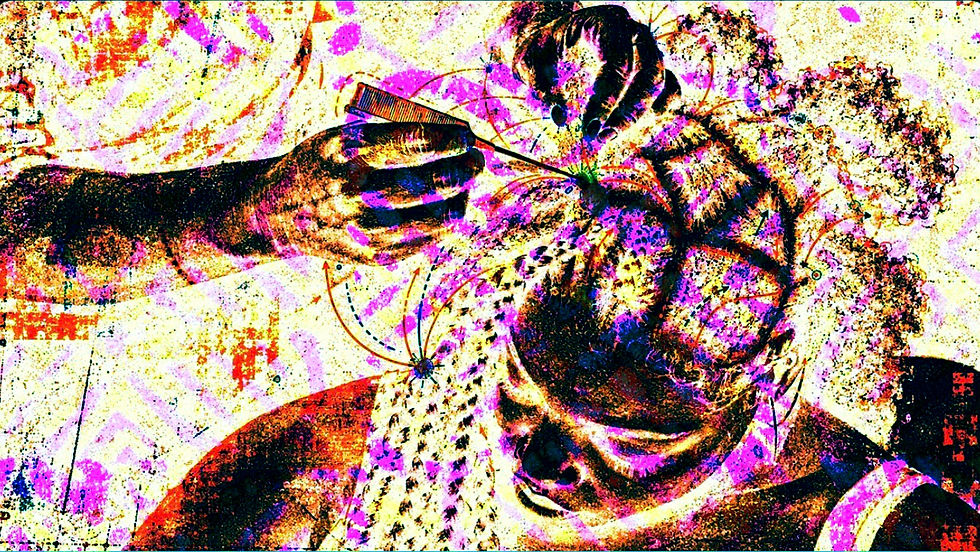
“Terrain leads” is not a soft suggestion to be gentler. It is a reorganization of authority.
The terrain is not the material a stylist overcomes on the way to the style. It is an active participant in the calculation. Density determines available support. Strand diameter changes how force travels. Follicle direction proposes pathways. Prior damage establishes limits. Sensation provides immediate feedback. Time reveals whether the system remained stable after the chair.
The client is not merely carrying the finished architecture away. Their body is co-authoring it.
This requires more than technique. It requires intuition and discernment: not mystical substitutes for training, but cultivated capacities to perceive relationships that a standardized formula erases. Intuition notices that a section does not feel like the others. Discernment decides that visual uniformity is not worth the force required to produce it. Consent remains active after the service begins. Communal knowing holds what one practitioner observes against what many bodies have been reporting across generations.
Embodiment is the ability to remain in relationship with that information.
Too many salon cultures teach us to override it. Do not move. Do not complain. Beauty hurts. It will loosen in a few days. Your head is tender. Your hair is difficult. Your edges were already thin. The client is instructed to distrust the body so the finished image can remain innocent.
But pain is not proof that the braid will last. Pain is data.
The refusal to read it is not tradition. It is disconnection.

This is where Black Palm Trees returns.
The relationship between Afro crowns and palm crowns is not a visual joke about similar silhouettes. It is an ecological and structural relation.
A palm frond gathers many leaflets along an organizing axis. Fronds emerge into a crown. Each crown belongs to a species, a stage of life and a particular terrain. Water, wind, light, disease, damage, pruning and age alter the architecture. The form remains recognizable without becoming identical. Even trees growing beside one another do not produce interchangeable crowns.
Leaflet.
Frond.
Crown.
Grove.
The pattern returns at another scale.
A palm does not fail because one frond carries a different angle. The difference records the life of the tree. Older fronds lower, weather and release. New growth emerges through the center. The crown holds time visibly. Its architecture is not a frozen ideal imposed once; it is the continuing outcome of exchange between organism and environment.
Afro hair does the same. The crown records water, handling, protection, friction, hormones, weather, rest, illness, color, cutting and time. New growth does not emerge into a neutral field. It enters a history. Older ends carry conditions the root has never encountered. Density can change. Shape changes as length and weight change. A trim is not automatically damage or failure; it can be ecological release. Preservation cannot mean forcing every fiber to remain forever.
Black Palm Trees brings the mathematics back into science by refusing to separate form from growth. Geometry describes relationships within the crown, but ecology explains why those relationships cannot be standardized across every crown.
The palm is not asking permission to be recognized as a fractal. It is living the pattern.
So are we.
Returning Afro hair to ecosphere

To return braiding to ecosphere is not to romanticize every traditional practice or presume that every Black or African braider is already carrying an intact ancestral system. It is to restore relationship as the condition of the work.
The service begins before the first part. It begins with reading.
What is the density here?
Where does it change?
What has this crown already survived?
How much weight can each region hold?
What does the client feel?
What is the intended duration, and what will removal require?
Does the reference image belong to this terrain, or must it be translated?
Where must the geometry change in order for the body to remain present?
The answer may produce shapes that are not identical. Squares may need to widen. Triangles may need to change their angles. Circles and curves may need to expand, contract or redirect. It may require fewer braids, larger sections, shorter length, less added hair, a different direction or refusal of the requested installation altogether. In an industry trained to worship duplication, this can look like inconsistency.
Inside ecosphere, it is precision.
Precision is not the ability to reproduce the same unit indefinitely. Precision is the ability to perceive which relationship this living system can sustain.
That knowledge cannot live in a single expert. It must move communally between braiders, clients, cosmetologists, locticians, trichologists, elders, children and the people whose scalps have been documenting the cost. Communal knowing does not erase specialized study. It prevents credentials from becoming permission to ignore what the community’s bodies already know.
A mathematician can identify the pattern and still fail to read the scalp. A braider can execute the pattern and still fail to feel the force. A dermatologist can name the resulting alopecia and still fail to understand the cultural system that keeps reproducing it. No one coordinate is the whole map.
The Afroscape gathers them without allowing any one of them to overrule the terrain.
The geometry must be alive

Gloria Ford Gilmer helped make visible the mathematics Black braiders had been practicing all along. Her work should not remain a museum label attached to a cultural object. It should reopen the question of what mathematical power is for.
If the geometry can describe the shape but cannot discern whether that shape is safe on this terrain, it is incomplete.
If culturally responsive teaching can connect a child to algebra through braiding but cannot connect a braider to the body in their chair, it is incomplete.
If African lineage can authenticate the style but cannot interrupt an industry of pain, loss and compulsory tightness, it is incomplete.
If a sound bite makes us proud but does not change what our hands do next, it has preserved information without restoring knowledge.
We do not need another artifact proving Black brilliance. We need the brilliance returned to relationship.
The shape is not the whole story. The braid is not the whole system. Geometry is not the whole ecosphere.
The living pattern moves from fiber to section, braid to crown, leaflet to frond, body to community. It repeats without surrendering difference. It remains precise because it remains responsive. It knows that no two crowns are identical and no terrain owes us the same result.
The map cannot keep overruling the land.
The photograph cannot keep overruling the scalp.
The installation cannot keep overruling the body.
Geometry must answer to the terrain.
The terrain leads.
Working source coordinates
Tanya Moore and Josh Levy, “The Unfailing Optimism of Dr. Gloria Ford Gilmer (1928–2021)”, Notices of the American Mathematical Society, March 2024.
Gloria Ford Gilmer, “Mathematical Patterns in African American Hairstyles,” presented at the 77th Annual Meeting of the National Council of Teachers of Mathematics, 1998.
Victoria Billero and Mariya Miteva, “Traction Alopecia: The Root of the Problem”, Clinical, Cosmetic and Investigational Dermatology, 2018.
Black Palm Trees, BespokeCurry, 2026.
Cosmos Watershed
This essay enters through Still Water, where the braider pauses long enough to observe the crown before imposing a pattern. It moves through Flowing Water, where squares, triangles, circles, curves and freeform parts change with density, direction, sensation and weight. Deep Water holds Gloria Ford Gilmer’s ethnomathematics, Black braiding knowledge, the body’s accumulated memory and what communal knowing has carried beyond institutional recognition. Turbulent Water names compulsory tightness, replication, traction alopecia and the colonial chamber formed when the map overrules the scalp. Tidal Water tracks repeated installations, cumulative tension, growth, shedding and the changing conditions of the crown across time. Sacred Water returns geometry to ecosphere, where the body remains co-author and the terrain leads.
Watershed | Tributaries |
Watershed | Still Water moving through Flowing, Deep, Turbulent and Tidal Water toward Sacred Water |
Relationship | Geometry and scalp terrain; braider and client; mathematical precision and embodied discernment; repetition and variation; pattern and ecosphere |
Hom(e)ie | The palm crown—living geometry that maintains recognizable form through environmental variation rather than mechanical duplication |
Origin | Finding Gloria Ford Gilmer’s ethnomathematical work through a TikTok sound bite and recognizing the distance between celebrating braiding as mathematics and confronting the harm still being done to scalps in the chair |
Expansion | Gilmer’s ethnomathematics carried into fractal form, scalp ecology, embodiment, communal knowing, the Afroscape and Black Palm Trees |
Application | Requiring every parting system, braid size, direction, weight and installation plan to respond to the actual density, sensitivity, history and capacity of the crown receiving it |
Lineage | Gloria Ford Gilmer; Black braiders and salon knowledge; embodied cosmetology; Black ecological intelligence; Mycelial Sankofa; Afro hair as tech(know)logy; communal scalp memory |
Counter Currents | Replication culture; compulsory neatness; identical geometric parts; excessive grip; pain treated as normal; image-led installation; traction alopecia; cultural inheritance without ecological relationship; Black knowledge reduced to museum artifact |
Cosmos Coordinates
Coordinate | Placement |
Primary Portal | The Afroscape • Afro Tings |
Connected Waters | Still Water, Flowing Water, Deep Water, Turbulent Water, Tidal Water and Sacred Water |
Tings Connections | Afro Tings; I Know Tings; I Touch Tings; I See Tings; I Move Tings |
Primary Methodology | Mycelial Sankofa |
Methodological Practice | Returning Gilmer’s mathematical coordinate to a living network of salon knowledge, cosmetology, scalp sensation, hair science, ecological observation, communal memory and the bodies documenting the consequences |
Cosmos Concepts | Hair as Tech(know)logy; terrain leads; colonial chambers; fractal form; Afro Autonomic; Black Palm Trees; scalp ecology; communal knowing; embodiment; material time; the Wata(ring) W(hole) |
Geographic Coordinate | Gilmer’s salon research in Baltimore and New York moving into the contemporary Black and African braiding industries, digital hair culture and the wider Afroscape |
Relational Coordinate | The scalp is not a passive surface beneath the braid. The braider, client, hair, scalp, pattern, added material, environment and duration co-produce the installation |
Temporal Coordinate | Gilmer’s 1998 presentation moving into contemporary TikTok rediscovery, current braiding culture and the accumulated bodily consequences of repeated installations |
Orientation | From the image back toward the scalp; from externally imposed geometry toward terrain-led form; from institutional recognition toward embodied and communal knowing |
Core Refrain | Geometry must answer to the terrain. |
Expansion Principle | Living geometry repeats through variation. Precision is the ability to perceive which relationship a particular crown can sustain |
Cosmos Constellations
Constellation | How it enters this essay | What it makes visible |
Hair as Tech(know)logy | Braiding becomes a system of measurement, spatial reasoning, tension distribution, material forecasting and embodied calculation. | The braid is not merely a style or illustration of mathematics. It is knowledge produced through the body. |
Mycelial Sankofa | Gilmer’s research joins salon practice, cosmetology, scalp memory, hair science, palm ecology and communal testimony. | Knowledge becomes usable when it returns through multiple living connections rather than remaining an isolated historical fact. |
The Afroscape | Geometry is placed inside the larger ecological field of density, water, porosity, direction, weight, sensation, consent, atmosphere, history and time. | Mathematics is one instrument inside the hair system. It is not the whole system or its ruler. |
Colonial Chambers | Squares, triangles, circles, curves and freeform parts become chambers when external uniformity confines a living terrain that requires variation. | The shapes are not inherently colonial. The chamber begins when the map is allowed to overrule the land. |
Black Palm Trees | Leaflet, frond, crown and grove echo fiber, section, braid and community through recognizable form that changes with environmental conditions. | Living geometry maintains relationship without demanding identical units or interchangeable crowns. |
Afro Autonomic | The scalp communicates through sensation, soreness, inflammation, resistance, relief and changing capacity. | Pain is data. The body is reporting the calculation before the industry agrees to read it. |
The Four-C Fallacy | Classification and standardization substitute a general type for the specific crown in front of the practitioner. | Naming the category does not produce knowledge of the terrain. Classification cannot replace curiosity. |
The Wata(ring) W(hole) | The crown becomes a relational system through which water, force, memory, touch, material and time continue moving. | Afro hair cannot be understood by isolating one visible pattern from the whole ecology sustaining it. |
Material Time | Repeated tension, previous processing, illness, shedding, growth and accumulated installations remain present in the crown. | The current service enters a history. No scalp arrives as an untouched surface. |


Comments